Introduction: Reading TCS Beyond the Headlines
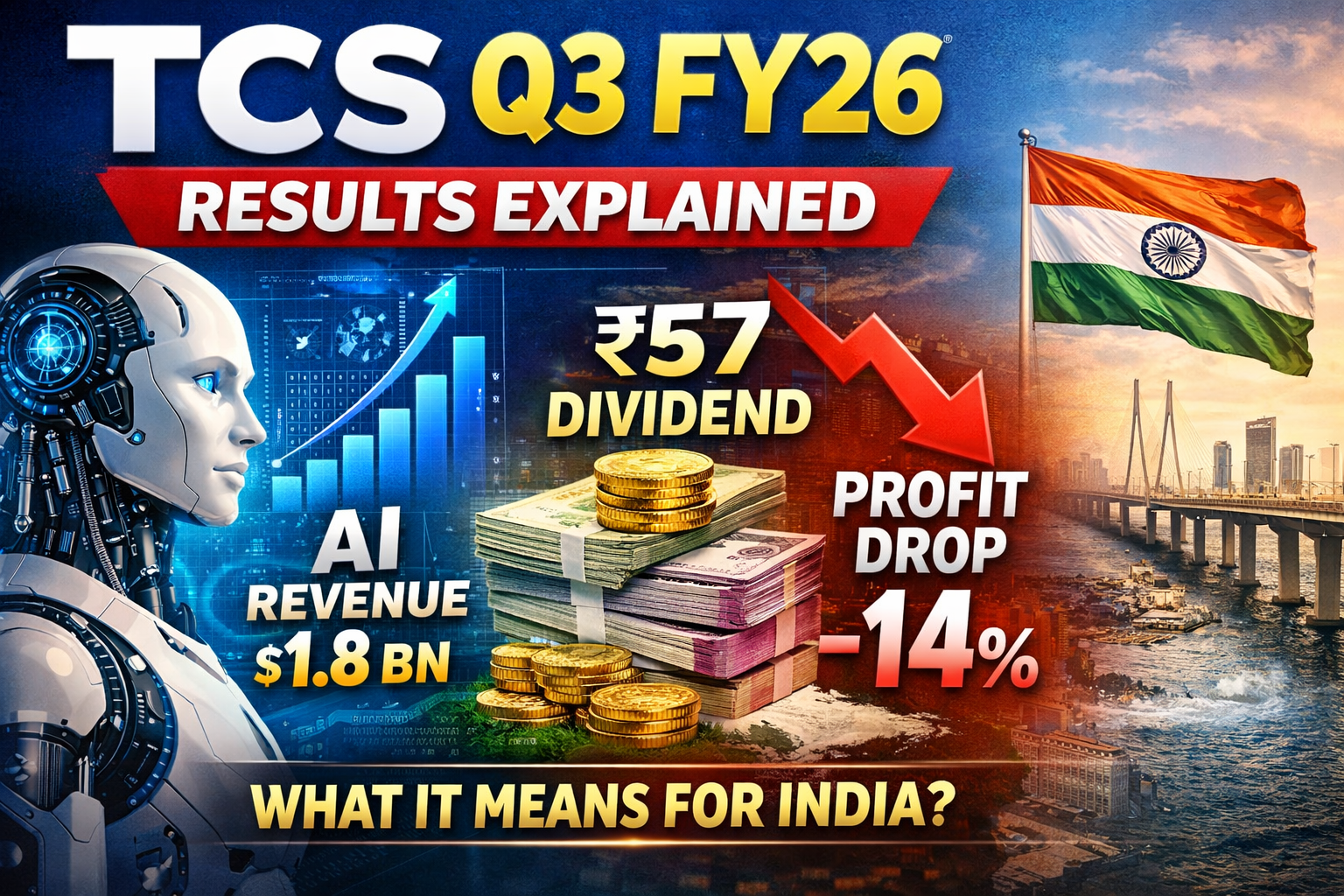
When Tata Consultancy Services announced its Q3 FY26 results on January 12, 2026, most headlines focused on one number — a 14% year-on-year decline in net profit. At first glance, the reaction seemed justified. But markets often confuse accounting noise with business reality.
A deeper look at the numbers shows something very different. Despite global IT slowdown fears, geopolitical uncertainty, and cautious enterprise spending, TCS continues to demonstrate resilience. Revenue grew, margins held firm, AI revenue accelerated, and shareholders received one of the largest dividends in the company’s history.
This article explains what really happened in TCS Q3 FY26, why the profit dip is misleading, and why TCS remains a cornerstone of India’s technology and export economy.
1. Why the Profit Decline Is Not a Business Weakness
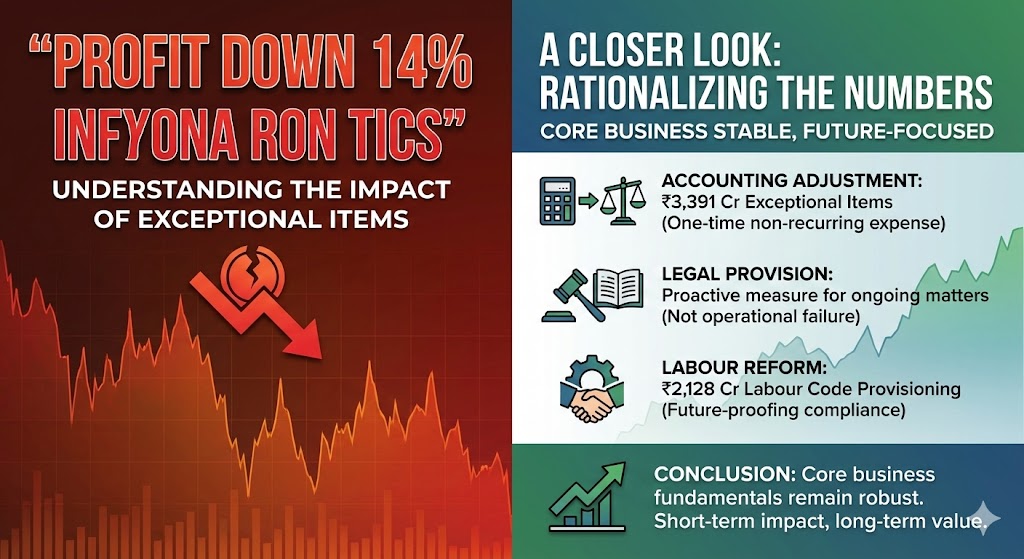
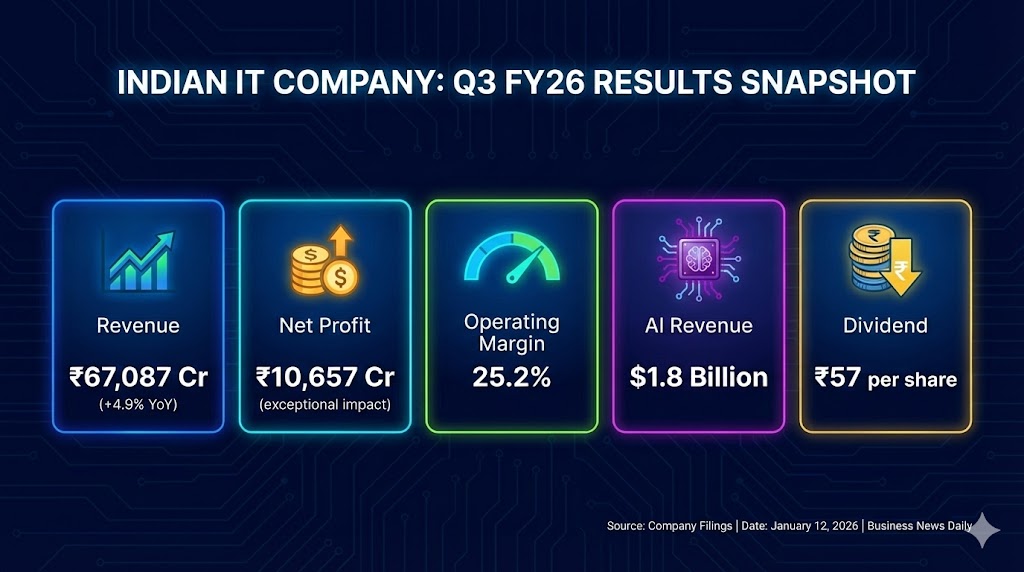
The reported net profit for Q3 FY26 stood at ₹10,657 crore, reflecting a 14% year-on-year decline. However, this drop was driven primarily by exceptional items worth ₹3,391 crore, not by deterioration in core operations.
A significant portion of this provisioning relates to legal costs and restructuring charges, including ₹2,128 crore set aside for compliance with new labour codes. These labour reforms are part of India’s broader effort to formalise employment and expand social security coverage.
Such provisions are one-time accounting adjustments, not recurring operational expenses. History shows that markets often overreact to these events, even though they have little bearing on long-term earnings power.
What matters more is that the underlying business remained stable, with revenue growth and margin discipline intact.
2. TCS Q3 FY26 Financial Performance: Key Numbers That Matter
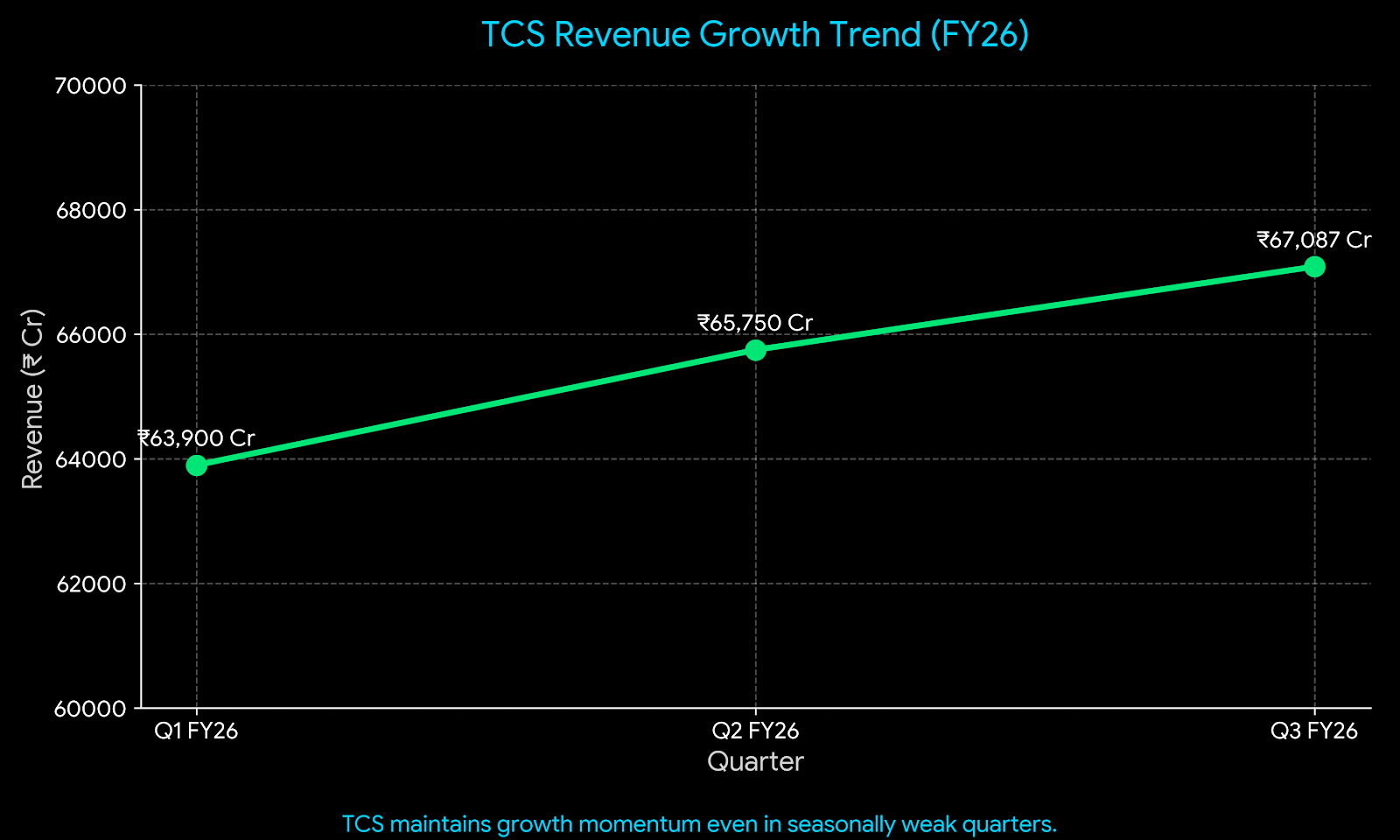
TCS reported revenue of ₹67,087 crore in Q3 FY26, marking a 4.9% increase year-on-year and 2% growth quarter-on-quarter. This is notable because the December quarter is traditionally seasonally weak for IT services.
Even more impressive was the company’s ability to maintain operating margins at 25.2%, despite global inflation, rising wage costs, and higher compliance expenses. Many global IT peers have seen margin erosion during the same period.
The strongest signal of financial confidence came through capital returns. TCS announced a total dividend of ₹57 per share, consisting of an interim dividend of ₹11 and a special dividend of ₹46. The record date for this payout was January 17, 2026.
Such a large dividend reflects strong free cash flow, low leverage, and high balance-sheet visibility. Companies under stress do not distribute cash at this scale.
TCS Official Q3 FY26 Results
3. AI Revenue Growth: From Experiment to Core Business
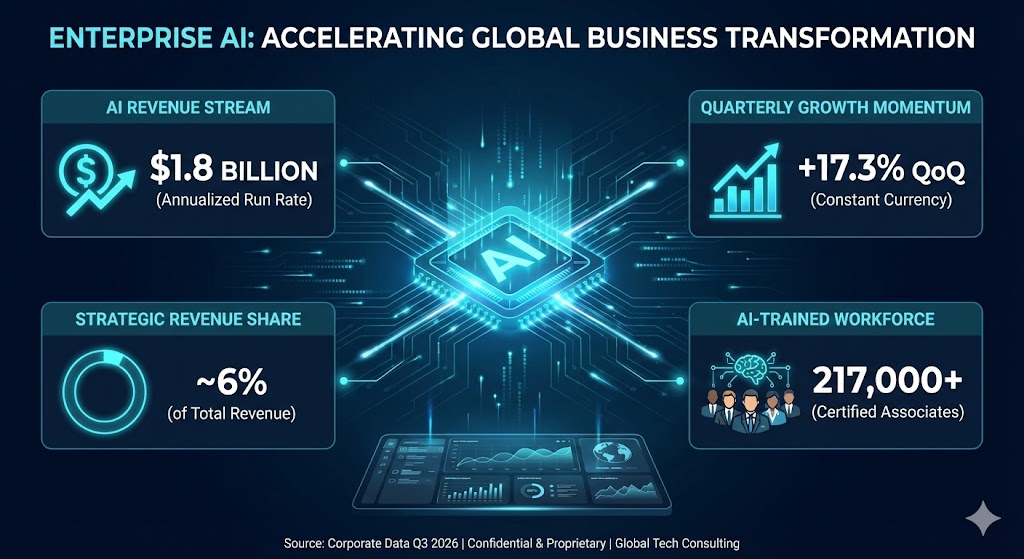
One of the most important developments in Q3 FY26 was the continued acceleration of AI-led revenue. TCS now reports annualised AI revenue of $1.8 billion, growing 17.3% quarter-on-quarter in constant currency terms.
AI now contributes around 6% of TCS’s total revenue, a meaningful share for a company of this size. This confirms that AI at TCS is no longer a pilot project or marketing narrative — it is a scalable enterprise business.
TCS has trained over 217,000 employees in AI and machine learning, creating one of the world’s largest AI-ready workforces. This gives the company a structural advantage in delivering enterprise AI solutions at scale, especially for banking, retail, healthcare, and government clients.
As global companies move from experimentation to deployment, this applied AI capability becomes a long-term revenue engine.
IndiaAI Mission – Government of India
4. Order Book Strength and Sector-Wise Performance
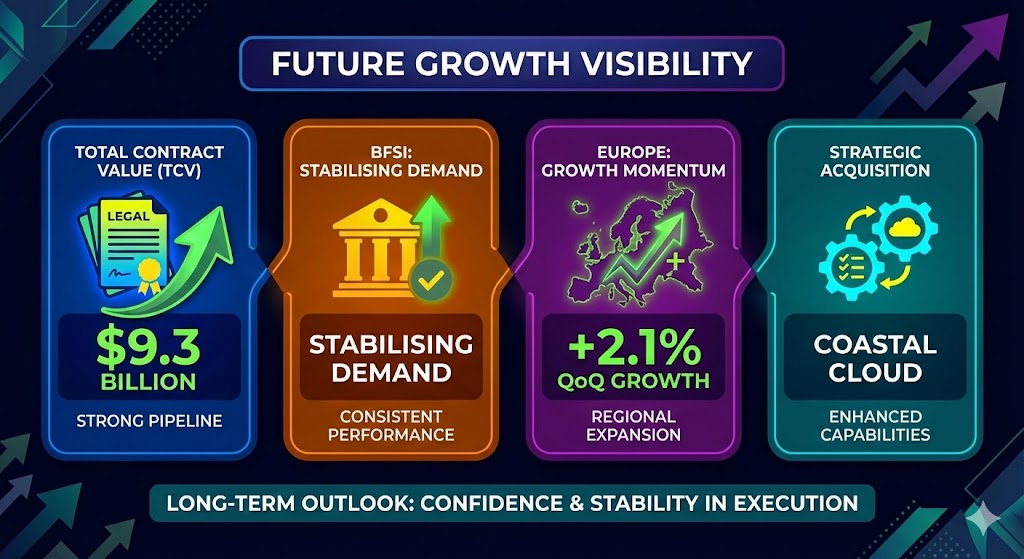
Another key indicator of future growth is Total Contract Value (TCV). In Q3 FY26, TCS reported a TCV of $9.3 billion, providing strong revenue visibility for upcoming quarters.
The BFSI segment continued to be the backbone of TCS’s business. While North American financial institutions have been cautious, early signs of recovery are visible in digital transformation and compliance-driven projects.
A notable positive surprise came from Continental Europe, which recorded 2.1% quarter-on-quarter growth. This indicates successful localisation and sector diversification in a challenging economic environment.
Strategically, TCS’s $700 million acquisition of Coastal Cloud, a Salesforce-focused consulting firm, strengthens its high-margin consulting and platform capabilities. This move helps TCS reduce dependence on commoditised IT services and improve long-term profitability.
5. Workforce Changes: Efficiency, Not Layoffs
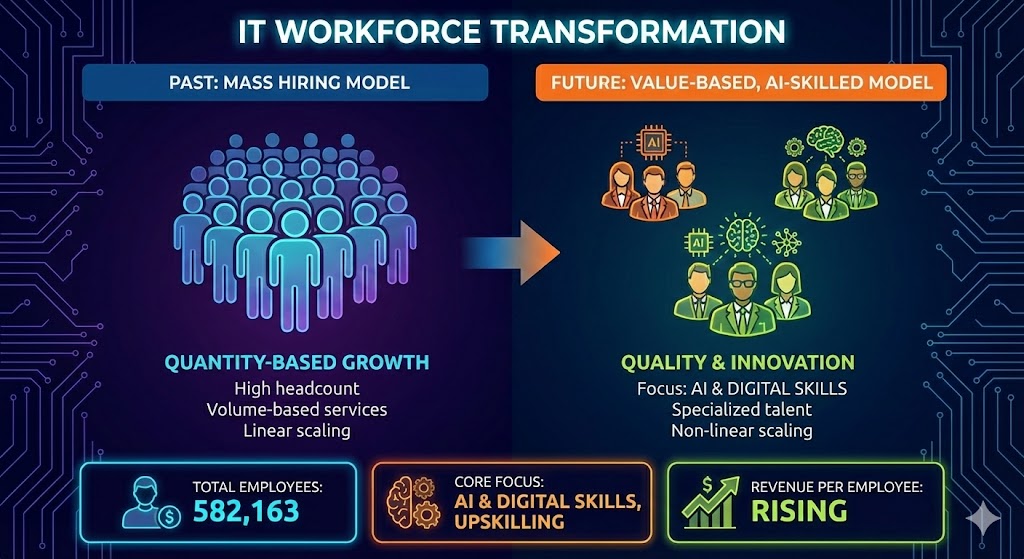
During Q3 FY26, TCS’s total employee count declined to 582,163, triggering concerns about job cuts. However, this change reflects workforce optimisation, not mass layoffs.
TCS is shifting from volume-based hiring to skill-based productivity, particularly in AI, cloud, and digital platforms. The result is higher revenue per employee, a critical metric for valuation re-rating in the IT sector.
This transition mirrors a broader shift in India’s IT industry — from labour-intensive growth to knowledge-intensive growth. In the long run, this improves margins, competitiveness, and sustainability.
6. Global Exposure and Geopolitical Resilience
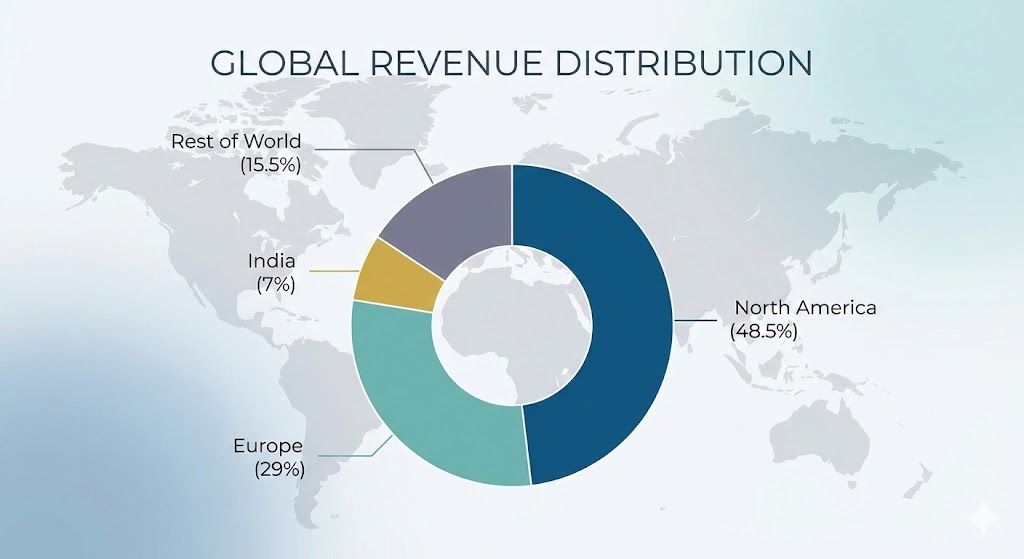
Nearly 48.5% of TCS’s revenue comes from North America, making it a critical link in Indo-US economic ties. Despite concerns around protectionism and visa restrictions, enterprise demand for Indian IT services remains strong.
What strengthens TCS’s resilience is its distributed delivery model. By expanding local delivery centres across Europe, Latin America, and Eastern Europe, TCS reduces geopolitical and regulatory risk.
This global diversification ensures that even in a fragmented world economy, TCS remains operationally flexible and strategically insulated.
7. Final Verdict: Why TCS Remains a Long-Term Winner
When viewed holistically, TCS’s Q3 FY26 performance reflects stability, discipline, and strategic clarity.
Core revenue continues to grow
Margins remain among the best in the industry
AI revenue is scaling rapidly
Cash flows are strong and consistent
Shareholder returns remain unmatched
While many companies struggle to adapt to the AI transition, TCS is executing steadily and quietly. This consistency explains why TCS continues to serve as a financial and strategic anchor for India’s technology sector.
TCS Investor Presentation / Financials
Frequently Asked Questions (FAQs)
Why did TCS profit fall in Q3 FY26?
The profit decline was due to one-time exceptional items, including legal provisions and labour code compliance costs. Core business performance remained stable.
How much AI revenue did TCS generate in FY26?
TCS reported annualised AI revenue of $1.8 billion, growing over 17% quarter-on-quarter.
Is the ₹57 dividend from TCS sustainable?
Yes. The dividend reflects strong free cash flow and balance-sheet strength, consistent with TCS’s long history of shareholder payouts.
What is TCS’s order book position?
TCS reported a Total Contract Value of $9.3 billion in Q3 FY26, indicating strong future revenue visibility.
Is TCS still a good long-term investment?
From a fundamentals perspective, TCS remains strong due to stable margins, AI-led growth, and consistent cash generation.