

1. Introduction: The Intersection of Chaos and Strategy
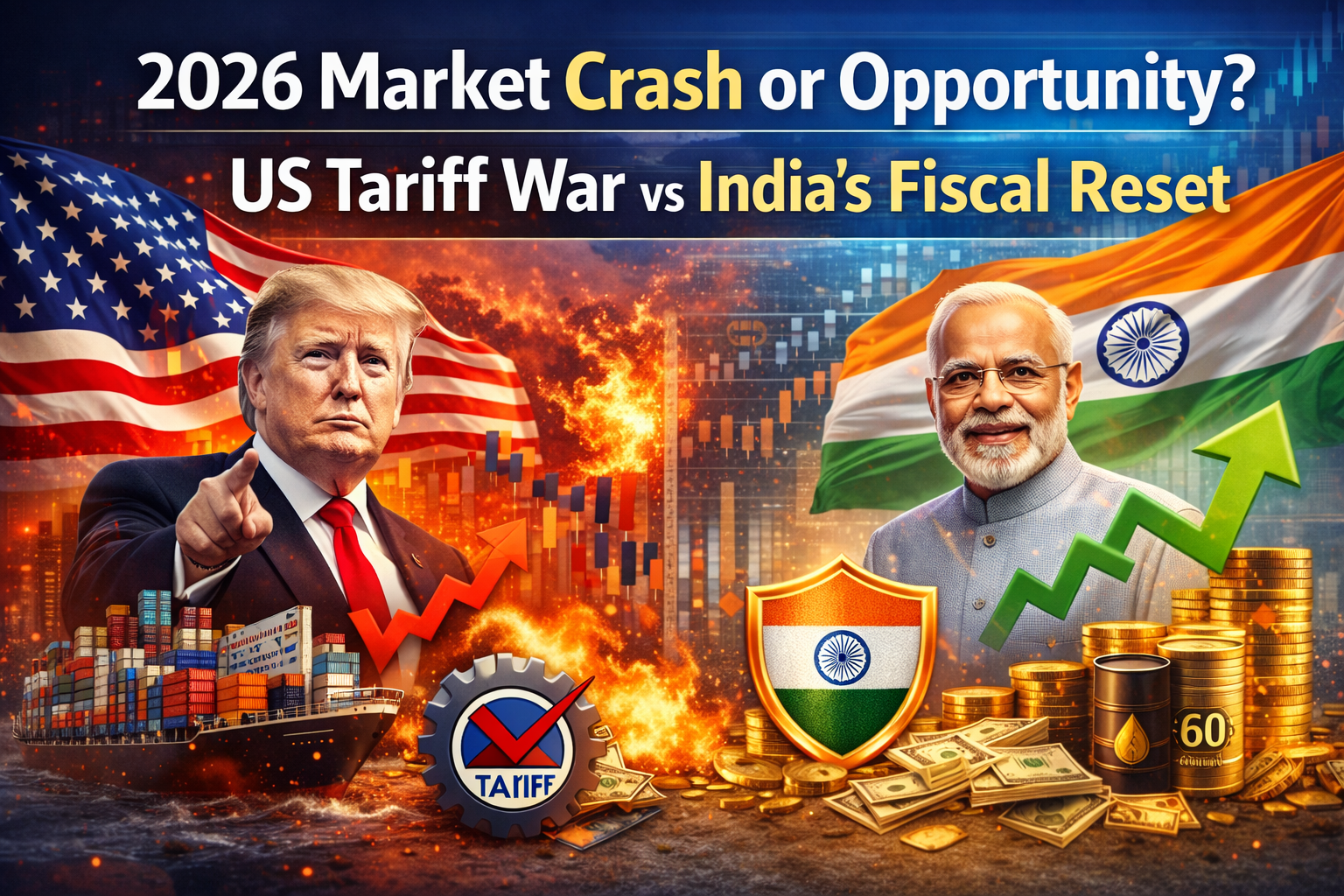
At the start of 2026, the global economic stage feels more like a tension-filled drama than a predictable market cycle. In the United States, policymakers and global rivals are locked in what many economists call a “tariff theatre” — bold tariff threats and trade battles that grab headlines and unsettle markets. Meanwhile in India, away from the global spotlight, policymakers are quietly but deliberately preparing one of the most significant fiscal reforms in years: a reset of the tax and economic structure aimed at long-term growth and stability.
This dual dynamic — global chaos on one hand and internal strategy on the other — is reshaping how investors, businesses, and everyday people think about capital, savings, jobs, and markets.
The global markets are showing this stress. Major stock indices in Europe and Asia have been retreating, and on January 9 the Indian Nifty was trading below the 25,700 level, signaling near-term weakness in the market. Foreign investors (FIIs) have been selling Indian equities, with net outbound flows of around ₹3,367 crore on January 8, 2026 alone, contributing to broader pressure on stock prices.
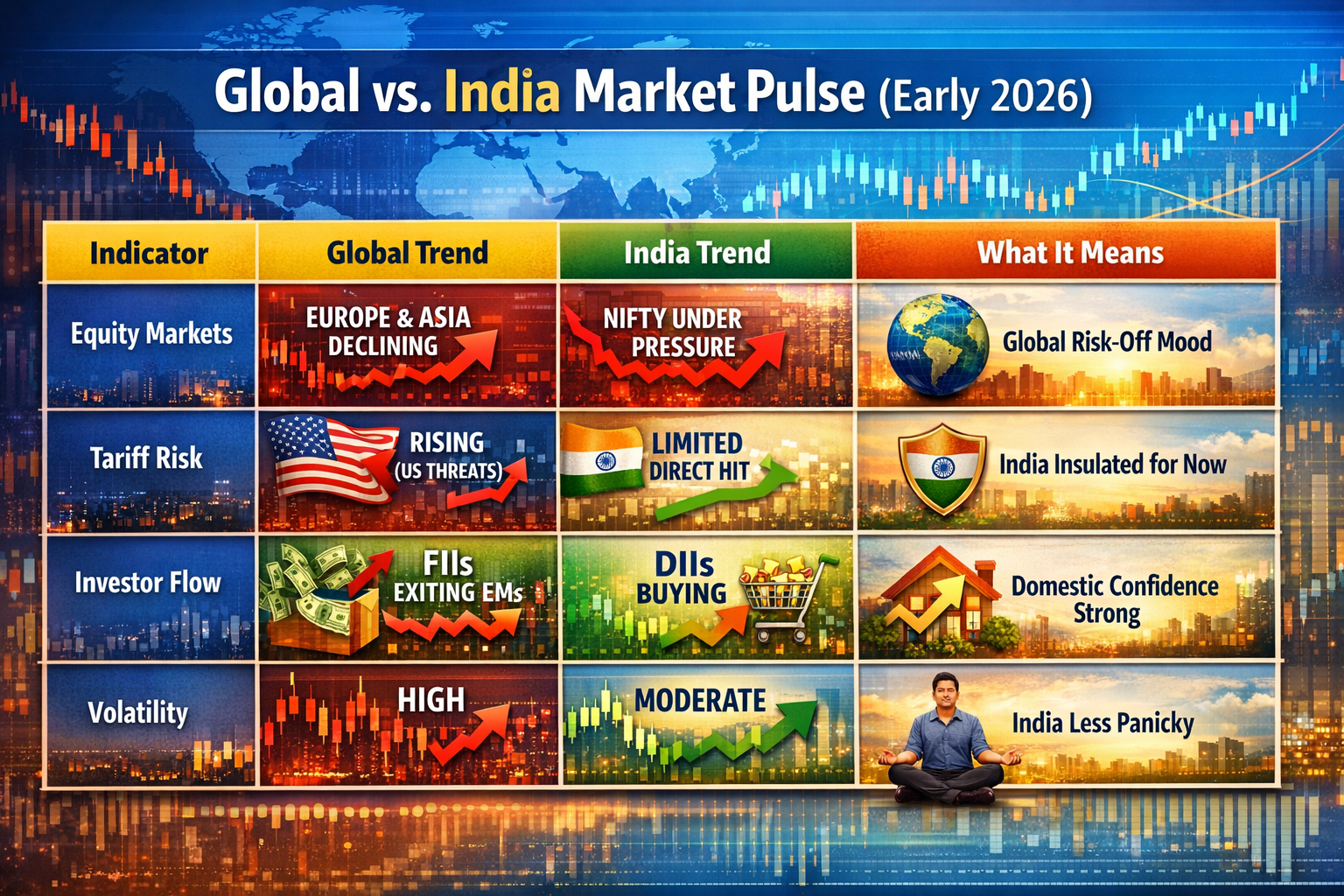
At the same time, Domestic Institutional Investors (DIIs) — a critical source of stability — have stepped in, buying equities worth about ₹3,701 crore, helping cushion some of the FII selling pressure.
This tug-of-war between global forces and domestic confidence captures exactly where we stand: on one side, geopolitical storms; on the other, India’s strategic fiscal reset.
Global Market Performance
2. Geopolitical Shockwaves: The “Tariff Theatre” & Energy Crisis
When global leaders start talking about tariffs and trade friction, markets react. Tariffs are taxes on imported goods — and if they get too high, they can slow down international trade, hurt exporters, and stoke inflation. For 2026, the United States has renewed its talk of wide-ranging tariff measures, including potential increases of 15%–35% on goods from major trading partners like Mexico, Canada, and possibly India.
While exact details and implementation dates are still part of political negotiation, the mere threat is powerful enough to make global buyers cautious and global sellers rethink their strategies.
One clear example of shifting trade dynamics is in Canada: its share of exports to the United States has fallen to multi-year lows, causing Canadian markets and businesses to pivot toward Asia and the United Kingdom to maintain growth. This shows how trade pressure in one part of the world causes ripple effects globally — not just in prices, but in long-term trade relationships.
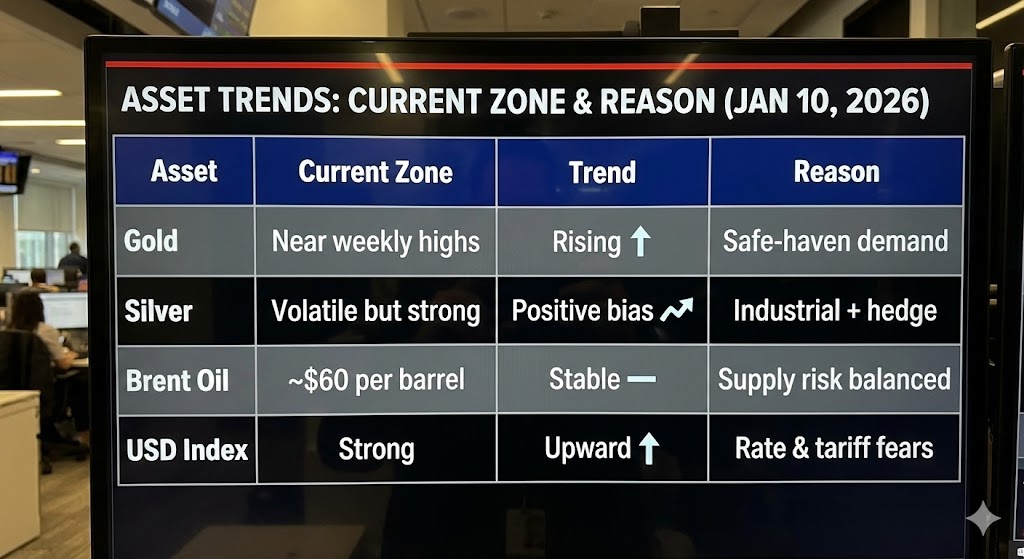
At the same time, geopolitics isn’t limited to tariffs. Tensions in places like Venezuela have had real market effects too. After major political developments in Venezuela late in 2025 and early 2026, precious metals like gold and silver regained investor interest as safe-haven assets. Investors typically flee to precious metals when they fear political or economic instability, and bullion markets showed strength entering 2026.
On energy markets, Brent crude — the benchmark global oil price — has been trading near around $60 per barrel due to lingering supply uncertainty and shifting production patterns. Oil prices have been relatively stable but fragile, and geopolitical shifts could push them higher or lower quickly.
Brent Crude Oil Price
Another major driver of market dynamics is government defense spending. In the United States, there are proposals for a military budget near $1.5 trillion for 2027, approaching nearly twice current levels. While this pulls in sectors like defense manufacturing, it also raises concerns about government borrowing and longer-term debt. India, too, has taken note of rising global military demand as tensions escalate worldwide — and companies like Hindustan Aeronautics Limited (HAL) and Bharat Electronics Limited (BEL) are seen as strategic beneficiaries of India’s push for defense self-reliance.
Taken together, these global events — tariffs, geopolitical conflict, and shifting energy dynamics — are a kind of fiscal and political “perfect storm.” They influence markets, trade flows, and investor behavior in ways that can be unpredictable and powerful.
US Trade & Tariff Policy
3. The Indian Fiscal Reset: Budget 2026 Countdown
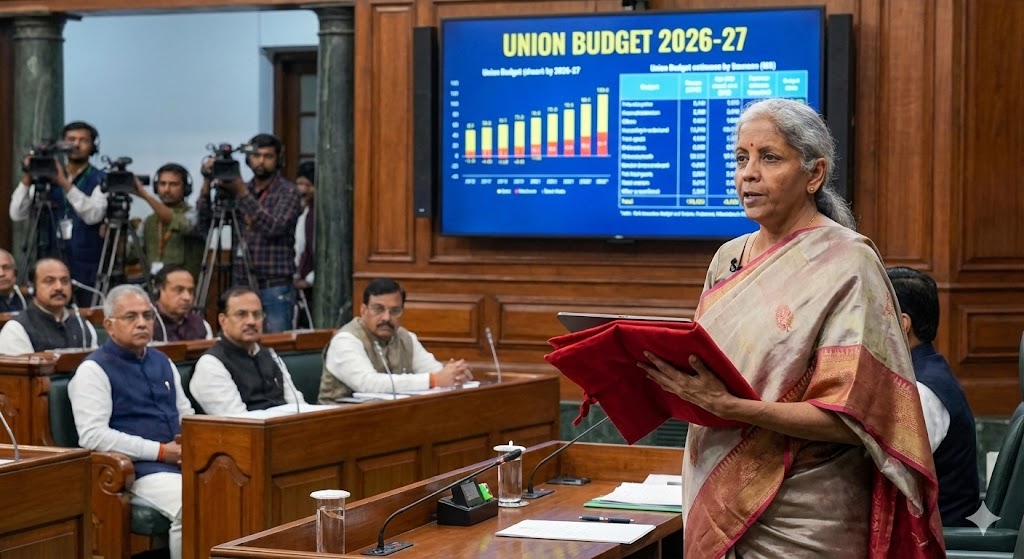
While global tensions make headlines, India’s policymakers are quietly preparing a transformational fiscal reset: the Budget of 2026. At its core, the budget is expected to focus on tax reform, industrial incentives, and job creation strategies.
One area of change centers on the Income Tax framework. The current tax regime already offers a relatively higher standard deduction — ₹75,000 for salaried taxpayers — which effectively means many taxpayers with income up to around ₹12.75 lakh have zero tax liability under the new tax regime when this deduction and other rebates are considered.
In addition, there is growing talk among analysts and tax experts about even more transformative proposals — such as joint taxation for married couples, which would represent a major structural reform benefiting middle-class tax households. These reforms are aimed at simplifying the tax code, reducing compliance frustration, and putting more disposable income into consumers’ hands.
Another major area of fiscal strategy is government incentives. The Indian government is proposing to double the Production-Linked Incentive (PLI) allocation for the automotive sector to around ₹5,800 crore in the 2025–26 financial year. This move would shift the scheme from merely incentivizing capacity creation toward scaling up actual production — an important distinction in terms of industrial output.
This higher PLI support would boost established manufacturers like Mahindra & Mahindra, Tata Motors, Bajaj Auto, and others that are investing in electric vehicles and high-value manufacturing. The government reports that cumulative investment under the PLI automotive scheme has already reached about ₹35,657 crore, with many major players participating.
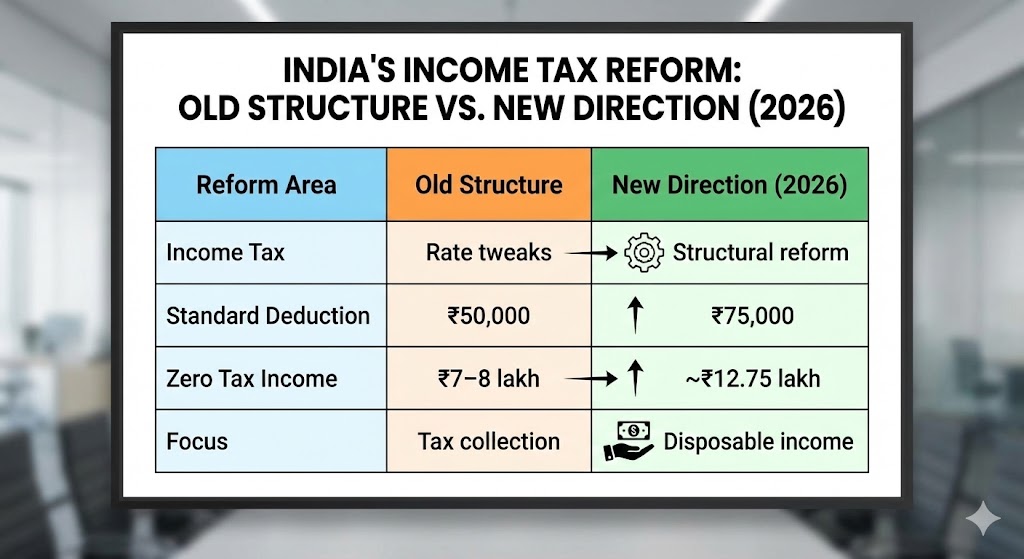
Alongside PLI increases, India may roll out additional incentives worth ₹23,000 crore targeting capital goods and manufacturing sectors to strengthen supply chains and domestic production further.
All of these fiscal policies — tax reform, enhanced incentives, and targeted spending — point to a broader shift in India’s economic strategy. Policymakers are not just tweaking numbers; they are focusing on structural resets designed to enhance competitiveness, employment, and productivity in the face of global uncertainty.
4. Market Mechanics: The FII vs. DII “Tug-of-War”
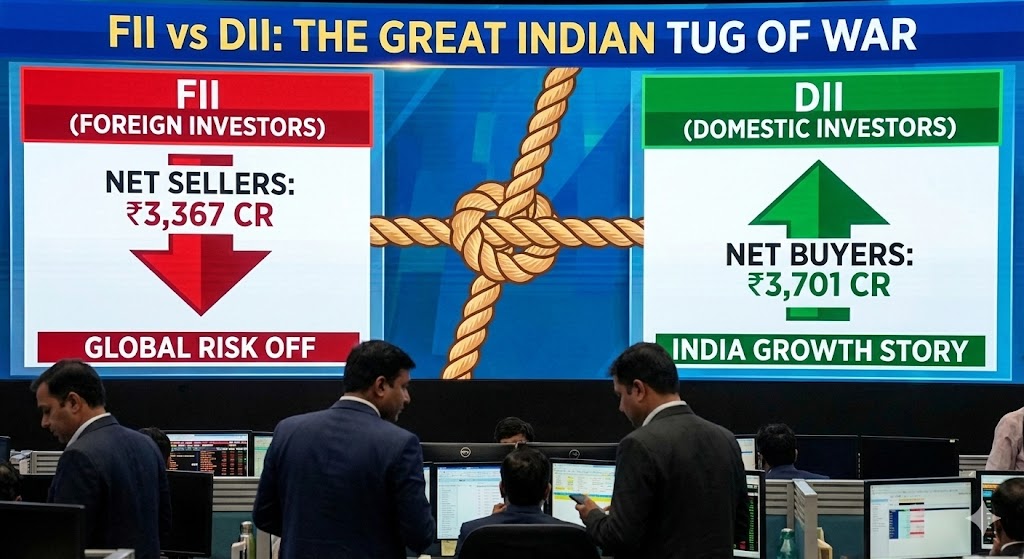
If markets could talk, they’d say 2026 started with a serious mood of uncertainty.
Foreign Institutional Investors (FIIs) have been selling Indian equities, including a net sell of roughly ₹3,367 crore on January 8, reflecting global caution and sensitivity to geopolitical stress.
At the same time, Domestic Institutional Investors (DIIs) have been buying, showing faith in India’s internal strength. On the same day that FIIs were selling, DIIs put in net purchases of about ₹3,701 crore, helping prevent a sharper fall in market indices.
This push-pull dynamic creates a “tug-of-war” in the markets. On one hand, global sentiment and foreign flows push prices down; on the other, domestic confidence and policy support provide a buffer against deeper declines.
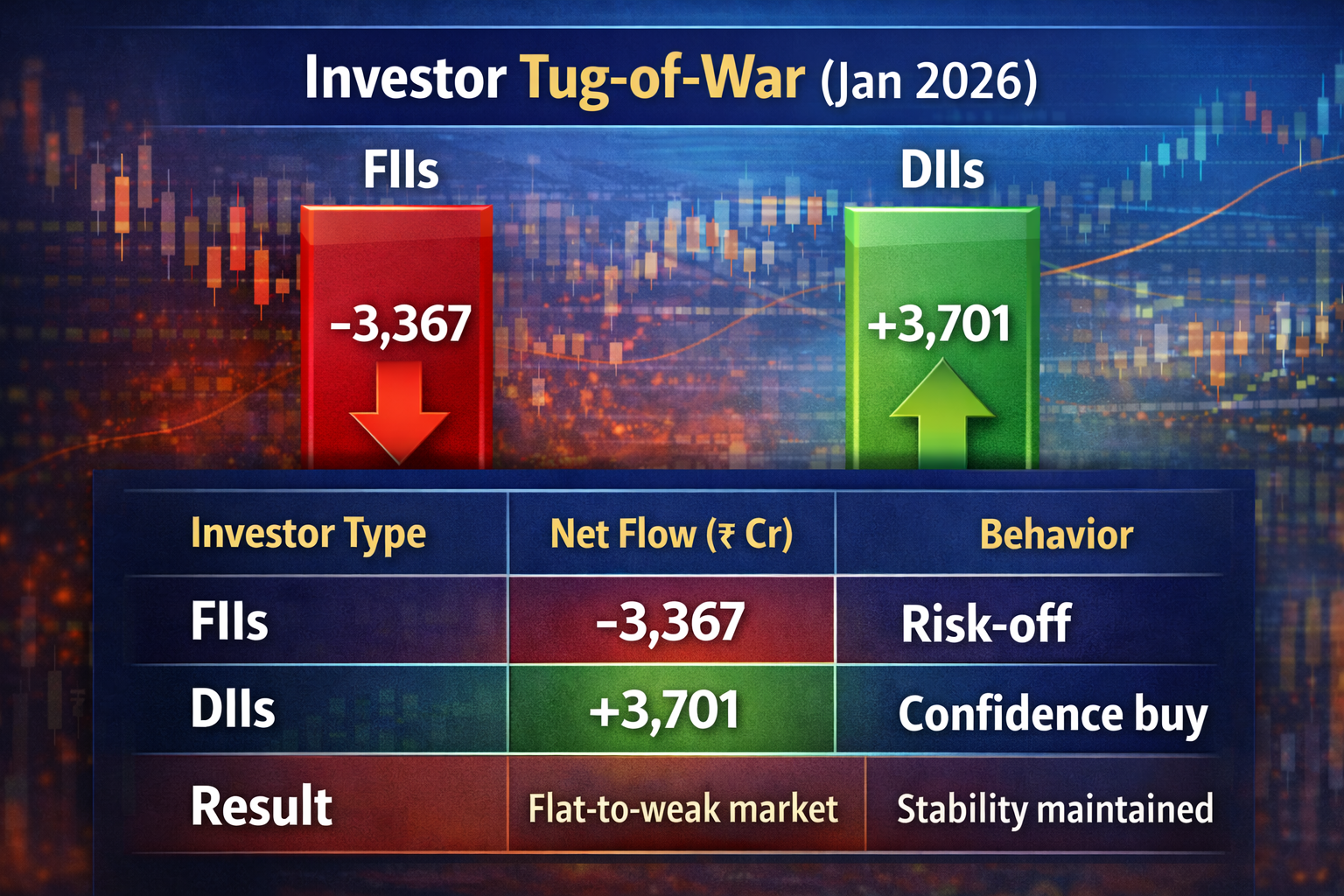
Technically, markets appear to be in a “wait-and-watch” mode. The Nifty Index’s support around the 25,700–25,500 zone stands as a key technical floor — meaning if prices break below these levels convincingly, more downside momentum could follow.
At the same time, sentiment indicators like the India VIX (volatility index) are climbing, signaling greater fear and uncertainty compared to recent months. Higher VIX generally means traders expect bigger swings in price — not a smooth path upward.
In other words, markets are still digesting two things:
Global forces beyond India’s control — tariffs, outflows, and geopolitical risks
Domestic policy shifts designed to strengthen resilience
This delicate balance is what investors must navigate in early 2026.
5. Conclusion: Investor Verdict for Q1-Q2 2026
So what should investors do in this complex environment?
First, understand the nature of the “storm.” Geopolitics is currently acting as a strong driver of market sentiment — it pushes fear and uncertainty into global prices. But India’s fiscal policy — tax reforms, PLI boosts, manufacturing incentives — is acting as a stabilizer for the domestic economy.
In such conditions, hedging becomes important. Precious metals like gold and silver have regained appeal as safe havens amid geopolitical tension and uncertainty about monetary policy. For instance, gold prices have continued high — trading above historic levels, buoyed by safe-haven demand and global uncertainty — with some analysts forecasting prices to climb further through 2026.
Silver too showed notable strength in 2025, and some forecasts suggest further upside potential as markets enter price-discovery territory.
Simultaneously, if one believes in the long-term India growth story, then accumulating stocks linked to India’s strategic sectors — such as defense, domestic manufacturing, and auto sector winners backed by PLI incentives — may pay off during periodic corrections.
In simple terms:
Don’t just trade volatility. Volatility is noise — it comes and goes.
Trade the structural shift. The big story is India’s fiscal reset and its move toward higher-value domestic production, lower dependence on foreign imports, and more rational tax structures.
For everyday investors, this means looking beyond day-to-day market swings and thinking about how long-term trends — tax reform, manufacturing incentives, fiscal discipline — could shape investment returns in the months and years ahead.
❓ Frequently Asked Questions (FAQ)
1. What is the US tariff war and why does it matter in 2026?
The US tariff war refers to higher import taxes proposed or imposed by the United States on goods coming from other countries. In 2026, these tariff threats matter because they can slow global trade, increase costs for businesses, and create uncertainty in financial markets. Even countries not directly targeted, like India, feel the impact through weaker global demand and volatile capital flows.
2. Will US tariffs directly impact India’s economy?
India’s direct exposure to US tariffs is limited compared to countries like Mexico or Canada. However, indirect effects are important. Global trade uncertainty can reduce foreign investment flows, weaken export demand, and increase market volatility. That said, India’s large domestic market and policy reforms provide some insulation.
3. Why are global stock markets under pressure in early 2026?
Global stock markets are under pressure due to a mix of factors:
Rising geopolitical tensions
US tariff threats
Higher interest rates in developed markets
Risk-off sentiment among global investors
When uncertainty rises, investors reduce exposure to equities and move money into safer assets.
4. Why are FIIs selling while DIIs are buying Indian stocks?
Foreign Institutional Investors (FIIs) react more to global risks like tariffs, currency movements, and US policy changes. Domestic Institutional Investors (DIIs), such as mutual funds and insurance companies, focus more on India’s long-term growth story. In January 2026, FIIs turned cautious, while DIIs continued buying, helping stabilize the market.
5. What does “risk-off” and “risk-on” mean in markets?
Risk-off: Investors prefer safety, selling stocks and buying assets like gold, bonds, or cash.
Risk-on: Investors are confident and willing to invest in stocks and higher-risk assets.
Current global conditions reflect a partial risk-off environment.
6. Why do gold and silver rise during geopolitical crises?
Gold and silver are considered safe-haven assets. During geopolitical tensions, wars, or trade conflicts, investors fear losses in stocks and currencies. Precious metals hold value during uncertainty, so demand rises, pushing prices higher.
7. Is gold a good investment in 2026?
Gold can be a useful hedge in 2026, especially during periods of global uncertainty, currency weakness, and geopolitical risk. While it may not always give fast returns like stocks, it helps protect wealth during volatile phases.
8. What is India’s fiscal reset in Budget 2026?
India’s fiscal reset refers to structural reforms planned in Budget 2026, including:
Simplifying the income tax system
Higher standard deduction for salaried taxpayers
Manufacturing and production incentives (PLI schemes)
Focus on domestic growth and job creation
The goal is long-term economic stability rather than short-term stimulus.
9. How does Budget 2026 benefit the middle class?
Budget 2026 reduces tax pressure on the middle class by:
Increasing standard deduction
Raising the effective zero-tax income threshold
Exploring structural reforms like simplified tax slabs
This increases disposable income and boosts consumption.
10. What is the Auto PLI scheme and why is it important?
The Auto Production-Linked Incentive (PLI) scheme rewards companies for increasing production in India. In 2026, the proposed increase in allocation supports:
Electric vehicle manufacturing
Advanced auto components
Job creation and export growth
It strengthens India’s position as a global manufacturing hub.
11. Which sectors may benefit most in 2026?
Key sectors likely to benefit include:
Defense manufacturing
Automobiles and EVs
Capital goods
Infrastructure-linked industries
These sectors align with government policy priorities.
12. Is the Indian stock market heading for a crash in 2026?
A full-scale crash is unlikely unless global conditions worsen sharply. India’s strong domestic demand, policy reforms, and DII support reduce downside risk. However, short-term volatility and corrections are possible.
13. How should long-term investors approach 2026?
Long-term investors should:
Avoid panic during volatility
Focus on quality companies
Use corrections to accumulate strong sectors
Maintain diversification with assets like gold
Patience and discipline matter more than timing the market.
14. What role does volatility (India VIX) play for investors?
India VIX measures market fear. A rising VIX signals uncertainty and short-term risk. For investors, higher volatility means:
Avoid excessive leverage
Expect sharp price swings
Focus on long-term fundamentals
15. Final takeaway for investors in 2026?
2026 is not just about fear or opportunity — it’s about adjustment. Global geopolitics may drive volatility, but India’s fiscal and manufacturing strategy provides long-term stability. Smart investors focus on structure, not noise.
🔎 People Also Ask (PAA)
Is the US tariff war likely to trigger a global market crash in 2026?
A full global market crash is unlikely unless tariff tensions escalate into a prolonged trade war. However, short-term corrections and volatility are expected as investors react to uncertainty, higher costs, and slowing global trade.
How do US tariffs affect emerging markets like India?
US tariffs affect emerging markets indirectly. They increase global uncertainty, weaken export demand, and cause foreign investors to pull money from riskier assets. India remains relatively insulated due to strong domestic demand and policy support.
Why is India less affected by global trade tensions?
India’s economy is driven more by domestic consumption than exports. Structural reforms, fiscal discipline, and strong domestic investor participation reduce India’s dependence on global capital flows.
What happens to stock markets during tariff wars?
During tariff wars, companies face higher costs and lower profit visibility. Markets usually react with sell-offs, increased volatility, and a shift toward defensive sectors and safe-haven assets.
Why are investors buying gold and silver during global uncertainty?
Gold and silver protect value when currencies weaken or markets fall. During geopolitical stress and trade wars, investors prefer assets that are not linked to corporate earnings or government policies.
Is silver a better investment than gold in volatile markets?
Silver tends to be more volatile than gold because it has both industrial and investment demand. It can offer higher returns during rallies but may fall more sharply during corrections compared to gold.
What role does Budget 2026 play in stabilising Indian markets?
Budget 2026 focuses on tax relief, manufacturing incentives, and fiscal stability. These measures support economic growth, corporate earnings, and investor confidence during global uncertainty.
How does income tax reform impact market sentiment?
Lower tax burden increases disposable income, boosts consumption, and improves corporate revenue outlook. This creates a positive feedback loop for markets over the medium to long term.
What is the difference between FII and DII investment behaviour?
FIIs are influenced by global trends like interest rates and geopolitics, while DIIs focus on domestic fundamentals. In volatile periods, DII buying often stabilises Indian markets.
Why does the Indian stock market not fall sharply when FIIs sell?
Strong DII participation, long-term savings inflows, and policy credibility act as shock absorbers. This prevents panic selling and sharp crashes.
What does ‘India VIX rising’ indicate for traders?
A rising India VIX indicates fear and expected price swings. Traders should reduce leverage and expect short-term volatility, while investors can look for gradual accumulation opportunities.
Which sectors are safest during geopolitical tensions?
Historically, sectors like defense, utilities, FMCG, and precious metals perform better during uncertain periods due to stable demand and government support.
Is 2026 a good year for long-term investing in India?
For long-term investors, 2026 offers opportunities due to reforms, manufacturing push, and demographic strength. Short-term volatility should be viewed as a chance to build positions gradually.
Can India benefit from global supply chain shifts?
Yes. As companies diversify away from over-dependence on a few countries, India stands to gain through manufacturing incentives, skilled labor, and policy reforms.
What is the biggest risk investors should watch in 2026?
The biggest risks include escalation of geopolitical conflicts, prolonged trade wars, sharp commodity price spikes, and sudden global liquidity tightening.
What is the biggest opportunity for investors in 2026?
The biggest opportunity lies in India’s structural transformation — tax reform, manufacturing growth, defense indigenisation, and long-term domestic consumption.



Spinning the reels at win55club tonight! Games seem lively and the payouts are promising, fingers crossed I get lucky! Feeling good vibes, so far so good. See what all the fuss is about over at win55club.