I. The “Altitude Sickness”
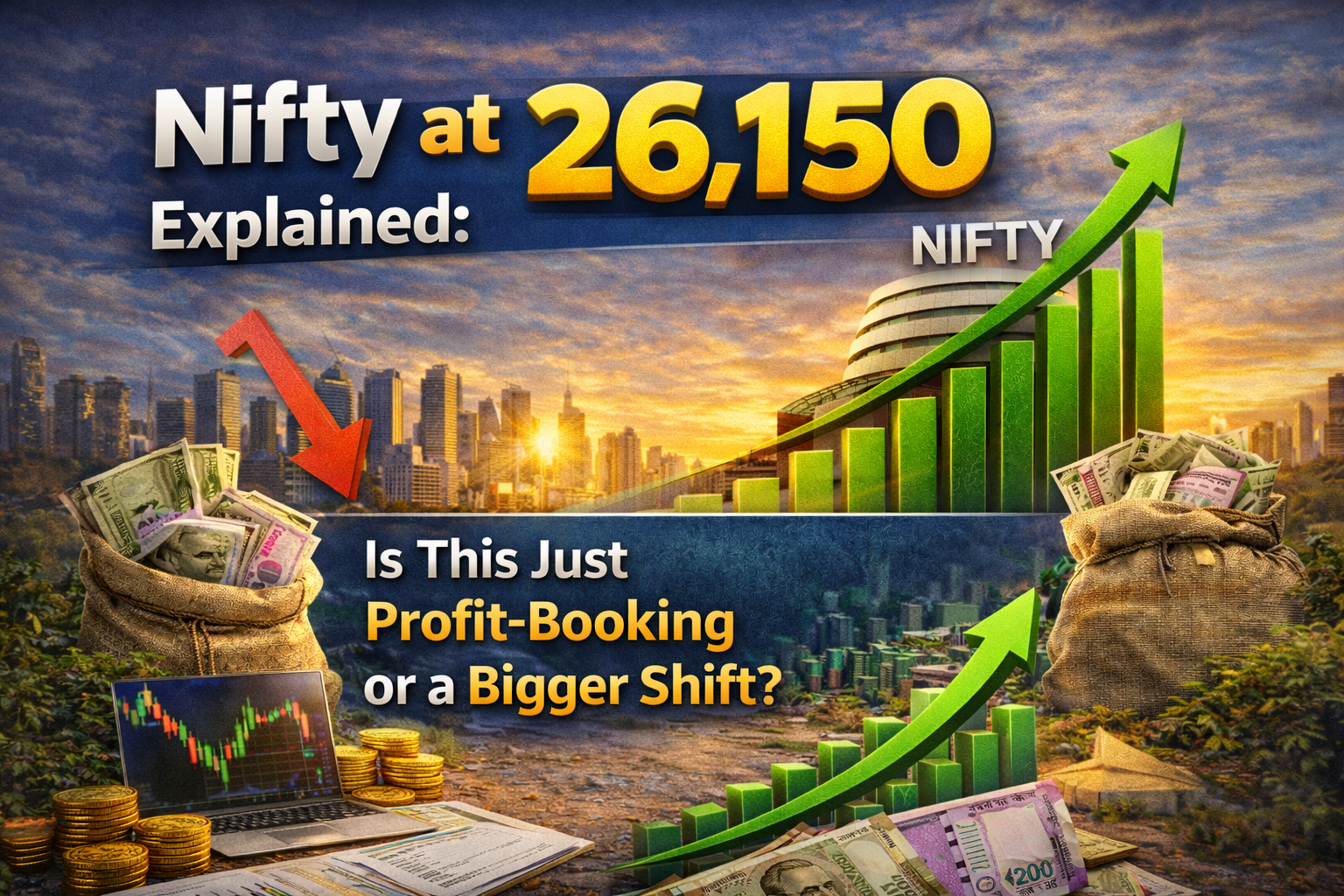
On January 2, 2026, the Indian equity market hit a historic moment. The Nifty 50 closed at 26,328.55, its highest level ever. For investors, it felt like the market had entered a new orbit. But markets, like mountains, come with altitude risks. Just four days later, on January 6, the index slipped below the 26,150 level during intraday trade.
The fall surprised many retail investors. After all, the market had rallied nearly 1.5% in the first three trading sessions of 2026. But for large institutions, such fast gains are often a signal to pause and protect profits. This is classic market psychology: when prices rise too fast, risk managers step in.
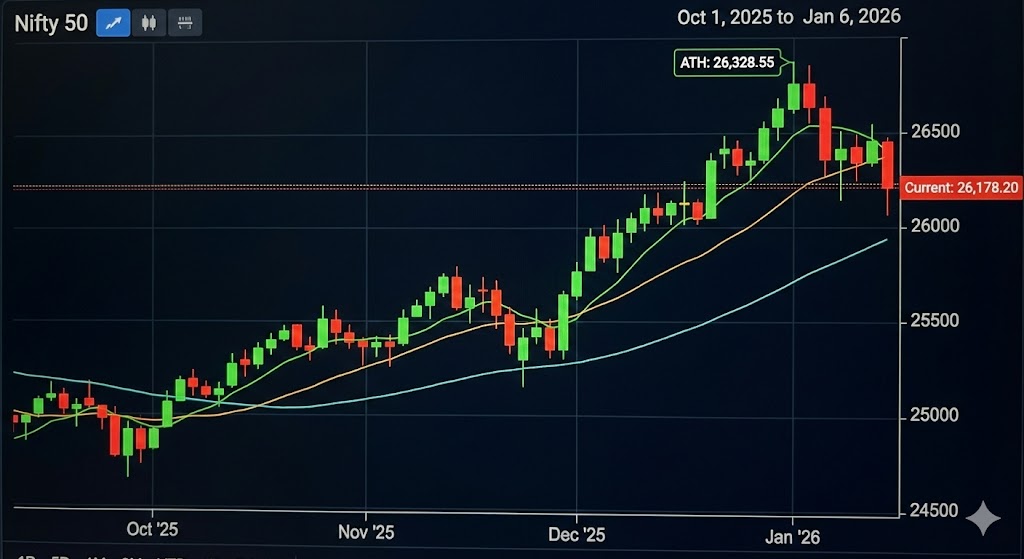
A 0.6% to 1% correction from an all-time high is usually healthy. It allows prices to cool down and buyers to reassess value. What made this move different was not the size of the fall, but its speed and trigger. The selling pressure was driven less by domestic fundamentals and more by geopolitical and policy-related shocks that arrived suddenly.
In simple words, the market did not fall because India’s story turned weak. It fell because global uncertainty knocked at the door at a sensitive moment.
National Stock Exchange of India (NSE)
II. The Reliance Correction: A Case Study in Geopolitical Risk
The sharpest signal of stress came from one stock that often acts as a mirror of India’s economy: Reliance Industries (RIL).
On Monday, RIL touched a fresh 52-week high of ₹1,611.80. By Tuesday, it had dropped sharply, falling 5.18% intraday to ₹1,496.30. For a heavyweight stock, this was a big move—and it pulled the broader index down with it.
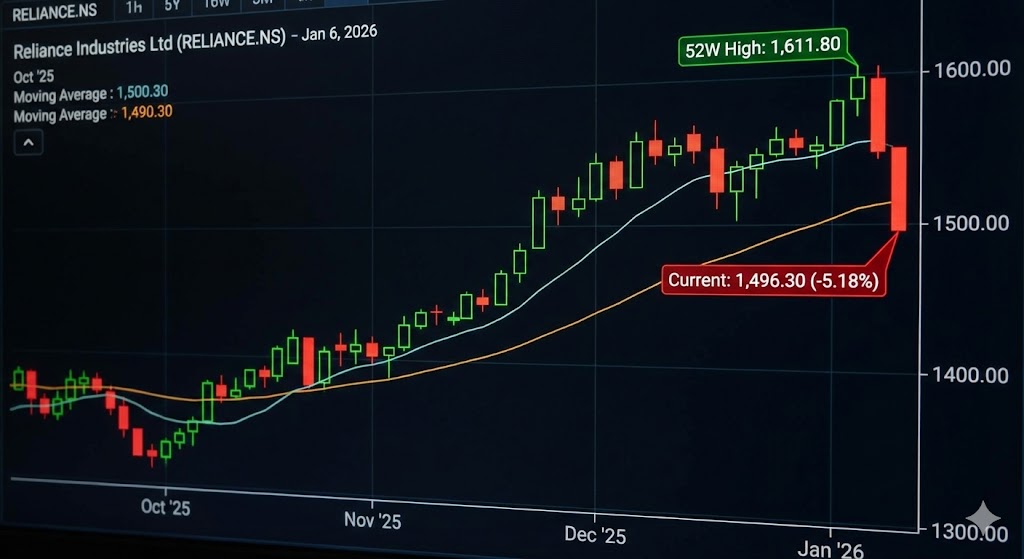
The immediate trigger was Reliance’s clarification that it expects zero Russian crude shipments in January. This statement sent a clear message to markets: U.S. pressure on buyers of Russian oil is beginning to work. Investors quickly recalculated the risk.
Reliance is often seen as India’s energy proxy. Its refining and petrochemical profits are closely linked to crude sourcing. Over the past two years, discounted Russian oil helped Indian refiners protect margins. If Reliance steps back from these supplies due to tariff threats or sanctions risk, its Gross Refining Margins (GRMs) could face short-term pressure until new supply chains are secured.
This does not mean Reliance’s long-term business is broken. It means that in the short term, geopolitics has entered the balance sheet. Markets hate uncertainty, and Tuesday’s sell-off reflected that fear.
Reliance Industries – Investor Relations
III. Geoeconomic Catalyst: The “Venezuela Opportunity” vs. “Sanction Fear”
Interestingly, the same global developments that scared investors also carry opportunity. According to analysts at Jefferies, Reliance is one of the few global refiners capable of processing heavy Venezuelan crude efficiently.

After the U.S. military intervention in Venezuela—often referred to as “Operation Absolute Resolve”—there is speculation that Venezuelan oil could return to global markets in larger volumes. For a complex refiner like Reliance, this could be a long-term positive.
But markets don’t price long-term opportunity during moments of panic. Instead, they focus on immediate risk. The fear dominating Dalal Street was not about Venezuela’s oil potential, but about U.S. tariff threats.
The U.S. President’s warning of 50% duties on countries buying Russian oil changed the narrative overnight. Reliance, which was seen as a growth and cash-flow stock, suddenly became a geopolitical target in the eyes of traders.
This clash between opportunity and fear explains the violent move. Fundamentally, Reliance may benefit from new oil flows in the future. But until policy clarity emerges, the stock remains vulnerable to headline-driven volatility.
IV. Market Breadth: VIX, Sectoral Rotation, and the Safety Nets
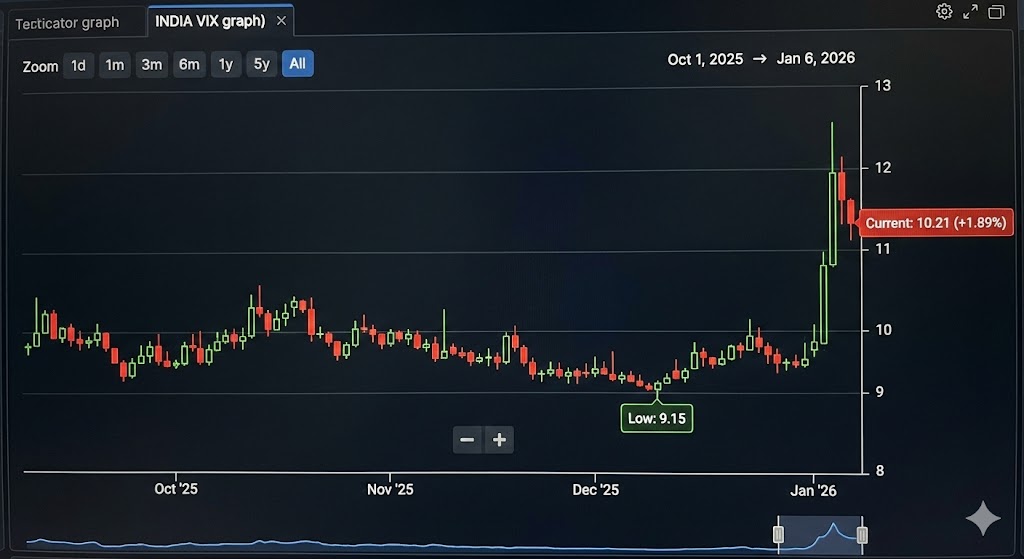
The stress was not limited to one stock. Market-wide indicators confirmed rising nervousness. The India VIX, which measures expected volatility, jumped 1.89% to around 10.21. While this is not panic territory, it clearly shows that fear is creeping back into option markets.
Other large stocks added to the pressure. Trent fell nearly 8%, reflecting concerns over valuation after a strong rally. Kotak Bank slipped about 2.2%, dragging the financial space temporarily.
However, this was not a total market breakdown. Some sectors acted as shock absorbers. Healthcare stocks led by Apollo Hospitals rose about 3.5%, showing that defensive sectors still attract money during uncertainty. Banking also showed resilience, with ICICI Bank gaining around 2.8%.
Bombay Stock Exchange (BSE) (optional but useful)
This sectoral rotation tells an important story. Investors are not exiting India. They are rearranging portfolios, moving from stocks exposed to global policy risk toward domestic and defensive plays.
V. Technical Outlook: The 26,000 Battleground
From a technical perspective, the Nifty settled near 26,178. The immediate and most important level now is the 26,000 psychological mark. This zone is expected to act as strong support, as many long-term investors see it as a buying area.
On the upside, the index faces resistance in the 26,240–26,300 range. A decisive move above this zone, supported by strong volumes, would signal that the bull trend is ready to resume.
What supports the market at these levels is the macro backdrop. India’s projected 6.9% GDP growth for FY27 provides a strong fundamental floor. Corporate balance sheets are healthier than in past cycles, banks are well-capitalised, and domestic demand remains steady.
This is why most experts describe the current phase as “buy on dips”, not a reason to exit the market completely. Volatility may stay for a while, but panic selling is not justified by fundamentals.
VI. Conclusion: The “Janus” Market
January 2026 has revealed a two-faced market, much like Janus, the Roman god with two faces. One face looks forward, celebrating record highs, strong GDP growth, and long-term reform-driven optimism. The other face looks outward, worried about a new global order shaped by aggressive trade policies and sanctions.
The recent Nifty slide is not a sign that India’s growth story is failing. It is a reminder that in today’s world, geopolitics can move markets as much as earnings. For long-term investors, the message is clear: focus on quality over momentum.
Corrections at high levels are normal. They test conviction and reward patience. For readers of SR Vishwa, this phase is less about fear and more about understanding risk—because markets that climb to high altitudes need rest before the next ascent.
❓ Frequently Asked Questions (FAQ)
1. Why did the Nifty fall from the 26,300 level?
The Nifty fell mainly due to profit-booking after hitting record highs. Global uncertainties, especially around oil geopolitics and trade policy risks, added pressure at elevated levels.
2. Is the fall in Nifty a sign of a market crash?
No. A fall of less than 1% from an all-time high is considered a normal market correction and not a crash. Such moves help cool overheated markets.
3. What role did Reliance Industries play in this correction?
Reliance Industries saw a sharp decline due to concerns over crude supply changes and geopolitical pressure. As a heavyweight stock, its fall had a strong impact on the Nifty.
4. What is profit-booking in the stock market?
Profit-booking happens when investors sell stocks after a strong rally to lock in gains. It is a healthy and common part of market cycles.
5. Did global geopolitics influence the Nifty slide?
Yes. Fears related to U.S. tariff threats, sanctions on oil trade, and uncertainty around global energy supply influenced investor sentiment.
6. What does the rise in India VIX indicate?
A rise in India VIX shows increasing market caution and demand for hedging. However, current levels still suggest controlled volatility, not panic.
7. Which sectors supported the market during the fall?
Healthcare and select banking stocks showed strength, helping limit broader market damage and indicating sectoral rotation rather than full risk exit.
8. Is 26,000 an important level for Nifty?
Yes. The 26,000 level is a key psychological and technical support zone where long-term investors may look for buying opportunities.
9. Should retail investors worry about this correction?
For long-term investors, such corrections are normal. As long as fundamentals remain strong, short-term volatility should not cause panic decisions.
10. Does India’s economic outlook still support equities?
Yes. India’s strong GDP growth outlook, healthy banks, and stable domestic demand continue to support the long-term equity story.
11. Is this a good time to buy Nifty dips?
Many experts view this phase as a “buy-on-dips” market rather than a trend reversal, provided global risks do not worsen sharply.
12. What could trigger a bigger market shift from here?
A sharper global slowdown, aggressive trade sanctions, or a sudden spike in oil prices could cause deeper corrections. For now, risks remain manageable.
13. How long can this consolidation last?
Consolidation can last days or weeks. Markets often move sideways after sharp rallies before resuming their trend.
14. Is momentum trading risky at current levels?
Yes. Momentum stocks can see faster corrections during volatile phases. Quality and fundamentally strong stocks are safer during such periods.
15. What is the key takeaway for investors?
The current Nifty move reflects caution, not collapse. Focus on quality, manage risk, and avoid emotional reactions to short-term headlines.
🔍 People Also Ask
Why did Nifty fall after hitting 26,300?
Nifty fell due to profit-booking at record highs combined with global uncertainties around oil prices, trade policy risks, and geopolitical developments.
Is the Nifty correction in January 2026 normal?
Yes. Corrections of 0.5%–1% after sharp rallies are normal and help markets cool down without damaging long-term trends.
What is the difference between profit-booking and a market crash?
Profit-booking is a short-term pullback after gains, while a crash involves deep, broad-based selling driven by economic or financial stress.
How important is the 26,000 level for Nifty?
The 26,000 level is a key psychological and technical support zone that many investors track for stability and buying interest.
Did Reliance Industries cause the Nifty fall?
Reliance did not cause the fall alone, but its sharp decline had a strong impact because of its heavy weight in the index.
What does a rising India VIX mean for investors?
A rising India VIX indicates higher market uncertainty and increased hedging activity, but current levels still suggest controlled volatility.
Are foreign investors selling Indian stocks?
There has been selective selling, but domestic institutional investors continue to provide strong support to the market.
Which sectors are safer during market corrections?
Defensive sectors such as healthcare and select banking stocks tend to perform better during periods of market uncertainty.
Is this correction a buying opportunity?
Many analysts view mild corrections as opportunities to accumulate quality stocks, especially when economic fundamentals remain strong.
Could global geopolitics cause a deeper fall in Nifty?
Geopolitical shocks can increase volatility, but a deeper fall would require sustained global economic or financial stress.
How long can market consolidation last?
Market consolidation can last from a few days to several weeks, depending on news flow and investor confidence.
What should long-term investors do during such volatility?
Long-term investors are advised to stay focused on fundamentals, avoid emotional decisions, and use volatility to rebalance portfolios.
Is momentum trading risky at current Nifty levels?
Yes. Momentum strategies can be risky during volatile phases, as stocks may correct sharply after steep rallies.
Does India’s GDP growth outlook support equities?
Strong GDP growth projections continue to support Indian equities over the medium to long term.
What signals would confirm a trend reversal?
A sustained break below key support levels, rising inflation, or weakening corporate earnings could indicate a trend change.