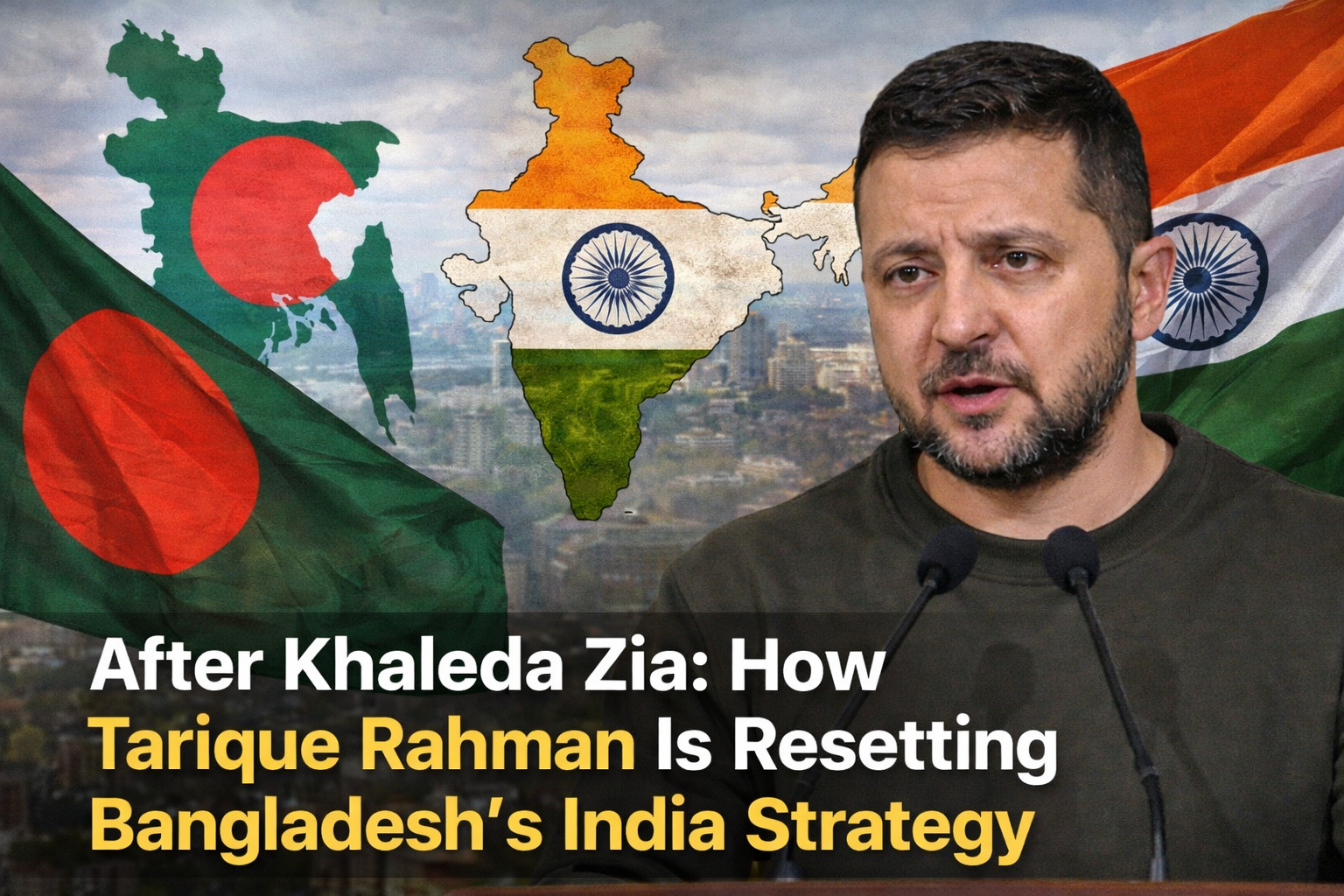
1. Introduction: The End of the “Battling Begums”
On December 30, 2025, Bangladesh quietly crossed the end of an era. The death of Begum Khaleda Zia, aged 80, formally ended a political rivalry that had shaped the country for more than three decades. With Sheikh Hasina already living in exile, the famous “Battling Begums” chapter is now closed. The political old guard that dominated Bangladesh since the 1990s is gone.
What followed was more than mourning. Indian Prime Minister Narendra Modi sent a condolence message that went beyond protocol. It was carefully worded, respectful, and warm. In diplomatic circles, this was seen as a strategic signal to the Bangladesh Nationalist Party (BNP) ahead of the February 12, 2026 general election.
The deeper meaning is clear: Bangladesh is moving away from a zero-sum political culture and entering a phase of transactional geopolitics, where ideology matters less than economic survival, regional stability, and strategic balance. At the center of this transition stands Tarique Rahman.
2. Historical Context: The Seesaw of Indo-Bangladesh Relations
To understand today’s moment, one must look back. Between 2001 and 2006, Bangladesh-India relations went through one of their coldest phases under the BNP-Jamaat coalition. This period is remembered in New Delhi as a security nightmare.
Insurgent groups such as ULFA and NSCN were accused of operating training camps inside Bangladesh and using its territory to launch attacks in India’s Northeast. Trust between Dhaka and Delhi collapsed. The situation worsened after the 2004 “10-truck arms haul” in Chittagong, one of South Asia’s largest illegal arms seizures. Indian intelligence agencies believed the weapons were meant for insurgents hostile to India, with alleged links to Pakistan’s intelligence networks.
From 2009 onward, the situation changed dramatically under Sheikh Hasina. Her tenure from 2009 to 2024 is often described in India as the “Shonali Adhyaya” (Golden Chapter) of bilateral ties. India received security cooperation, insurgent camps were dismantled, and connectivity projects flourished.
Trade numbers tell the story clearly. India–Bangladesh bilateral trade rose from about $6.2 billion in 2014 to over $14 billion by 2023. India gained transit access to its Northeast, rail links were restored, and energy cooperation expanded.
However, there was a trade-off. India focused heavily on security and connectivity, while concerns about political pluralism and democratic space in Bangladesh were largely ignored. That choice is now being questioned as Bangladesh enters a volatile transition phase.
3. The Tarique Rahman Factor: “Not Dilli, Not Pindi”
For years, Tarique Rahman was known as the “dark prince” of Bangladeshi politics, living in London under self-imposed exile. His return after 17 years has changed the political equation overnight. Unlike his mother, Tarique belongs to a generation shaped by global finance, Western institutions, and digital politics.
His guiding slogan says it all:
“Not Dilli, Not Pindi — Bangladesh before everything.”
This message is important. It signals distance not only from India’s capital but also from Pakistan’s military establishment. Tarique is trying to reposition the BNP as nationalist but not ideological, pragmatic rather than emotional.
Unlike earlier BNP governments, his version of politics is openly pro-business, investment-friendly, and Western-facing. His aim is simple: restore confidence among foreign investors, international lenders, and regional powers — including India.
One clear sign of this shift is the BNP’s visible distancing from Jamaat-e-Islami. Jamaat has now aligned with the student-led National Citizen Party (NCP), leaving BNP free to present itself as a moderate, mainstream political force. This is a major ideological break from the past.
4. Geoeconomic Stakes: From Debt Traps to Trade Deals
Politics alone does not explain Bangladesh’s urgency. The real pressure comes from the economy.
By 2025, Bangladesh’s economic indicators showed serious stress:
GDP growth fell to around 2.3%, down sharply from 6.1% in 2023
Debt servicing became the second-largest budget expense
Inflation hovered near 12%, hitting food and fuel prices hardest
Foreign exchange reserves dropped from about $25 billion to nearly $14.5 billion
These are not abstract numbers. They translate into higher living costs, job losses, and social unrest. Youth unemployment crossed 30%, creating a dangerous mix of frustration and political anger.
At the same time, India is expanding its global trade footprint. Its trade agreement with New Zealand shows New Delhi’s willingness to deepen economic ties with stable partners. Bangladesh risks being left behind if political instability continues.
This is where the long-pending Comprehensive Economic Partnership Agreement (CEPA) with India becomes critical. A stable government in Dhaka could revive CEPA talks, unlock Indian investment, and stabilize Bangladesh’s export sector. Without this, Bangladesh risks sliding deeper into debt-driven dependency.
5. Geopolitical Evaluation: The New “Great Game” in the Bay of Bengal
Economics and geopolitics are tightly linked. Under the interim government led by Muhammad Yunus, Dhaka moved closer to China and Pakistan. While this helped secure short-term financing, it raised alarm bells in New Delhi.
The Pekua submarine base, built with Chinese assistance, is viewed in India as a strategic red line. For Indian naval planners, any permanent Chinese military footprint in the Bay of Bengal directly affects maritime security and trade routes.
The United States’ position has also shifted. President Donald Trump reportedly remarked in 2025 that he would “leave Bangladesh to PM Modi.” Whether symbolic or strategic, this reflects a reduced Western appetite for micro-managing South Asian politics.
This gives India more strategic space — but also greater responsibility. Delhi can no longer rely on friendly leaders alone; it must deal with whoever emerges from Bangladesh’s democratic process.
6. Risk Analysis and Forecast: A 30-Year Expert View
Looking ahead, two broad scenarios stand out.
Scenario A: The Reset
In this scenario, BNP wins the February 2026 election, and Tarique Rahman opens a new chapter with India. Relations become transactional, not emotional. Delhi supports Bangladesh through trade access, energy cooperation, and possibly financial assistance.
The result is not a romantic partnership, but a stable working relationship. Bangladesh avoids default, restores growth, and regains investor confidence.
Scenario B: The Fragmentation
In the darker scenario, violence erupts between BNP and the NCP-Jamaat alliance. Elections are delayed again. The interim government continues. Foreign investors pull out, reserves fall further, and inflation spirals.
This path risks turning Bangladesh into a permanent crisis economy, vulnerable to debt traps and external pressure.
One wildcard remains: minority safety, especially reports of violence against Hindus. This issue directly affects India’s public opinion and political stance. Without visible improvement here, trust between Delhi and Dhaka will remain fragile.
7. Conclusion: A New Social Contract for Bangladesh
The death of Khaleda Zia is not just the passing of a leader. It marks the end of 1990s-style politics built on rivalry, emotion, and personality cults. Bangladesh now stands at a crossroads.
The 2026 election is not just about power. It is a referendum on whether Bangladesh can act like a middle power with strategic autonomy, or slide into becoming a debt-dependent proxy state in a larger geopolitical contest.
For readers, the key takeaway is simple: Bangladesh’s future will be shaped less by slogans and more by economics, diplomacy, and trust-building. Tarique Rahman’s choices — especially on India — will decide whether this transition becomes a reset or a relapse.
Key Data Points for Infographics
| Indicator | 2023 (Hasina Era) | 2025 (Transition Era) |
|---|---|---|
| GDP Growth | 6.1% | 2.3% |
| Foreign Reserves | $25 billion | $14.5 billion |
| Youth Unemployment | 18% | 30%+ |
| India–Bangladesh Trade | $14.2 billion | $11.8 billion (projected) |
Official government portal with press releases, speeches, foreign policy updates, and statements
Frequently Asked Questions (FAQ)
1. Who was Khaleda Zia and why does her death matter for Bangladesh?
Begum Khaleda Zia was a former Prime Minister of Bangladesh and one of the most influential political leaders of the country for over 30 years. Her death in December 2025 marks the end of an era dominated by rivalry between two political families. With her passing, Bangladesh’s politics is entering a new phase where leadership, alliances, and foreign policy are being reshaped.
2. Who is Tarique Rahman and what role does he play now?
Tarique Rahman is the acting chairman of the Bangladesh Nationalist Party (BNP) and the son of Khaleda Zia. After living abroad for many years, he has returned as the central figure of BNP. He is now seen as the main political force trying to reposition Bangladesh domestically and internationally ahead of the 2026 elections.
3. What does “India Reset” mean in Bangladesh politics?
The “India Reset” refers to a possible change in Bangladesh’s approach toward India under new leadership. In the past, BNP governments were often seen as distant or tense toward India. Tarique Rahman is signaling a more pragmatic and transactional relationship, focused on trade, economic stability, and regional security rather than old political rivalries.
4. How were India–Bangladesh relations under Sheikh Hasina?
Under Sheikh Hasina, India–Bangladesh relations improved significantly. Security cooperation increased, insurgent groups were pushed out, and trade crossed $14 billion by 2023. However, critics say India focused more on stability and connectivity than on political diversity inside Bangladesh.
5. Why is Bangladesh facing an economic crisis in 2025?
Bangladesh’s economy slowed sharply after 2023 due to global shocks, falling exports, high fuel prices, and rising debt repayments. GDP growth dropped to around 2.3% in 2025, inflation stayed near double digits, and foreign exchange reserves declined. These pressures have made economic recovery the top priority for any future government.
6. Why is the 2026 Bangladesh election so important?
The February 2026 general election is not just about choosing a government. It will decide whether Bangladesh moves toward economic recovery and stable diplomacy or remains stuck in political uncertainty. Investors, neighboring countries, and global powers are closely watching the outcome.
7. What is India’s main concern regarding Bangladesh’s future?
India’s biggest concerns are security, economic stability, and minority safety. New Delhi wants a stable Bangladesh that does not allow hostile forces to operate near its borders and does not fall into excessive dependence on any single foreign power. Trade, transit, and regional peace are key priorities for India.
8. How does China factor into Bangladesh’s current situation?
China has invested heavily in Bangladesh’s infrastructure and offered loans during times of financial stress. While this provides short-term relief, it also raises concerns about debt dependency and strategic influence, especially in sensitive areas like ports and naval facilities in the Bay of Bengal.
9. What is the issue related to minorities in Bangladesh?
Reports of violence against religious minorities, especially Hindus, have drawn attention both inside and outside Bangladesh. This issue affects Bangladesh’s global image and its relationship with India. Addressing minority safety will be essential for rebuilding trust and stability.
10. What does “transactional geopolitics” mean for Bangladesh?
Transactional geopolitics means focusing on practical benefits rather than ideology. For Bangladesh, this means building relationships based on trade, investment, and economic survival instead of emotional alliances. Under this model, Bangladesh may work with India, China, the US, or others depending on national interest.
11. Can Bangladesh revive economic ties with India?
Yes, if political stability returns. Talks on a Comprehensive Economic Partnership Agreement (CEPA) with India could restart. This could boost exports, attract investment, and help Bangladesh recover from its economic slowdown.
12. What is the biggest risk for Bangladesh going forward?
The biggest risk is prolonged political instability. If elections are delayed or violence increases, economic conditions could worsen further. Stability, inclusive governance, and balanced foreign policy are critical to avoiding long-term damage.
13. What should readers remember about the post-Zia era?
The post-Zia era is not just a leadership change. It is a shift in how Bangladesh sees itself in the region and the world. The choices made now will shape the country’s economy, diplomacy, and social stability for the next generation.
Official government site for Bangladesh’s foreign policy, international relations, and diplomatic news
People Also Ask (PAA)
Who is Tarique Rahman and why is he important now?
Tarique Rahman is the acting chairman of the Bangladesh Nationalist Party (BNP) and the son of former Prime Minister Begum Khaleda Zia. After years abroad, he has emerged as the main political leader shaping BNP’s future and Bangladesh’s foreign policy direction ahead of the 2026 elections.
What does “Post-Zia Era” mean in Bangladesh politics?
The “Post-Zia Era” refers to the period after Khaleda Zia’s death in December 2025. It marks the end of decades of politics dominated by two rival leaders. Bangladesh is now entering a phase where new leadership, new alliances, and economic priorities are taking center stage.
How could Bangladesh’s India policy change under Tarique Rahman?
Tarique Rahman is signaling a more practical approach toward India. Instead of old political tensions, the focus may shift to trade, investment, and economic cooperation. This approach is often described as an “India Reset,” where relations are based on mutual benefit rather than ideology.
Why are India–Bangladesh relations important for the region?
India and Bangladesh share long borders, trade routes, and security interests. Stable relations help control border crime, improve connectivity to India’s Northeast, and support economic growth on both sides. Any instability in Bangladesh directly affects India’s regional security and economy.
What was the state of India–Bangladesh relations under Sheikh Hasina?
Under Sheikh Hasina, relations with India improved significantly. Security cooperation increased, insurgent groups were removed, and bilateral trade crossed $14 billion by 2023. However, critics say political diversity inside Bangladesh weakened during this period.
Why is Bangladesh facing economic stress in 2025?
Bangladesh’s economy slowed due to lower exports, high global inflation, rising fuel costs, and heavy debt repayments. GDP growth fell sharply, foreign reserves declined, and youth unemployment increased. These problems have made economic recovery the top issue in national politics.
What role does China play in Bangladesh’s economy?
China is a major investor in Bangladesh’s infrastructure, including ports, roads, and power projects. While this brings short-term benefits, it also raises concerns about long-term debt and strategic dependence, especially in sensitive regions like the Bay of Bengal.
Why is the 2026 Bangladesh election so crucial?
The 2026 election will decide whether Bangladesh returns to political stability or continues in uncertainty. The outcome will shape economic recovery, foreign investment, and relations with India, China, and Western countries.
What is India’s main concern about Bangladesh’s future?
India is concerned about border security, political stability, and the safety of minorities in Bangladesh. India also wants Bangladesh to avoid excessive dependence on any one foreign power and remain a stable partner in South Asia.
How does minority safety affect India–Bangladesh relations?
Reports of violence against minorities, especially Hindus, directly affect public opinion in India. Minority protection is a key trust issue and plays an important role in shaping India’s diplomatic approach toward Bangladesh.
What is meant by “transactional geopolitics” in this context?
Transactional geopolitics means focusing on practical outcomes like trade, investment, and stability rather than emotional or ideological alliances. Bangladesh may work with different global powers based on national interest and economic needs.
Can Bangladesh recover economically after 2026?
Yes, but only with political stability. A stable government can restore investor confidence, revive trade talks with India, and manage debt more effectively. Continued instability would make recovery much harder.
What should readers watch in the coming months?
Readers should watch political alliances, election preparations, economic data, and how Bangladesh balances relations with India, China, and the West. These signals will show the country’s direction in the post-Zia era.
Putin Residence Attack Claim Explained: Russia–Ukraine Standoff, US, Europe & India React