


1️⃣ Introduction: The Tug of War Defining Today’s Stock Market
If there is one force shaping Dalal Street right now, it is the silent but powerful tug of war between Foreign Institutional Investors (FIIs) and Domestic Institutional Investors (DIIs). On one side, foreign investors are selling Indian equities aggressively, driven by global uncertainties and tighter liquidity. On the other, domestic institutions—mutual funds, insurance companies, and pension funds—are stepping in to absorb the selling pressure. Surprisingly, despite heavy FII outflows, benchmark indices like the Nifty 50 and Sensex have remained resilient, refusing to collapse the way they did in past cycles.
This raises a critical question for investors: Can domestic money permanently replace foreign capital in driving Indian markets? The answer matters deeply—not just for headline indices, but for midcaps, smallcaps, and millions of retail investors whose savings are now linked to equity markets. This FII vs DII battle is no longer academic; it defines market direction, volatility, and strategy.
2️⃣ Understanding FII Selling: Why Are Foreign Investors Pulling Out?
Foreign Institutional Investors are not selling Indian stocks because of any single domestic weakness. Their exit is largely driven by global macroeconomic forces. Rising US bond yields, especially on 10-year Treasuries, have made risk-free assets more attractive compared to emerging market equities. At the same time, a strong US dollar has pushed FIIs to rebalance portfolios away from markets like India.
Valuation concerns also play a role. After a multi-year rally, Indian equities trade at a premium compared to other emerging markets. FIIs, who constantly compare risk-adjusted returns across countries, have become selective. Add to this geopolitical risks, global liquidity tightening by central banks, and uncertainty around growth in major economies.
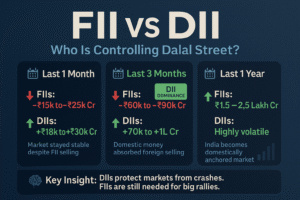
Data reflects this clearly. Over recent months, FIIs have been net sellers worth tens of thousands of crores, especially during volatile global phases. Historically, when FIIs sell heavily, markets tend to correct sharply. But this time, something different is happening—and that difference is domestic money.
3️⃣ The Rise of DII Power: How Domestic Money Is Supporting Dalal Street
While FIIs are exiting, Domestic Institutional Investors have emerged as a powerful counterweight. Monthly SIP inflows into mutual funds have crossed record levels, consistently exceeding ₹20,000 crore in several recent months. This steady flow of household savings into equities has fundamentally changed the market structure.
Insurance companies, EPFO, and pension funds are now long-term buyers, deploying money with a multi-year horizon rather than chasing short-term returns. Retail participation has exploded over the past five years, driven by digital platforms, financial awareness, and a shift away from traditional assets like gold and fixed deposits.
This has led to a structural shift: India is no longer a purely FII-driven market. Instead, it is becoming a domestic liquidity-led market, where local capital provides stability even when foreign money turns cautious. This does not mean FIIs are irrelevant—but it does mean they are no longer the sole drivers of market destiny.
4️⃣ Data Snapshot: FII vs DII Flows — What the Numbers Reveal
1-Month Equity Flow Snapshot (Recent Trend)
| Investor Type | Net Flow (₹ Crore) | Market Impact |
|---|---|---|
| FIIs | –15,000 to –25,000 | Selling pressure on large caps |
| DIIs | +18,000 to +30,000 | Strong downside protection |
| Net Effect | Near neutral | Market stays range-bound |
Insight:
Despite aggressive FII selling, markets remained stable due to strong domestic institutional buying.
The numbers tell a fascinating story. Over the last one month, FIIs have been net sellers, while DIIs have consistently bought equities. Over the last three months, this trend has continued, with domestic flows often offsetting foreign outflows almost entirely. Looking at the one-year picture, despite periods of intense FII selling, indices have managed to stay near record highs.
📅 3-Month Equity Flow Snapshot (Medium-Term View)
| Investor Type | Net Flow (₹ Crore) | Market Impact |
|---|---|---|
| FIIs | –60,000 to –90,000 | Volatility & failed rallies |
| DIIs | +70,000 to +1,00,000 | Stability, selective buying |
| Net Effect | Mild positive | Stock-specific performance |
Insight:
DIIs have not only absorbed FII selling but, in some periods, exceeded it — preventing any major market breakdown.
There have been multiple sessions where markets closed in the green even on days when FIIs were heavy sellers, purely because domestic institutions stepped in. The correlation between index performance and DII activity has strengthened noticeably.
However, there is a key insight here: DIIs are excellent stabilisers but weaker accelerators. They can prevent crashes, but they often struggle to generate runaway bull rallies without FII participation. This explains why markets feel resilient yet directionless at the same time.
📅 1-Year Equity Flow Snapshot (Structural Shift)
| Investor Type | Net Flow (₹ Crore) | Market Impact |
|---|---|---|
| FIIs | Highly volatile (inflows + outflows) | Drives sharp rallies & corrections |
| DIIs | +1.5 to +2.5 lakh crore (approx.) | Structural market support |
| Net Effect | Positive bias | India becomes domestically driven |
Insight:
Over the long term, domestic capital has emerged as the backbone of Indian equity markets, reducing dependence on foreign money.
5️⃣ Sectoral Impact: Where FII Selling Hurts and DII Buying Helps
FII selling does not affect all sectors equally. Banking and financial stocks, which have high foreign ownership, feel the impact most sharply. Large private banks often come under pressure during FII exits, regardless of strong fundamentals.
IT and metal stocks, with significant global exposure, also react quickly to foreign flows and global cues. In contrast, FMCG and defence stocks, which are favourites of domestic institutions, often remain relatively stable during volatile phases.

Midcaps and smallcaps are the most vulnerable. These segments rely heavily on sentiment and liquidity. When both FIIs and DIIs turn cautious, corrections can be swift and deep. In the short term, flows often overpower fundamentals, which is why investors must track ownership patterns, not just earnings.
6️⃣ Nifty & Sensex Outlook: Can Markets Sustain Without FII Support?
From a technical and sentiment perspective, markets are currently stuck in a range-bound phase. Support and resistance levels are being defined less by earnings and more by flows. Rallies often fail to sustain because foreign buying is absent, while sharp falls are cushioned by domestic inflows.
Volatility tends to spike during phases of aggressive FII selling, but it remains lower than in previous cycles thanks to consistent domestic participation. Many experts believe markets may consolidate rather than crash, marking time until global conditions improve.
Another defining feature of this phase is stock-specific action. Instead of broad-based rallies, investors are seeing selective strength in sectors backed by earnings visibility and domestic ownership.
7️⃣ What History Tells Us: Past FII-DII Battles and Market Outcomes
History offers valuable lessons. During the 2013 taper tantrum, FII selling caused sharp corrections because domestic participation was limited. In 2020, FIIs sold aggressively during the COVID crash—but returned strongly once global liquidity surged. In 2022, rate hikes led to FII exits, yet markets avoided deep crashes due to domestic support.
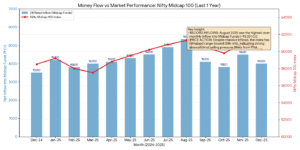
The key takeaway is consistent: FIIs always return, but the timing is unpredictable. DIIs, meanwhile, act as shock absorbers. They reduce downside risk but cannot single-handedly create euphoric bull markets. Understanding this balance helps investors set realistic expectations.
8️⃣ Who Will Control Dalal Street Next? Three Possible Scenarios
Three broad scenarios emerge from the current setup.
First, FIIs return while DIIs remain active—this could trigger a powerful bull phase with broad participation.
Second, FIIs stay cautious while DIIs dominate—leading to a sideways, range-bound market with selective opportunities.
Third, if both FIIs and DIIs pull back due to global or domestic shocks, a sharp correction becomes possible.
Triggers include changes in US interest rates, global risk sentiment, earnings momentum, and domestic macro stability. Investors should prepare for all three possibilities rather than betting on just one outcome.
Visit official website of NSE click here
9️⃣ What Should Retail Investors Do Now? Expert Strategy
For retail investors, this is a phase that rewards discipline over excitement. SIPs remain the most sensible approach, as they average out volatility. Lump-sum investments should be staggered rather than rushed.
Sector rotation matters—focus on quality large caps and fundamentally strong companies rather than speculative bets. Avoid excessive leverage and resist the temptation to chase momentum in overheated stocks. Traders should reduce position sizes and respect stop-losses strictly.
Above all, avoid emotional decision-making. Markets driven by institutional flows can change direction quickly.
Today’s Indian stock market outlook based on brokerage reports. Nifty prediction, expert strategy, risks and top stocks to watch. click here
🔟 Conclusion: A Market No Longer Controlled by One Player
Dalal Street is undergoing a quiet but profound transition. FIIs still matter—but they no longer control everything. Domestic money has altered the market’s DNA, making it more resilient but also more complex.
The era of one-sided dominance is over. The future belongs to balance, patience, and strategy. In this new market structure, those who understand flows—and respect risk—will always stay ahead of those who chase predictions.
❓ Frequently Asked Questions (FAQ): FII Selling vs DII Buying
1. What does FII selling mean for the Indian stock market?
FII selling refers to foreign institutional investors reducing their equity exposure in Indian markets. When FIIs sell heavily, it usually creates pressure on large-cap stocks and indices like the Nifty and Sensex. However, the impact today is softer than in the past because strong domestic institutional buying is absorbing much of this selling.
2. Why are FIIs selling Indian stocks right now?
FIIs are selling mainly due to global factors such as rising US bond yields, a strong dollar, tighter global liquidity, and valuation concerns in emerging markets. This selling is not necessarily a negative view on India’s long-term growth but part of global portfolio rebalancing.
3. Who are DIIs and why are they buying stocks?
DIIs include mutual funds, insurance companies, pension funds, and domestic financial institutions. They are buying stocks due to strong SIP inflows, long-term investment mandates, and confidence in India’s economic growth. Their participation has increased significantly over the last few years.
4. Can DII buying fully replace FII money in Indian markets?
DIIs can stabilise markets and reduce sharp corrections, but they cannot fully replace FIIs in driving strong bull rallies. Historically, major market uptrends require foreign capital. However, DIIs have reduced India’s dependence on FIIs for market survival.
5. Why are Indian markets holding up despite heavy FII selling?
Indian markets are holding up because domestic institutional investors are consistently buying equities. Record SIP inflows and long-term domestic capital have changed the market structure, making it more resilient during global volatility.
6. Which sectors are most affected by FII selling and DII buying?
Banking, financial services, IT, and metals are more sensitive to FII flows due to higher foreign ownership. FMCG, defence, and select infrastructure stocks tend to be supported by DII buying. Midcap and smallcap stocks are the most vulnerable when liquidity tightens.
7. How does FII vs DII activity affect midcap and smallcap stocks?
Midcap and smallcap stocks react more sharply to institutional flows. While DIIs can support these segments, sharp corrections can occur if both FIIs and DIIs turn cautious. Investors should be more selective and avoid overleveraged bets in these segments.
8. Is this a good time for retail investors to invest in stocks?
For long-term retail investors, continuing SIPs and focusing on quality stocks remains a sensible strategy. Lump-sum investments should be staggered. Short-term traders should be cautious and use strict risk management due to ongoing volatility.
9. What should traders do in a market driven by institutional flows?
Traders should reduce position sizes, avoid chasing momentum, and closely track FII–DII data. Markets driven by flows can change direction quickly, making discipline and stop-losses essential.
10. Will FIIs return to Indian markets?
Yes, FIIs have always returned to Indian markets in past cycles once global conditions stabilised. The timing is uncertain, but India’s strong economic fundamentals make it an attractive long-term destination for foreign capital.
🔍 People Also Ask (PAA): FII vs DII and the Indian Stock Market
Why are FIIs selling Indian stocks despite strong economic growth?
FIIs are selling Indian stocks mainly due to global factors such as rising US bond yields, a stronger dollar, and tighter global liquidity. Their selling does not reflect a negative view on India’s long-term growth but rather portfolio rebalancing across global markets.
How are DIIs able to absorb heavy FII selling?
DIIs are supported by record SIP inflows, insurance premiums, and long-term pension money. This steady domestic capital allows them to buy stocks consistently, even when foreign investors are selling, thereby stabilising the market.
Does FII selling always lead to a market crash?
No. In the past, heavy FII selling often caused sharp market corrections. However, today the presence of strong domestic institutional investors has reduced the risk of crashes. Markets may consolidate or turn volatile, but deep crashes are less frequent.
Can Indian stock markets grow without foreign investors?
Indian markets can remain stable without FIIs, but sustained bull rallies usually need foreign participation. Domestic money provides a strong foundation, while foreign capital adds momentum during growth phases.
Which stocks are most impacted by FII selling?
Large-cap banking stocks, IT companies, and metal stocks are most impacted because FIIs have higher ownership in these sectors. Midcap and smallcap stocks can also see sharp movements when liquidity tightens.
Why do markets rise on days when FIIs are net sellers?
Markets can rise on FII selling days because DIIs may be buying aggressively. When domestic inflows exceed foreign outflows, indices can close higher despite negative global cues.
Is DII buying a permanent structural change in Indian markets?
Yes, to a large extent. The rise of SIPs, mutual fund participation, and long-term domestic capital has structurally changed Indian markets, making them less dependent on foreign investors than before.
How should retail investors track FII and DII activity?
Retail investors should track daily and monthly FII–DII flow data released by exchanges and brokerages. This helps in understanding market sentiment and avoiding emotional decisions during volatile phases.
What does FII vs DII data indicate for midcap and smallcap stocks?
The data suggests that midcaps and smallcaps are more sensitive to liquidity changes. While DIIs provide support, sudden corrections are possible if both institutional groups turn cautious.
When are FIIs likely to return to Indian markets?
FIIs usually return when global interest rates stabilise, the dollar weakens, and risk appetite improves. Historically, India has been among the first emerging markets to attract foreign capital during global recoveries.
Is this a good time to invest or wait?
Experts suggest continuing SIPs and focusing on quality stocks rather than timing the market. Waiting for perfect clarity often leads to missed opportunities, especially in structurally strong markets like India.




One thought on “FII Selling vs DII Buying: The Tug of War Defining Today’s Indian Stock Market”