Why Donald Trump Is Targeting Indian Rice: Dumping, Tariffs, and the $12 Billion Story
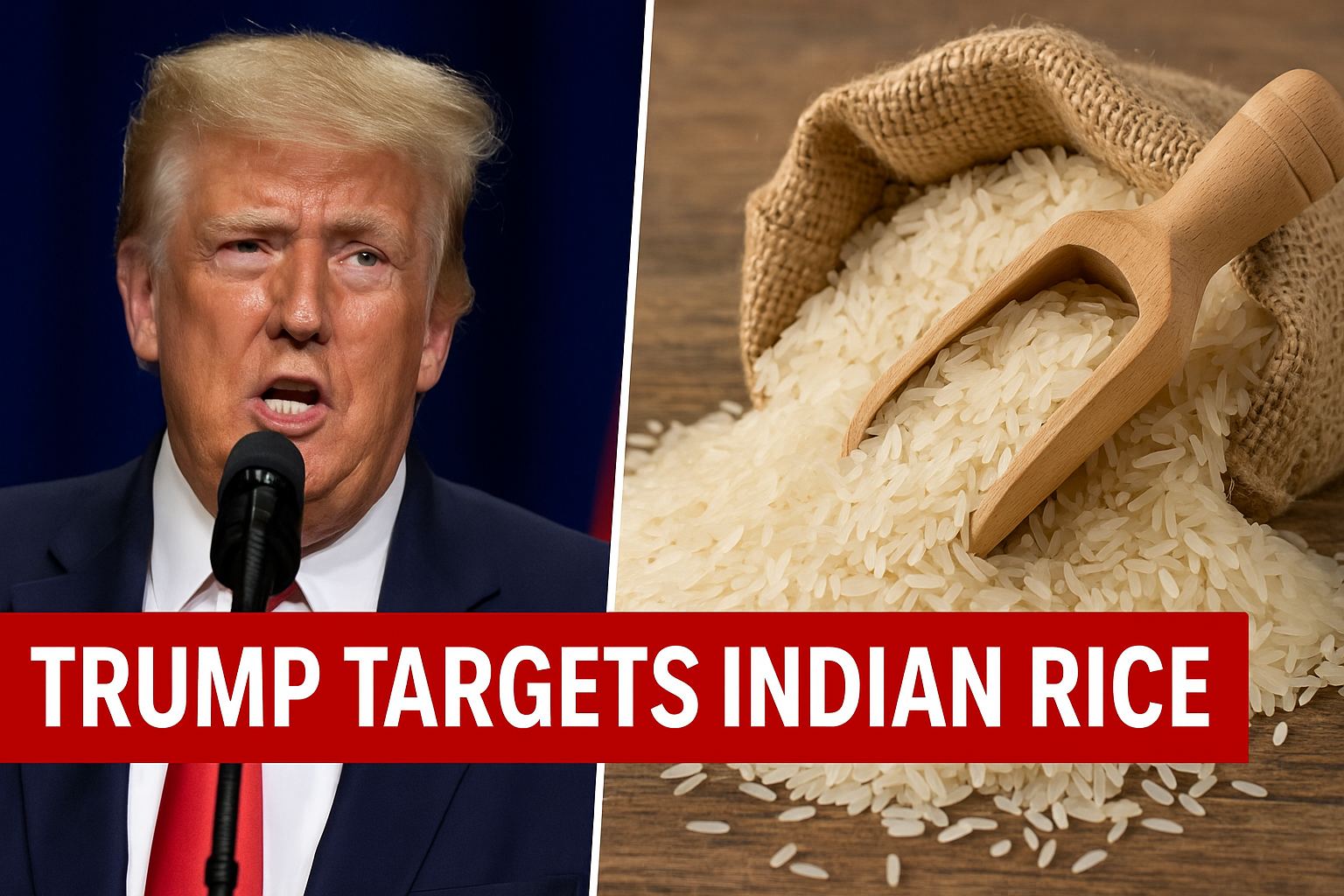
In the past few days, former US President Donald Trump has made several surprising statements about India. Earlier, he spoke about buying oil from India, strengthening friendship with Russia, and improving trade ties. But suddenly, he shifted the conversation to rice. Trump claimed that India is sending cheap rice to the United States, and Americans are being forced to consume it. He even suggested that India is practicing “dumping” and that he may impose tariffs on Indian rice. This statement created a wave of reactions, not just in the US but across the world. To understand this controversy, we must explore what dumping really means, why American farmers are upset, and how Trump used India’s name to justify a massive 12-billion-dollar relief package for US farmers.
Trump’s Statement on Indian Rice
During a meeting with American farmers, Trump accused India of dumping rice in the US market. According to him, India sends rice at very cheap prices, making it difficult for American farmers to get the right value for their produce. He argued that the US might need to impose tariffs on Indian rice imports. But in the same event, Trump also announced a huge relief amount of 12 billion dollars for US farmers. This raised questions about whether the aim was truly to protect farmers or to create a political narrative using India’s name. Trump knows that taking India’s name brings immediate media attention, and his remarks about rice quickly became headline news.
What Is Dumping? A Simple Explanation
Dumping is a term used in international trade when a country sells a product in another country at a price lower than its actual cost of production or lower than the price it charges in its own domestic market. When dumping happens, it becomes difficult for local producers in the importing country to compete because imported products are available at much cheaper rates. Countries usually respond by increasing import duties or imposing anti-dumping tariffs. Trump is now claiming that Indian rice is coming into the US market at very low prices, making it harder for American rice farmers to survive. But to understand whether this claim is true, we need to look at the global rice market.
Is India Really Dumping Rice in America?
India is the world’s largest producer and exporter of rice. It exports more than 30% of the world’s total rice, making it a global leader. But exporting large quantities does not mean dumping. The United States itself exports rice to many countries, but when it comes to certain varieties—especially Basmati—it does not produce the same quality that India does. Basmati rice is known for its aroma and long grains, and it is highly popular among Asian communities living in the US. Therefore, the claim that Americans are being “forced” to consume Indian rice is not true. People buy Indian rice because they prefer its quality and taste.
India’s Rice Advantage: Why the World Chooses It
India dominates the rice market due to several reasons. First, India’s climate is highly suitable for paddy cultivation. Regions like Punjab, Haryana, Uttar Pradesh, West Bengal, and Bihar produce large quantities of rice each year. Second, the Indian government offers strong support to farmers through subsidies and Minimum Support Price (MSP). MSP acts as a safety net, ensuring farmers receive a minimum guaranteed price for their produce. With this assurance, farmers feel comfortable investing in rice production.
The third factor is the global demand for Indian rice. Indian Basmati and non-Basmati varieties are exported to more than 150 countries. From Middle Eastern nations like Saudi Arabia and Iraq to African countries like Benin and Guinea, Indian rice is loved for its taste, aroma, and affordability.
Top Countries Importing Rice From India
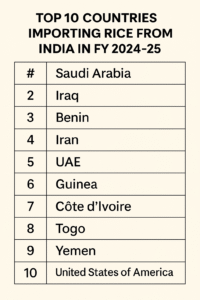
India exports rice to countries across the world. The top importers include Saudi Arabia, Iraq, Iran, Benin, UAE, Guinea, Togo, Côte d’Ivoire, Yemen, and the United States. This clearly shows that the US is an important market but not the biggest. Most Indian rice actually goes to West Asia and Africa. Even if the US imposes higher tariffs, India has many other strong markets to rely on.
Top Rice Exporting Countries in the World
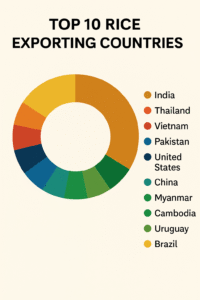
Globally, India leads the list of rice exporters. Other major rice-exporting countries include Thailand, Pakistan, Vietnam, the United States, Cambodia, Myanmar, Italy, China, and Brazil. The interesting part is that while the US exports rice to other nations, it still imports premium varieties from India and Pakistan. This proves that the US needs Indian rice because its own production cannot match the demand for aromatic and long-grain rice like Basmati.
Why American Farmers Are Upset

Rice farmers in the US are mainly located in southern states. In recent years, they have faced rising costs in terms of fuel, seeds, fertilisers, labour, and irrigation. At the same time, global rice prices have remained stable or sometimes lower due to competition from Asian countries. This has led American farmers to believe that they are not receiving the right price for their rice. They argue that India provides heavy subsidies to its farmers, and this makes Indian rice cheaper in the global market. US farmers have been urging the government to impose tariffs on rice imports to protect their interests. Trump’s statement came after farmer groups complained that cheap rice from India, Vietnam, Thailand, and China was hurting their incomes.
India’s Subsidies and Why They Attract Complaints
The Indian government offers significant support to its farmers through MSP, subsidised electricity, low-cost fertilisers, crop insurance, and irrigation facilities. Many countries, including the US, argue that such subsidies distort global trade by making Indian rice cheaper. However, India counters this by saying that most Indian farmers are small and marginal and need government support to survive. India also argues that developed nations like the USA and European Union offer subsidies worth billions to their farmers, so it is unfair to target India alone.
Why Trump Is Doing This: Raghuram Rajan’s View

Former RBI Governor Raghuram Rajan believes that Trump’s trade decisions are often political rather than economic. He says Trump frequently uses India’s name to gain attention and project himself as a strong leader in front of his domestic audience. Rajan also believes that Trump enjoys portraying himself as someone who can punish foreign countries to protect American interests. According to Rajan, the tariff threats against India are more of a political move meant to influence American farmers and voters rather than an economic necessity.
Official website of Secretary of Agriculture visit here
Will Tariffs on Indian Rice Hurt India?
The United States is just one of the many countries to which India exports rice. Even if the US increases tariffs, India will still have strong demand from other markets in the Middle East, Africa, and Asia. Indian Basmati has a global fan base. Restaurants, hotels, and households across the world prefer Indian rice for its flavour and aroma. If tariffs rise, the biggest impact will be on American importers, Indian grocery stores in the US, and consumers who prefer premium rice. Prices in the US may rise, and consumers may end up paying more. India, however, has a diversified market and will not face a major long-term loss.
Conclusion: The Real Story Behind the Rice Controversy
Trump’s criticism of India over rice looks more like a political strategy than an economic issue. India is the world’s largest rice exporter, producing high-quality rice that is loved globally. American farmers are under pressure due to high costs and strong global competition, and Trump used India’s name to justify a massive relief package worth 12 billion dollars. India has a strong rice export network and will continue to dominate the global market, regardless of political statements. The controversy might continue, but Indian rice will remain a favourite worldwide—both in quality and quantity.