

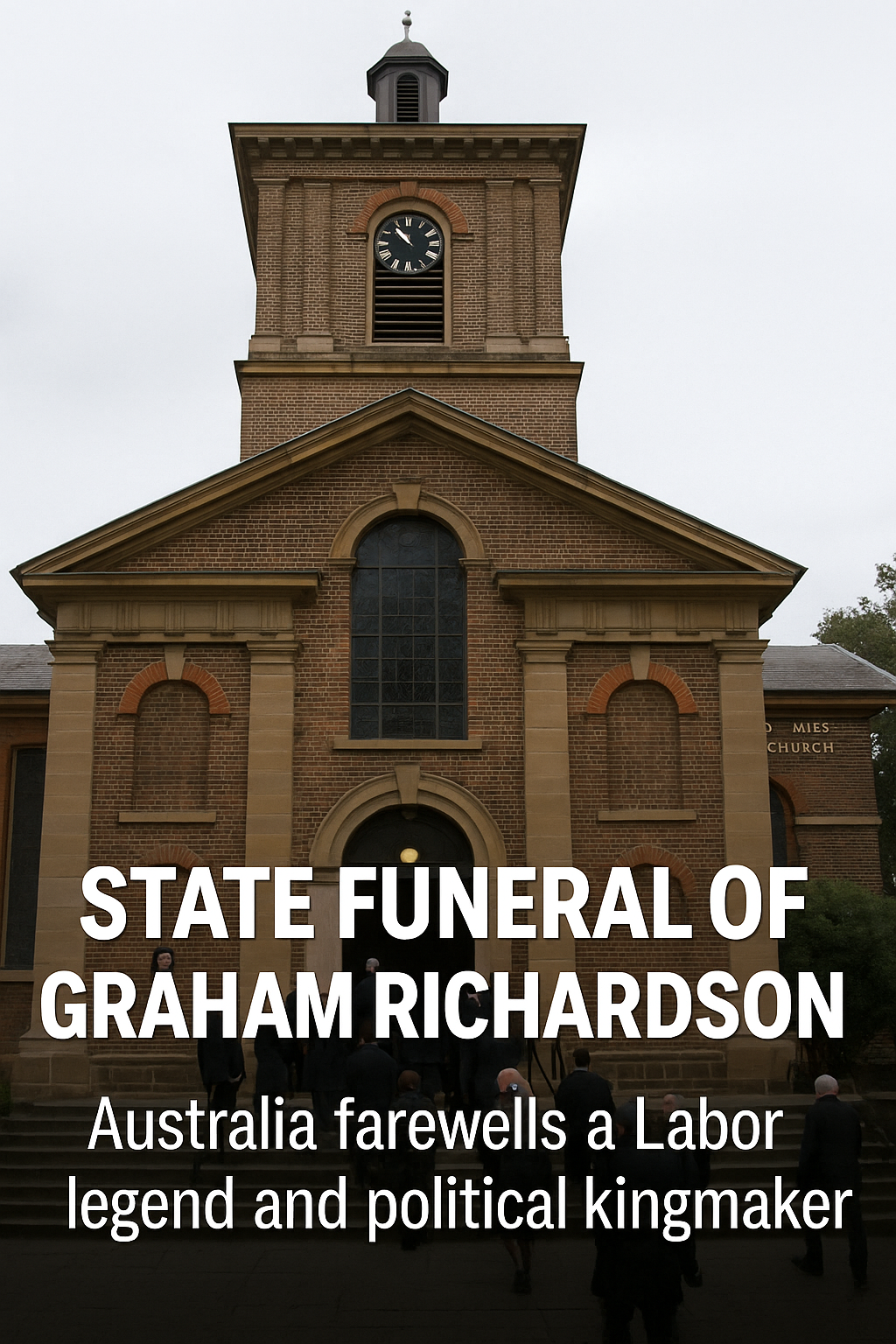
State Funeral of Graham Richardson: Australia Farewells a Political Kingmaker
Australia bid farewell to one of its most influential political figures on 9 December 2025, when Graham “Richo” Richardson was honoured with a state funeral at St James’ Church in Sydney. Richardson, who passed away on 8 November at the age of 76, was a former Labor senator, cabinet minister, factional strategist and later a prominent media commentator. His funeral was a moment of national reflection, drawing leaders from across the political spectrum to celebrate the life of a man who shaped the modern Labor Party and left a unique mark on Australian politics. The ceremony blended emotion, history and political significance, giving Australians one final chance to remember a figure who was as controversial as he was influential.
A Powerful Farewell at St James’ Church
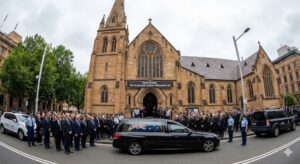
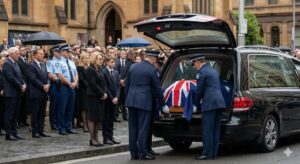
The state funeral was originally planned for St Mary’s Cathedral but was moved to St James’ Church after scheduling issues, creating a more intimate yet dignified atmosphere. The church filled early as family, friends, colleagues, journalists and political heavyweights took their places. Richardson’s coffin was displayed according to the family’s wishes, reflecting both his national contribution and his deep love for the St George Dragons, the rugby league team he passionately supported throughout his life. The overall setting conveyed a sense of warmth, respect and nostalgia, perfectly matching the personality of the man being farewelled.
Leaders Across the Political Divide Pay Respect
The funeral drew some of the country’s most recognisable political faces. Prime Minister Anthony Albanese delivered the main eulogy, offering both political insight and personal reflection. He described Richardson as a man who could build bridges where none existed, a strategist who mastered the art of forming “unlikely friendships.” Former prime minister Tony Abbott attended the service as well, a symbolic gesture that demonstrated the deep respect Richardson commanded even from his ideological opponents. Other attendees included Deputy Prime Minister Richard Marles, former Nationals leader Barnaby Joyce, prominent media commentator Alan Jones, neurosurgeon Charlie Teo and many former ministers, staffers, union leaders and business figures. Their presence showed how vast and varied Richardson’s network had been, crossing political, media and business worlds.
Anthony Albanese’s Tribute: Remembering “The Master of Unlikely Friendships
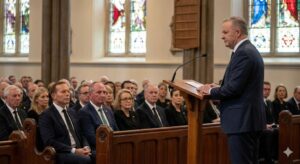
Prime Minister Anthony Albanese’s eulogy was a moving tribute that captured the essence of Richardson’s political style and personality. Albanese recalled a man who fought political battles fiercely but always retained an ability to put grudges aside when the moment called for it. He noted Richardson’s “rogue’s charm” and his unusual capacity to form unexpected alliances, qualities that made him both an effective negotiator and an unforgettable figure in Canberra. The prime minister also highlighted Richardson’s accomplishments as a minister, especially his environmental leadership. He was instrumental in protecting the Daintree Rainforest and strengthening protections for Kakadu National Park, and he played a key role in stopping the controversial Wesley Vale pulp mill. Albanese acknowledged Richardson’s controversies, but emphasised that political legacies are complex and must be seen with nuance — something Richardson himself understood better than most.
Barnaby Joyce’s Memorable Tribute: Admiration from an Opponent
One of the most talked-about moments of the funeral came from former Nationals leader Barnaby Joyce, who offered a blunt yet affectionate remembrance of Richardson. Joyce described him as “absolutely and utterly ruthless” in politics, but also “a great guy” to know personally. His most memorable line — “He had a can of petrol, and if you were on the wrong side of him, you got burned badly” — drew laughter in the church and summed up Richardson’s reputation as both a genial companion and a fierce factional warrior. It was a rare but genuine moment where political truth and humour blended perfectly.
Why Graham Richardson Was Called the “Minister for Kneecaps”
One of the most common questions about Richardson’s political legacy is why he was often referred to as the “Minister for Kneecaps.” The nickname never had an official basis; rather, it came from his reputation as a ruthless yet effective Labor Right factional enforcer. During the Hawke and Keating era, Richardson played a critical behind-the-scenes role in leadership contests, union negotiations and internal party strategy. He was known for his ability to secure votes, strike deals and pressure opponents, often ensuring that the Labor Party held together during turbulent political times. His work helped keep Bob Hawke in power and later helped Paul Keating secure the prime ministership. His colleagues half-jokingly said that if you crossed him politically, your career might suffer — hence the dramatic nickname.
official website of Sydney Tourism click here
A Real Policy Legacy: Richardson’s Achievements Beyond Factional Politics
While Richardson was famous for his factional power, he also contributed significantly to Australia’s policy landscape. As Environment Minister, he oversaw major conservation achievements, including the heritage protection of the Daintree Rainforest and Kakadu National Park. His decision to oppose the Wesley Vale pulp mill earned him appreciation from environmental groups and placed him among the few Labor factional leaders who also pursued progressive environmental reforms. Beyond the environment, he served as Minister for Health, Social Security, Transport and Communications, leaving a wide-ranging policy footprint. After leaving Parliament, he reinvented himself as a popular political commentator on Sky News, hosting the program “Richo” and later appearing regularly on election panels and political analysis shows. His direct, unscripted style made him one of Australia’s most recognisable political commentators.
A Complex Legacy: Controversies and Criticisms
Like many powerful political figures, Richardson’s career was not without controversy. He faced allegations regarding business connections and was accused at times of misusing his position, which contributed to his withdrawal from cabinet and eventually from the Senate. Some commentators questioned whether he deserved a state funeral given these controversies. However, supporters argued that Richardson’s contributions to Australia — particularly in environmental protection, electoral strategy and political stability — merited national recognition. The funeral itself reflected this belief, offering a portrait of a man whose life, like many in politics, contained both high achievements and serious flaws.
Official website of PM VISIT NOW
Personal Life: Battles With Illness and Strength in Family
Richardson’s later years were marked by significant health struggles. He battled chondrosarcoma, a rare and aggressive bone cancer, and underwent multiple surgeries. At various points he appeared on television in a wheelchair, determined to continue working despite immense physical challenges. His family — his wife Amanda and son D’Arcy — were central to his final years, and according to friends, he fought hardest to stay alive long enough to see D’Arcy complete his schooling. Richardson also had two older children from his first marriage, and although those relationships had ups and downs, he often spoke with pride about their achievements. His family’s emotional tribute during the service highlighted his deep love for them, contrasting the toughness he displayed in public life with the vulnerability he showed at home.
Richo’s Influence on Modern Australian Politics
Richardson’s funeral reminded Australia of his enormous impact on the nation’s political landscape. He was a key strategist behind Labor’s victories in the 1980s and early 1990s, and he helped shape the future of the party by mentoring younger politicians, many of whom rose to senior leadership roles. His political philosophy, summed up in the title of his autobiography “Whatever It Takes,” still resonates within the party today. It describes not only his approach to winning elections, but also his broader view of politics as a contest where outcomes matter more than appearances.
Follow me on facebook click here
A Final Goodbye to a Larger-Than-Life Character
In the end, the state funeral of Graham Richardson was more than a farewell. It was a reminder of a period in Australian political history dominated by big personalities, backroom battles, economic reform and decisive leadership. Richardson was a central figure in that era. Whether viewed as a strategist, a kingmaker, an environmental defender, a ruthless factional leader or a devoted family man, he left a multifaceted legacy that continues to influence Australian politics. As mourners stepped out of St James’ Church into the Sydney heat, it was clear that Australia had said goodbye to a man impossible to forget — a political player who shaped his era and left a story that will be retold for decades.

One thought on “State Funeral of Graham Richardson: Australia Farewells a Labor Powerbroker and Political Kingmaker”