The National Herald case has once again come into national focus after the Delhi Police Economic Offences Wing (EOW) registered a new FIR involving transactions between Associated Journals Limited (AJL) and Young Indian Pvt Ltd. The latest development has revived an already long-running legal and political debate that dates back to 2012. As fresh allegations surface and political reactions intensify, the case has become one of the most watched legal matters in India.
This article presents a simple, unbiased, and fact-based explanation of the latest updates—what the FIR says, what the allegations are, how political leaders have reacted, and why the case remains significant.
What Is the National Herald Case?
The National Herald newspaper was established by freedom movement leaders under the company Associated Journals Limited (AJL). Over the decades, AJL acquired properties in several Indian cities. In 2012, questions were raised about how the company was financially revived through loans and how the ownership structure changed after the creation of Young Indian Pvt Ltd.
The matter formally entered the legal arena when a private complaint was filed in 2012. Investigating agencies later began their own enquiries, examining:
AJL’s financial structure
The loan extended by a political party
The shareholding pattern of Young Indian
The valuation of AJL’s assets
Since then, the case has moved through multiple courts and investigative bodies, including the Enforcement Directorate (ED) and the Income Tax Department.
Latest Development: New FIR Filed by Delhi Police EOW
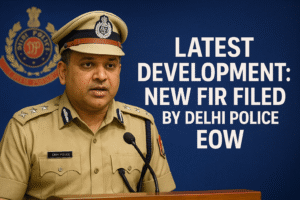
A major update came recently when the Delhi Police EOW registered a new FIR, adding fresh momentum to the case. According to the FIR’s contents as reported by sources, it looks into:
Allegations of criminal conspiracy
The process by which Young Indian acquired rights related to AJL
Whether any financial irregularities occurred during the transactions
Whether public or party funds were used in an inappropriate manner
With the FIR filed, investigators can now re-examine documents, statements, and financial records connected to both AJL and Young Indian.
This new FIR comes in addition to earlier proceedings by the Enforcement Directorate, which has been looking into the matter from the money-laundering angle.
Key Individuals and Entities Named
Reports indicate that the FIR mentions:
Young Indian Pvt Ltd
Senior office-bearers associated with the company
Individuals previously connected with AJL
Publicly available information has noted that past complaints and investigations have focused on board members and office-holders involved in decisions related to the transfer of loan rights and asset management.
It is important to note that all parties named maintain their innocence and have consistently stated that all transactions were lawful and transparent.
What Are the Core Allegations?
The case broadly revolves around how AJL’s debts and assets were managed, particularly when Young Indian acquired rights related to the loan.
The key points of the allegation include:
1. Acquisition Cost
Young Indian is said to have paid an amount of ₹50 lakh to acquire the rights connected to the loan extended to AJL.
2. Value of AJL’s Assets
Public estimates over time have stated that AJL’s real estate holdings across cities may be valued in the range of several thousand crores.
These properties were originally intended for journalistic and public-interest work.
3. Structure of the Transaction
The main concern highlighted by complainants is whether the acquisition gave Young Indian substantial indirect control over AJL’s assets.
Investigating agencies are now examining whether these steps were:
Financially fair
Structurally transparent
Compliant with applicable laws
No court has given a final verdict yet, and the matter remains under judicial review.
ED’s Role and Earlier Investigations
The Enforcement Directorate has previously examined whether any part of the transactions could amount to money laundering under the Prevention of Money Laundering Act (PMLA).
As part of its investigation, the ED:
Filed an ECIR (similar to an FIR)
Questioned key individuals
Examined financial records
Attached certain properties linked with the matter, pending adjudication
These attachments are currently under challenge in courts and have not attained finality.
Political Reactions: Contrasting Statements
The National Herald case has triggered strong reactions across the political landscape. While agencies continue their work, leaders from different parties have issued statements reflecting their positions.
BJP’s Stand
Leaders from the Bharatiya Janata Party (BJP) have stated that the matter deserves full investigation. They argue that:
Assets intended for public use should be transparently managed
Any doubts raised about financial transactions must be examined
Accountability strengthens public trust
Some BJP spokespersons have framed the issue as an important test of financial propriety in political organisations.
Congress’s Response
The Congress party, on the other hand, has strongly rejected the allegations, calling them:
“Baseless”
“Politically motivated”
An example of “targeting of the opposition”
Congress leaders say:
The transactions were fully legal
Young Indian is a non-profit entity
No personal gain occurred
No money trail indicating wrongdoing has been found
Congress also refers to the issue as a case of unjustified harassment, asserting that the purpose of the investigation is political rather than legal.
Why the Case Matters
The National Herald case remains important for several reasons:
1. High-Profile Individuals and Organisations
The involvement of well-known public figures and established institutions has naturally drawn national attention.
2. Questions About Political Funding
The case raises broader conversations about how political parties:
Provide loans
Raise funds
Manage assets
These discussions are central to the ongoing debate on transparency in political financing in India.
3. Interpretation of Corporate and Financial Law
The case touches multiple areas of law:
Company law
Tax law
PMLA provisions
Property rights
Courts may eventually clarify how similar financial structures should be interpreted.
4. Long-Term Political Impact
As the matter progresses through courts and investigative processes, the findings may shape public perception and political narratives.
Current Status and What Happens Next
With the new FIR registered, the next steps may include:
Collection of additional documents
Examination of past records
Recording of statements
Fresh scrutiny of property valuations
Coordination between EOW and other investigative agencies
All individuals and entities named in the case remain presumed innocent unless proven otherwise.
Court decisions in the coming months will determine how the case moves forward.
Conclusion
The National Herald case continues to evolve, with the latest FIR adding a new dimension to an already complex legal matter. While one side views it as an essential inquiry into financial propriety, the other sees it as a politically driven action.
As of today:
No final verdict has been delivered
Investigations are ongoing
Courts will ultimately decide the matter based on evidence
For readers, the case is a reminder of how legal, political, historical, and financial themes can overlap in India’s public life. The coming months will likely bring more clarity as investigations proceed and judicial processes advance.