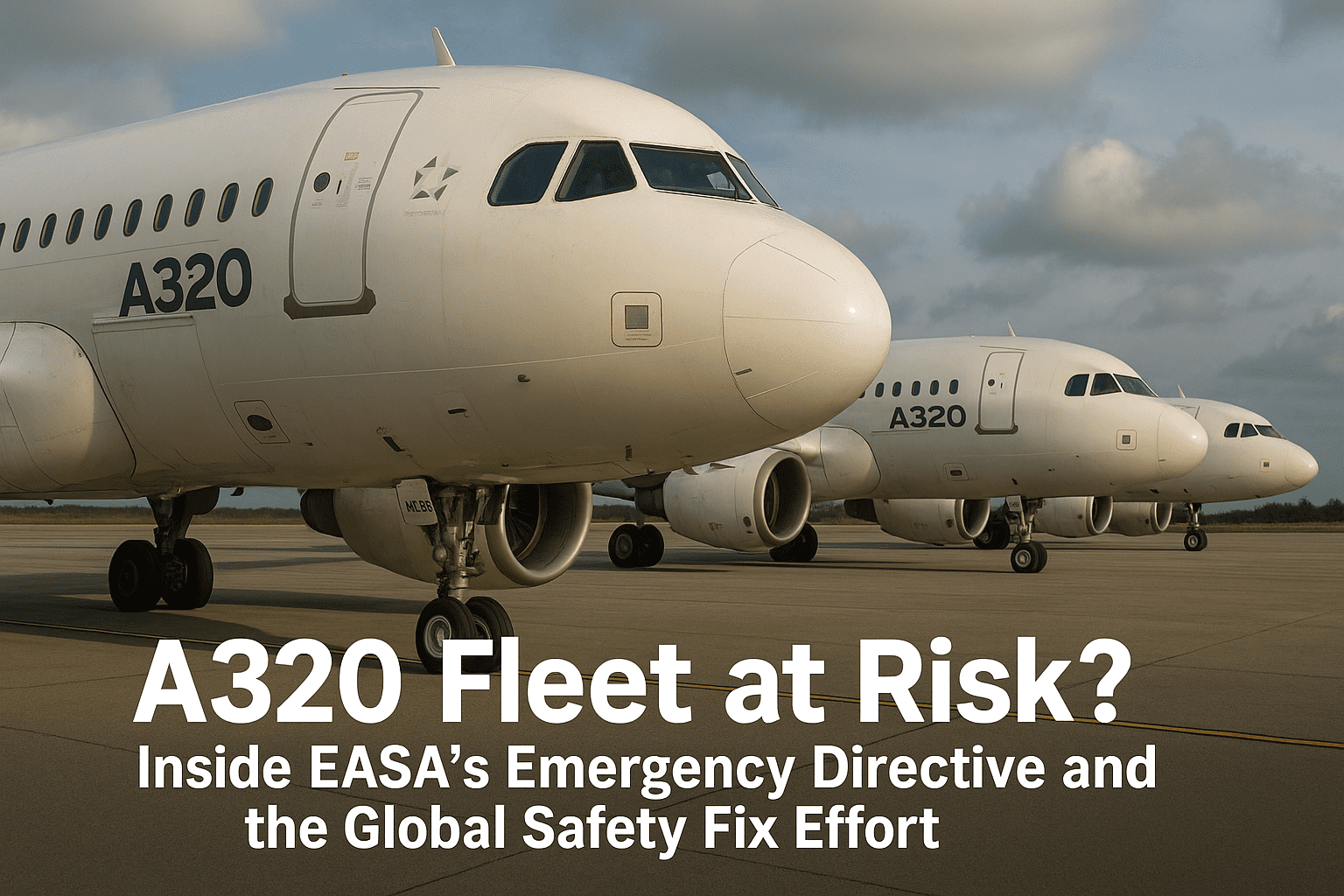
The global aviation sector is facing one of its most urgent technical challenges after the European Union Aviation Safety Agency (EASA) issued an emergency airworthiness directive for thousands of Airbus A320-family aircraft. With up to 6,000 A320 aircraft worldwide affected, this directive has triggered immediate action across airlines, regulators, and maintenance teams. The issue revolves around a critical glitch in the flight control system, identified after an aircraft experienced an unexpected pitch-down movement at cruising altitude.
This SEO-friendly, reader-focused article breaks down the incident, the technical cause, the international regulatory response, the impact on Indian airlines, and what passengers should know. Written in simple language and optimized for Google AdSense, it provides the clarity and depth that aviation readers expect.
What Triggered the Emergency: The In-Flight A320 Incident
The crisis began when an Airbus A320 flying at 35,000 feet experienced an uncommanded pitch-down event.
The aircraft’s nose dipped sharply without any pilot input, causing a brief loss of altitude. Although the pilots quickly regained control and diverted safely to Tampa, the incident raised an important red flag.
Thankfully, the flight landed safely, and no injuries were reported. However, such behaviour from a modern, fly-by-wire aircraft is extremely rare and required immediate investigation from aviation safety experts.
Root Cause: A Glitch in the ELAC Flight Control Computer
The investigation centered on one of the most important computer systems aboard the A320 — the Elevator Aileron Computer (ELAC).
What Does ELAC Do?
It translates pilot inputs into commands that move the plane’s wings and tail.
It controls the elevators (nose up/down) and ailerons (banking left/right).
Without ELAC, the aircraft’s flight control surfaces cannot respond accurately.
What Went Wrong?
Investigators discovered a software glitch in ELAC, which may have triggered the uncommanded movement. A surprising contributing factor was also identified:
Solar Radiation Exposure
Intense solar radiation at cruising altitude may have corrupted the ELAC software, causing a momentary malfunction.
High-energy particles from the sun, especially during increased solar activity, can affect sensitive aircraft electronics despite heavy protections.
This combination of software vulnerability + solar interference forced regulators to take the situation extremely seriously.
EASA Issues Emergency Warning
The EASA directive issued a clear and urgent message:
“This condition, if not corrected, could lead in the worst-case scenario to an uncommanded elevator movement.”
Why is this dangerous?
The elevator controls whether the aircraft climbs or descends.
An unexpected elevator movement at high speeds can stress the aircraft beyond its structural limits.
This could risk airframe damage, major loss of control, or severe instability in flight.
Because of this potential danger, immediate maintenance action or temporary grounding has been ordered globally.
Two Types of Fixes for the A320 Fleet
Airbus A320 aircraft are equipped with different generations of ELAC systems, so EASA has mandated two distinct fixes:
1. For Newer A320 Models — Software Update
Requires only an ELAC software patch.
Can be completed in a few hours, often done overnight.
Requires:
Connecting diagnostic tools
Updating the ELAC firmware
Running verification tests
This is the quickest fix and covers a large portion of the fleet.
2. For Older A320 Models — Hardware Replacement
Older ELAC units are more vulnerable and require physical component replacement.
Technicians remove the old units and install upgraded ELAC computers.
The process includes:
Mechanical replacement
Testing
Calibration
Possible test flights
The major challenge: About 1,000 older aircraft may take weeks to fix, depending on availability of parts and maintenance hangars.
Global Impact: Up to 6,000 Airbus A320 Aircraft Affected
The Airbus A320 family is one of the most widely used aircraft in the world. It serves short-haul and medium-haul routes for dozens of major airlines.
With 6,000 potentially affected aircraft, this directive touches nearly half of the global A320 fleet.
Airlines across:
Europe
Asia
Middle East
North America
Africa
…are working rapidly to implement the fix.
For a global aviation fleet of this size, the directive is one of the most significant safety orders in recent years.
India’s Response: DGCA Orders Immediate Compliance
India’s aviation regulator, the Directorate General of Civil Aviation (DGCA), has also acted quickly.
All Indian carriers operating A320-family aircraft — including A320ceo and A320neo variants — must complete the mandated fixes before flying the aircraft commercially.
Here is the latest status from Indian airlines:
IndiGo
200 aircraft affected
160 already upgraded
No major operational disruptions or cancellations
Maintenance teams working overnight
Air India
113 aircraft affected
42 aircraft upgraded
Minor schedule reshuffles to avoid inconvenience to passengers
Air India Express
25 aircraft affected
8 flights delayed due to maintenance requirements
Overall, Indian carriers are managing the issue efficiently, ensuring minimal flight disruption while maintaining full compliance with global safety standards.
What This Means for Passengers
Travelers may feel anxious reading news about aircraft glitches. But aviation experts emphasize that this situation shows the strength of global safety systems, not a failure.
1. The Safety System Worked Perfectly
An incident occurred.
It was analyzed immediately.
A global warning was issued.
A worldwide fix is now underway.
This is exactly how aviation safety is supposed to function.
2. Aircraft Are Being Repaired Before Risk Increases
The directive aims to prevent a very unlikely but potentially dangerous scenario. Airlines are acting now so that passengers remain safe at all times.
3. Aviation Still Remains the Safest Mode of Travel
Every global safety incident results in improved design, new software, and better systems — making flying even safer with time.
Even if a flight is delayed because an aircraft is undergoing the ELAC fix, remember:
Your safety is the priority. Delays are temporary; safety lasts forever.
Behind-the-Scenes Effort: Unseen but Crucial
Across the world, teams are working round-the-clock:
Airbus engineers verifying software.
Airline technicians performing updates at night.
Pilots doing extra checks during preflight rituals.
Regulators monitoring compliance.
This massive coordination ensures airlines can return their aircraft to service quickly and safely.
In India, maintenance teams at IndiGo, Air India, and Air India Express are operating at full capacity to complete the upgrades.
Key Takeaways — Simple, Clear, and Reassuring
A critical flaw was found in the ELAC flight control system of the Airbus A320.
Solar radiation may have contributed to a rare software malfunction.
EASA issued an urgent global directive affecting up to 6,000 aircraft.
Newer planes need quick software updates.
Older planes require hardware replacements that may take weeks.
Indian airlines have already upgraded a majority of their fleets.
Flight disruptions are minimal and safety measures are working flawlessly.
Conclusion
The emergency software fix for the Airbus A320 fleet highlights both the complexity and the strength of modern aviation. While an uncommanded pitch-down incident raised legitimate concerns, the rapid and coordinated response from global aviation authorities has ensured that safety risks are contained before they escalate.
Airlines worldwide — especially in India — are taking proactive steps with software patches, hardware upgrades, and strict compliance checks. For passengers, this is a reminder of how transparent, responsible, and well-regulated the aviation industry truly is.
As the fixes continue, the A320 fleet will emerge safer, more resilient, and better protected against rare system vulnerabilities. Passengers can continue flying with confidence, knowing that aviation safety systems function precisely as they should — with zero compromise.