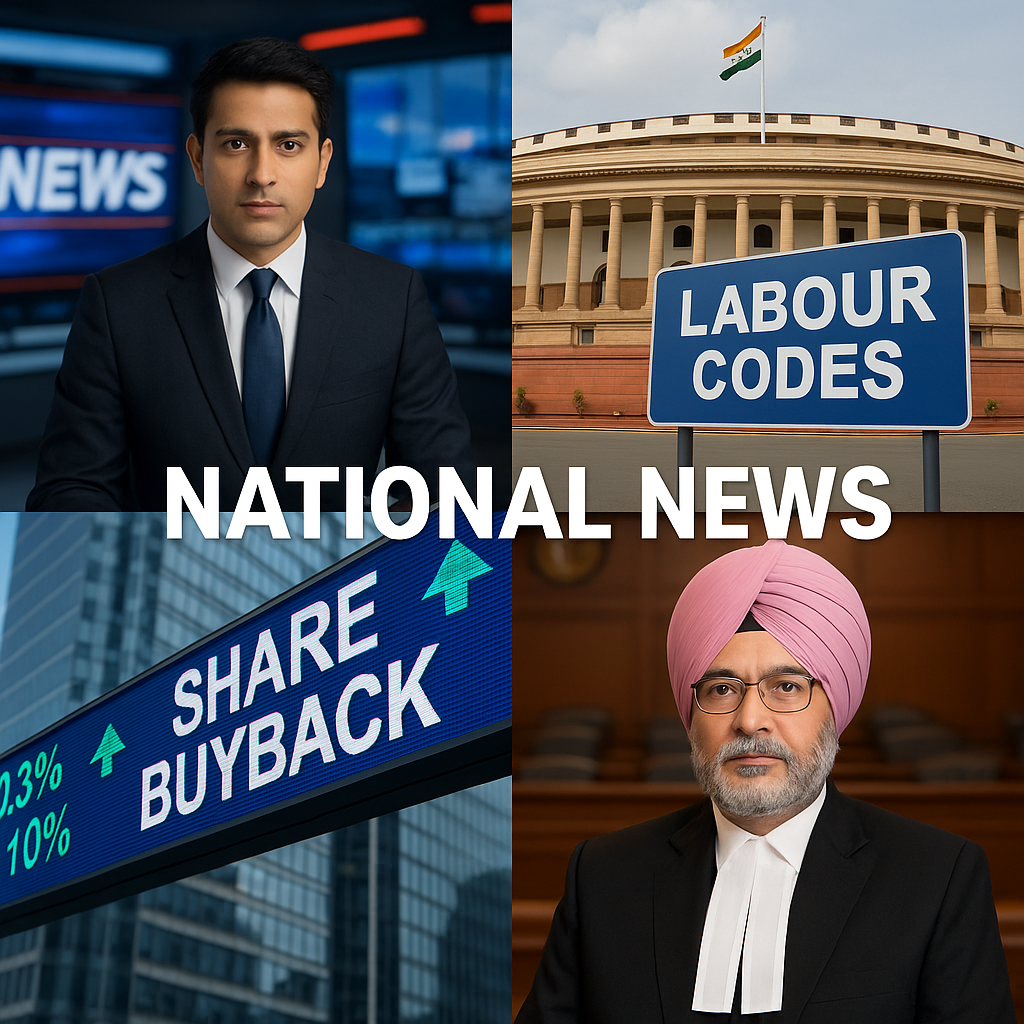
⭐ 1. Union Cabinet Approves Export Promotion Mission (EPM)
One of the biggest national developments in this time frame was the Government of India officially approving the Export Promotion Mission (EPM) — a flagship initiative aimed at boosting India’s export ecosystem. The mission focuses mainly on MSMEs, labour-intensive industries, and export diversification, ensuring better access to global markets. It includes measures such as simplified trade finance, compliance assistance, and international trade fair support.
For competitive exams, this topic is important because it relates directly to India’s foreign trade policy, MSME sector growth, balance of payments, and global competitiveness. Aspirants should remember the objective: making India a stronger export-driven economy by reducing bottlenecks and facilitating easy market access for small exporters.
⭐ 2. India Implements the Four Labour Codes from 21 November 2025
The major headline for polity and economy sections came on 21 November 2025, when India officially implemented the four consolidated Labour Codes, replacing 29 earlier laws. These codes include:
Code on Wages
Industrial Relations Code
Social Security Code
Occupational Safety, Health & Working Conditions Code
The Codes aim to simplify compliance for industries, boost ease of doing business, and ensure greater social security coverage for workers — including gig and platform workers.
Why is this important for exams?
Because it connects to labour reforms, concurrent list, worker rights, economic reforms, and governance challenges. Candidates should also be aware of the criticisms raised by trade unions, such as concerns about dilution of workers’ rights and lack of adequate consultation.
⭐ 3. National Response and Debates on Labour Reforms
Following the implementation of the Labour Codes, multiple trade unions across the country expressed opposition, raising concerns about contract labour rules, fixed-term employment provisions, and the ease of hiring and firing. Some unions warned of nationwide protests unless the government incorporated additional safeguards.
This issue is extremely relevant for UPSC Mains as it fits into discussions on “Reforms vs Rights,” labour welfare, industrial relations, and social justice.” Students must know both benefits (simplification, growth) and risks (worker insecurity, implementation challenges).
⭐ 4. Infosys Launches ₹18,000-Crore Share Buyback (20 November 2025)
A major corporate development was the announcement of Infosys’s ₹18,000-crore share buyback, one of the largest in India’s IT sector. The buyback took place using the tender-offer route and aimed at enhancing shareholder value.
For competitive exams, this topic fits into:
Capital markets
Corporate governance
Finance and investment mechanisms (buyback vs dividends)
Market trends impacting FIIs & DIIs
It is recommended that aspirants understand what a buyback is, why companies choose it, and its impact on EPS (earnings per share) and market behaviour.
⭐ 5. New Aviation and Connectivity Initiatives Launched
During this period, India saw a rise in new international aviation routes, expanding connectivity with the Middle East, Southeast Asia, and European destinations. Indian carriers announced new flights supporting tourism, business travel, and diaspora mobility.
For competitive exams, this news relates to:
Civil aviation policies
Open skies agreements
India’s growing global travel footprint
Economic benefits of tourism and trade connectivity
This also reflects India’s focus on strengthening its position as a global aviation hub.
⭐ 6. Justice Surya Kant Becomes the 53rd Chief Justice of India (24 November 2025)
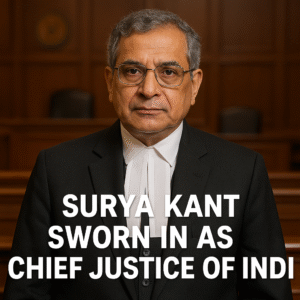
A significant constitutional development occurred when Justice Surya Kant was sworn in as the 53rd Chief Justice of India. His tenure is expected to focus on reducing court pendency, improving digital case management, and expediting Constitutional Bench matters.
For exam aspirants, this is crucial because it touches upon:
Appointment procedure of judges
Collegium system
Constitutional roles and powers of the CJI
Judicial reforms and access to justice
Such appointments often appear in UPSC prelims and are excellent material for GS-II mains answers.
⭐ 7. Government Initiates Fresh Export Incentives and Credit Schemes
In addition to the Export Promotion Mission, the government rolled out multiple export-linked incentives and improved the Credit Guarantee Scheme for Exporters, especially benefitting MSMEs. This aims to reduce dependency on costlier private financing and encourages small firms to enter global markets.
This development is linked to:
India’s foreign trade policy
MSME empowerment
Employment generation
Supply chain strengthening
Such schemes often appear in Banking & SSC exams under the economy section.
⭐ 8. Cultural and National Events Observed Nationwide
Several cultural, historical, and national events were observed during the November 15–24 period as part of India’s heritage and public awareness campaigns. Such events are frequently referenced in preliminary examinations, especially UPSC and State PCS.
Aspirants should revise:
The theme and purpose of the event
The ministry or organisation involved
Any government schemes launched alongside
These topics often help score marks in static + current affairs blended questions.
⭐ 9. State-Level Governance Decisions and Administrative Actions
Various state governments announced reforms related to education, policing, water management, and welfare schemes during this timeframe. While many of these are regional, they often become nationally relevant if they set precedents or align with central policies.
For competitive exam aspirants, these represent case studies for:
Federalism
Local governance
State capacity
Policy innovation
It’s useful to keep brief notes on noteworthy state policies because they strengthen answer writing in UPSC Mains.
📝 How to Use These National News Updates for Exam Preparation
✔ For UPSC Prelims:
Make one-line bullet notes with dates and ministries involved.
✔ For UPSC Mains:
Convert each news event into a paragraph with causes, impact, challenges, and reforms needed.
✔ For Banking, SSC, Railway Exams:
Focus on timelines, schemes, committees, Acts, economic indicators, and appointments.
✔ For Interviews:
Be ready to explain why a particular development matters for governance or economy.
⭐ Conclusion
Between 15 November and 24 November 2025, India witnessed several high-impact national events covering economic policy, labour reforms, judiciary, corporate developments, trade strategy, and governance. These updates are highly relevant for competitive exam aspirants and provide a strong foundation for both objective and descriptive questions.