Scope Outline
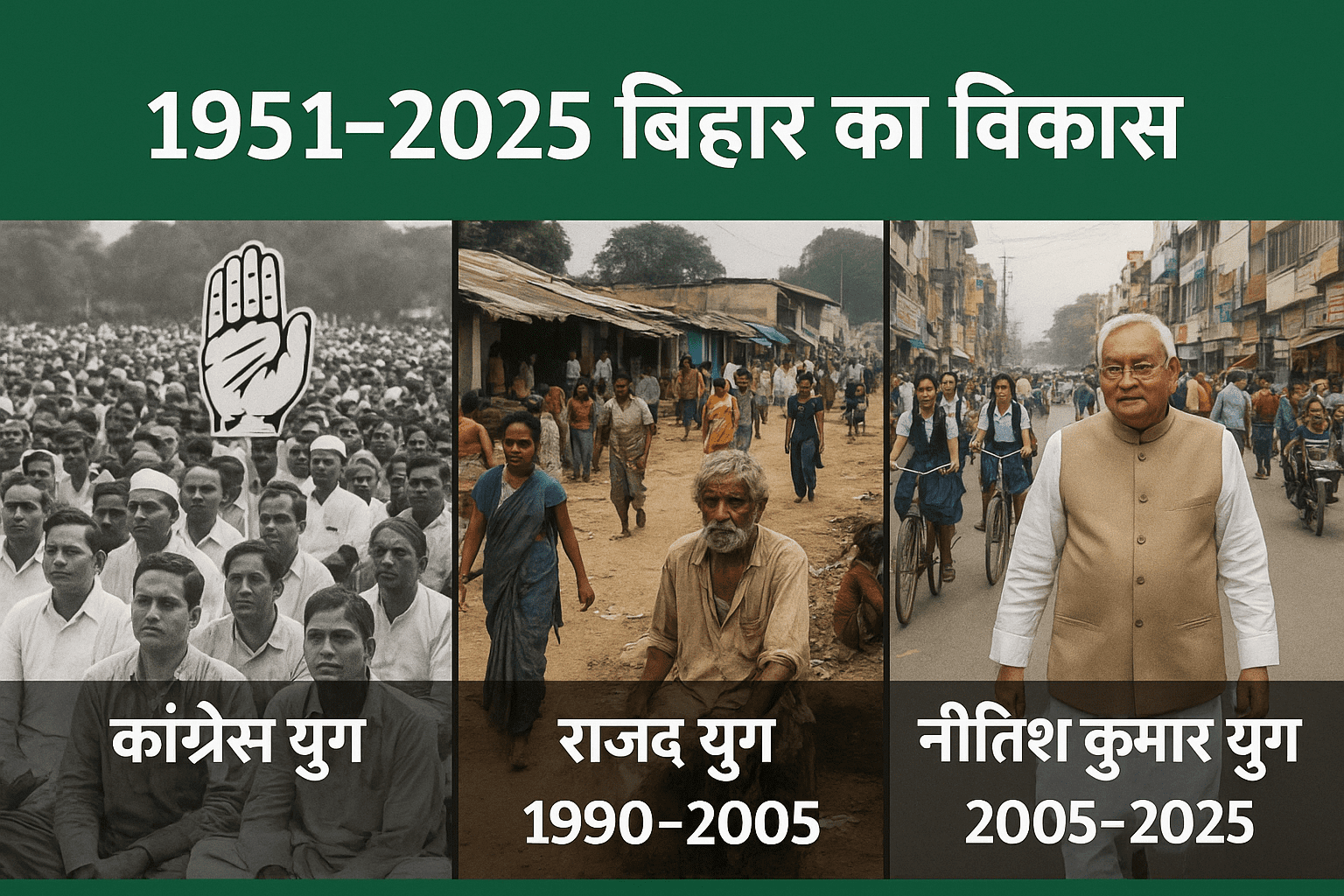
Bihar’s Evolution (1951–2025): Congress → RJD → NDA — Laws, Data, and What Changed (and Didn’t)
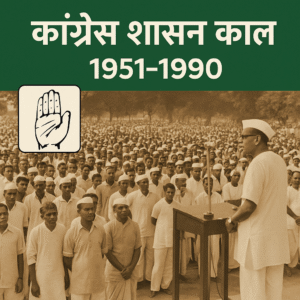
I) Congress-led Era (≈1951–1990): De-feudalization without an industrial take-off
Laws, institutions & state choices
Bihar Land Reforms Act, 1950 (immediately preceding the first election but foundational for the Congress decades): abolished zamindari/intermediaries; transferred estates and resource rights (forests, fisheries, hats/bazaars, mines) to the state and created a Land Commission. This legally reset agrarian power and revenue relations.
Through the 1960s–80s, Bihar aligned with national policy (5-Year Plans, agriculture focus), but the Green Revolution largely bypassed eastern India due to weak irrigation, low input access, small holdings and policy neglect—hurting Bihar’s yield growth.
Panchayati Raj laws evolved nationally; Bihar’s robust implementation and empowered PRIs would only come later.
Socio-economic outcomes
Literacy crawled from 13.5% (1951) to ~37–47% by 1991/2001, far below India’s average—an indicator of chronic under-investment in schooling and human capital.
Industrialization lagged; out-migration emerged as a structural feature (seasonal and long-term).
The poverty headcount stayed high through 1993–94; the big drop came only after 2004–05. (India-level series with Bihar among the worst.)
Political economy
Congress factions and brief coalition experiments produced policy continuity without deep state capacity, and floods (Kosi belt) plus land fragmentation kept farm incomes volatile. The abolition of zamindari changed rural power structures but did not translate into a productivity revolution.
Net take: Congress decades dismantled feudal intermediaries on paper and expanded the state’s role—but missed the industrial-education push and irrigation-led farm upgrade that Punjab/West UP enjoyed. The result: low literacy, high poverty, and migration entrenched.
II) RJD Era (1990–2005): Social justice mainstreamed; services and growth faltered
Laws/initiatives & political choices
Social justice coalition (Lalu Prasad 1990–97; Rabri Devi 1997–2005) prioritized caste inclusion and symbolic empowerment.
Panchayat pathway: Bihar aligned with the 73rd Amendment in the 1990s; by 2001, gram panchayat elections resumed after a long gap—laying the base for later women’s reservation expansion.
Charwaha Vidyalaya (early 1990s) attempted to bring working rural children into schooling—an innovative but contested experiment.
Socio-economic outcomes
Growth in the 1990s lagged India sharply; per-capita gains were negligible, and private investment confidence weakened. (Multiple sources record the 1990s as Bihar’s worst decade for relative growth.)
Crime & law-and-order became a political flashpoint. NCRB data show murders peaking around 2000 and then easing; overall, the 1990s built Bihar’s “kidnapping/extortion” image that repelled investment.
Literacy did rise (36.7% in 1991 → 46.9% in 2001), but the gap with India stayed wide.
Political economy
RJD shifted voice and representation toward backward classes and minorities, a lasting social transformation. But state capability and hard infrastructure (roads, schools, teachers, policing) deteriorated or failed to keep pace—locking the economy into low productivity.
Net take: The era democratized power and normalized backward-class leadership, but the cost was erosion of state capacity and a near-freeze in growth-enabling investments. The 2000 creation of Jharkhand (mineral/industry base) also shrank Bihar’s industrial core.
III) NDA / JD(U)-BJP-led Era (2005–2025): Capacity build-out, welfare at scale, uneven jobs
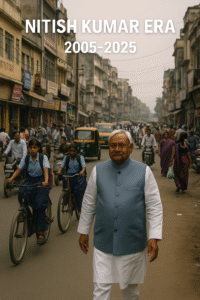
Politically there were coalition swaps (2015–17 Grand Alliance, then back with BJP), but the policy architecture since Nov 2005 is broadly identified with Nitish Kumar’s model.
Signature state laws & systems
Bihar Panchayat Raj Act, 2006: went beyond the 33% constitutional minimum to reserve up to 50% of PRI seats for women, plus rotating SC/ST/OBC quotas—mainstreaming women in local power.
Bihar Special Courts Act, 2009: fast-track prosecution and confiscation of disproportionate-assets property of public servants—nation-leading anti-corruption architecture.
Bihar Right to Public Services Act, 2011 (BRTPS): legal time-bound delivery of notified citizen services with appeal/review; later digitized dashboards and portals.
Bihar Prohibition & Excise Act, 2016: state-wide liquor ban (tough enforcement, large seizures, social debates).
Flagship programs & delivery
Girls’ bicycle and uniform schemes → dramatic rise in female secondary enrollment; became a global case stud
JEEViKA (Bihar Rural Livelihoods Project) from 2006 → 1.2–1.4 crore women in SHGs; rigorous evaluations find income, empowerment gains.
RTPS digitization, HRMS, and service dashboards → higher transparency and paperless workflows.
Outcomes (directionally improving, but with gaps)
GSDP growth rebounded strongly post-2005; recent CAG shows 14.47% nominal growth in 2023–24; the state remains low in per-capita income.
Literacy jumped to 61.8% (2011) and has kept rising; many reports peg ~74–80% today (methodologies vary).
Poverty: India’s big drop between 2004–05 and 2011–12 (Tendulkar) also reflected in Bihar; NITI’s MPI 2023 shows substantial multi-dimensional poverty reduction 2015–16 → 2019–21.
Policing: murders fell from 2000 highs; kidnappings/insurgency receded; yet Bihar still ranks high in violent crime and gun seizures; massive drives against illicit liquor and firearms continue.
Net take: The 2005–2025 period rebuilt the state—roads, schools, police presence, women’s political entry, service delivery, and SHG-led empowerment. But private-sector jobs, urbanization quality, and per-capita incomes remain weak.
Side-by-side: Eras at a glance
| Lens | Congress (1951–1990) | RJD (1990–2005) | NDA/JD(U)–BJP (2005–2025) |
|---|---|---|---|
| Core laws/policies | Bihar Land Reforms Act 1950 (abolished zamindari, state takeover of estates/resources). | Panchayat revival post-73rd Amendment; Charwaha Vidyalaya outreach. | Panchayat Raj Act 2006 (50% women); Special Courts Act 2009; Right to Public Services 2011; Prohibition 2016. |
| Growth & income | Low growth; Green Revolution bypassed east; migration entrenches. | 1990s growth slump; investment climate weak. | Sustained rebound; 14.47% nominal GSDP growth in 2023–24, but low per-capita persists. |
| Poverty | Very high through 1993–94. | High; limited decline. | Steeper decline since 2004–05; MPI shows big improvements by 2019–21. |
| Literacy | ~13.5% (1951) → ~37–47% (1991/2001). | 46.9% (2001). | 61.8% (2011), rising further; strong female gains via school support/bicycles. |
| Women’s empowerment | Limited institutional levers. | Symbolic rise (Rabri Devi as CM). | 50% PRI reservation, girls’ mobility schemes, SHGs (JEEViKA). |
| Law & order | Weak capacity. | Image hit: kidnappings/violence peaked around 2000. | Murder rates lower than 2000 peak; big enforcement on liquor/arms; still a top-5 violent-crime state. Scroll.in+2The Times of India+2 |
| State capacity | Low; flood management/irrigation gaps. | Service delivery frayed. | RTPS, HRMS, dashboards—process capacity strengthened. |
What changed Bihar most after 2005?
Women in power & classrooms – With 50% PRI reservation, plus bicycle/uniform/scholarships, the gender gap narrowed and local bodies became visibly female. Evidence shows improved attendance, delayed marriage, and higher agency via JEEViKA.
Rule-of-law optics – Special Courts Act (confiscations), better policing, and visible action on liquor/arms improved deterrence, even if crime rates remain debated.
Service delivery rights – BRTPS gave citizens legal time-limits for services, later digitized. This is quiet but transformative governance plumbing.
Why, then, is Bihar still called a “sick” state?
Even with progress, several structural traps remain:
Per-capita income is among India’s lowest despite high growth—meaning growth is from a very low base, and population growth dilutes gains.
Private jobs/industry: Post-Jharkhand, Bihar lost much of its mineral-industry base. Urbanization has been quantity without quality; manufacturing growth is improving but modest.
Human capital deficits: 2011 literacy (61.8%) trailed India by over 12 points; while rising, learning outcomes and health metrics (IMR/MMR) still lag.
Agriculture vulnerability: Eastern-India legacy—small holdings, floods, lagging irrigation and inputs—keeps productivity low.
Law-and-order perception: NCRB trends improved from the 2000 peak but perception lags reality; the state continues aggressive enforcement on liquor and arms to shift that narrative.
What would move the needle next (pragmatic roadmap)
Jobs flywheel: anchor labour-intensive manufacturing (food processing, textiles/leather, bicycles/low-end engineering) near rail freight corridors; align skilling to clusters; use plug-and-play parks to derisk MSMEs.
Irrigation & flood resilience: modernize Kosi-Gandak basins (pumped irrigation, drainage, climate-smart seeds, crop insurance adoption).
Urban reform: focus on Tier-2 city services (land records, building permissions, last-mile water/sewer) to attract firms; expand rental housing for migrant returnees.
Learning outcomes: take the “bicycle-era” access success into Foundational Literacy & Numeracy and secondary-to-skills pipelines, targeting girls and first-gen learners.
Criminal justice throughput: continue Special Courts playbook with forensics/time-bound trials to raise conviction rates (perception gap closes when case disposal improves).
Source notes (key citations)
Zamindari abolition: Bihar Land Reforms Act, 1950 (official text). India Code
Literacy history: Government economic survey tables & compilations (1951→2011). India Budget+1
Green Revolution bypass of East: explainer syntheses. Edukemy
RJD-era growth headwinds & 1990s slump: economy compilations. Wikipedia
Crime trend context: NCRB-based explainers; 2000 peak vs 2010s fall. Scroll.in
Panchayat 50% women (2006 Act): PRS & official text. PRS Legislative Research+1
Special Courts Act 2009 (confiscation): India Code/PRS. India Code
Right to Public Services 2011 & digitization: Act + 2025 portal updates. PRS Legislative Research+1
Prohibition 2016: official act. India Code
JEEViKA impact: independent evaluation + scale numbers. 3ie+1
GSDP and finances: CAG-reported growth 2023–24. The Times of India
Poverty decline: Planning Commission/NITI series. NITI AAYOG
Bottom line
Congress (1951–1990) broke feudal land relations but never built the irrigation-industry-education triad.
RJD (1990–2005) mainstreamed social justice, yet state capacity and investment climate eroded.
NDA/JD(U)–BJP (2005–2025) rebuilt the plumbing of the state—roads, services, women’s empowerment, and governance laws—delivering growth and poverty reduction, but per-capita income, high-quality urbanization, and private jobs still trail.
Bihar isn’t “sick” because nothing worked; it’s “still catching up” because each era solved one piece of a three-piece puzzle. The next government that locks jobs + urban reform onto the current governance base—and fixes flood-irrigation productivity—will finally flip Bihar from low-income out-migrating to middle-income job-creating.