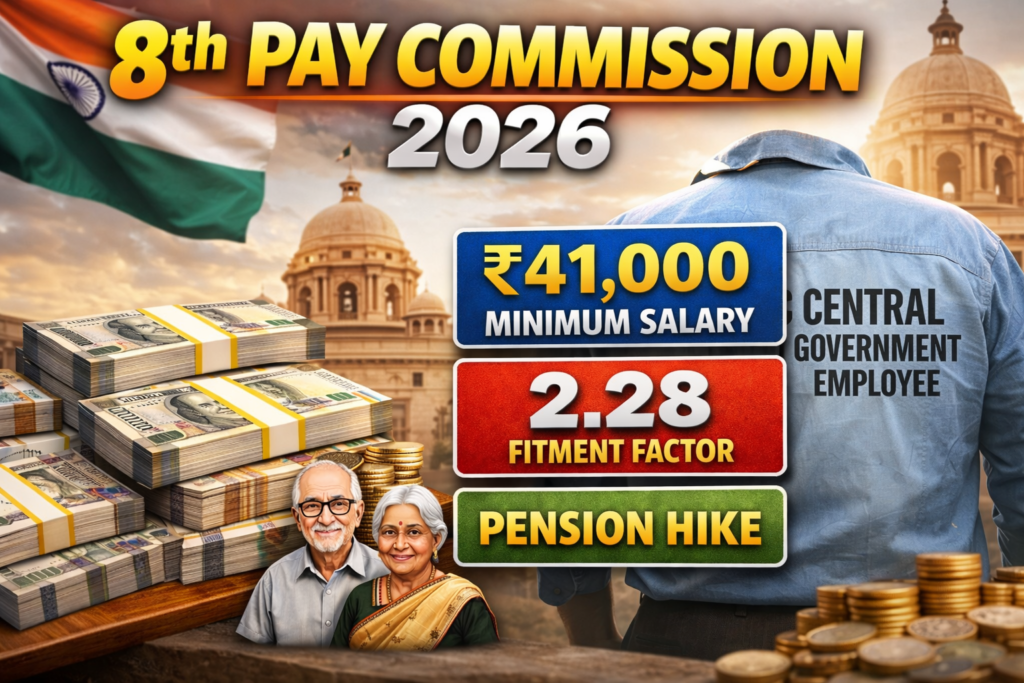
1. Introduction: The 2026 Economic Milestone
As India moves closer to 2026, one policy decision is quietly becoming a turning point for the economy—the 8th Pay Commission (8th CPC). This is not just about salaries going up for government employees. It is about how inflation, consumption, savings, and even fiscal discipline will shape India’s next economic phase.
The current 7th Pay Commission officially ends on 31 December 2025. From 1 January 2026, the new pay structure is expected to take effect. This impacts nearly 1.2 crore people, including around 50 lakh serving central government employees and over 67 lakh pensioners. Few policy decisions in India have such a wide and immediate reach.
In late 2025, the Union Cabinet cleared the Terms of Reference (ToR) for the 8th Pay Commission. This signaled that the government accepts one hard truth: post-pandemic inflation has reduced the real purchasing power of fixed-income earners. Food prices, rent, education, healthcare, and transport costs have all risen much faster than salaries.
This is why the 8th CPC is not merely a salary hike. It is a geoeconomic necessity—a correction to protect middle-class demand in a world shaped by global inflation, supply-chain shocks, and higher interest rates.
Ministry of Finance – Government of India
2. The Logic Behind the ₹41,000 Minimum Wage
A common myth is that pay commissions decide salary numbers randomly or politically. In reality, the minimum wage calculation follows a long-standing scientific method known as the Dr. Aykroyd Formula, endorsed by the 15th Indian Labour Conference (ILC).
This formula sets clear consumption norms for a worker’s family:
Food requirement: 3 consumption units per adult, equal to 2,700 calories per day
Clothing: 72 yards per family per year
Housing: Rent, maintenance, electricity, and fuel
Miscellaneous needs: Education, healthcare, transport, and social obligations
When these components are priced using 2025–26 retail price indices, the numbers tell a clear story. What cost ₹18,000 in 2016 now costs well above ₹35,000–₹38,000 just to maintain the same lifestyle. Add future inflation protection, and the fair minimum wage lands close to ₹41,000 per month.
This is not generosity. It is inflation neutralisation.
Minimum Wage Evolution Across Pay Commissions
| Pay Commission | Effective Year | Minimum Basic Pay |
|---|---|---|
| 6th CPC | 2006 | ₹7,000 |
| 7th CPC | 2016 | ₹18,000 |
| 8th CPC (Projected) | 2026 | ₹41,000 |
In simple terms, if wages do not rise at least this much, government employees effectively take a pay cut in real terms.
7th Pay Commission Report (Reference Base)
3. The “Fitment Factor” Debate: 2.28 vs. 2.86

The most discussed number around the 8th CPC is the fitment factor. This is the multiplier used to convert current basic pay into the new basic pay.
What Is the Fitment Factor?
It is a simple formula:
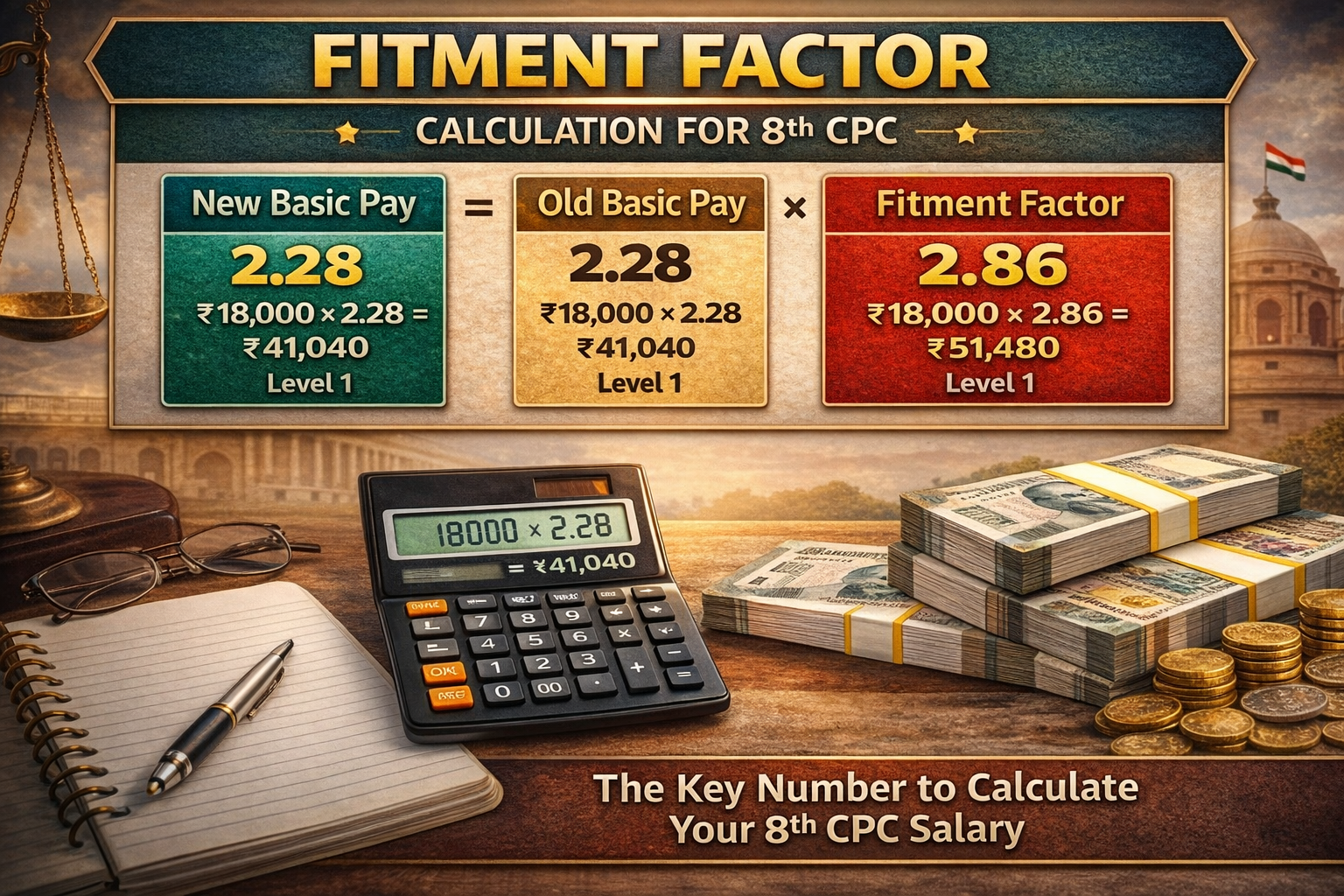
New Basic Pay = Old Basic Pay × Fitment Factor
Why 2.28 Is the Base Case
A fitment factor of 2.28 is considered the minimum logical floor. Why? Because:
₹18,000 × 2.28 ≈ ₹41,040
This directly matches the minimum wage derived from ILC norms
This makes 2.28 a technically justified and fiscally defensible number.
Why Unions Demand 2.86
Employee unions argue for a higher factor—2.86—based on three points:
Actual household inflation has been higher than CPI averages
Education and healthcare costs have outpaced income growth
Past pay commissions offered stronger real wage growth
However, adopting 2.86 would sharply raise government expenditure and widen the fiscal deficit. That is why most analysts see 2.28–2.5 as the realistic zone.
4. Impact on Pensioners: The Social Security Reset
The 8th Pay Commission is equally critical for pensioners. India currently has over 67 lakh central government pensioners, many of whom rely entirely on fixed monthly income.
Under the 7th CPC:
Minimum pension = ₹9,000 per month
With a 2.28 fitment factor:
Revised minimum pension = ₹9,000 × 2.28 = ₹20,520
This jump is not a luxury. Medical inflation in India has been running at 10–12% annually, much higher than headline inflation. Without pension revision, elderly households face financial stress and rising dependency.
The government has also introduced the Unified Pension Scheme (UPS) for new entrants. While UPS changes long-term pension mechanics, existing pensioners and near-term retirees will still see their base pension recalculated under the 8th CPC framework.
5. The Geoeconomic and Fiscal Perspective
From a macroeconomic lens, the 8th Pay Commission is a double-edged sword.
Fiscal Cost
Experts estimate the annual burden at ₹1.5–2 lakh crore. This includes salaries, pensions, allowances, and arrears.
Inflation Risk
A sudden rise in disposable income can increase demand for goods and services. This may put pressure on the inflation target managed by the Reserve Bank of India, which aims to keep CPI inflation near 4%.
Growth Boost
At the same time, higher spending power boosts demand in key sectors:
Automobiles: Two-wheelers, entry-level cars
Real Estate: Affordable and mid-income housing
FMCG: Food, personal care, household goods
Historically, pay commission cycles have supported GDP growth by strengthening middle-class consumption.
Department of Expenditure (DoE) – Pay Commission Authority
6. 8th Pay Commission Salary Calculator: A Simple DIY Guide
You do not need complex tools to estimate your new salary.
Step-by-Step Method
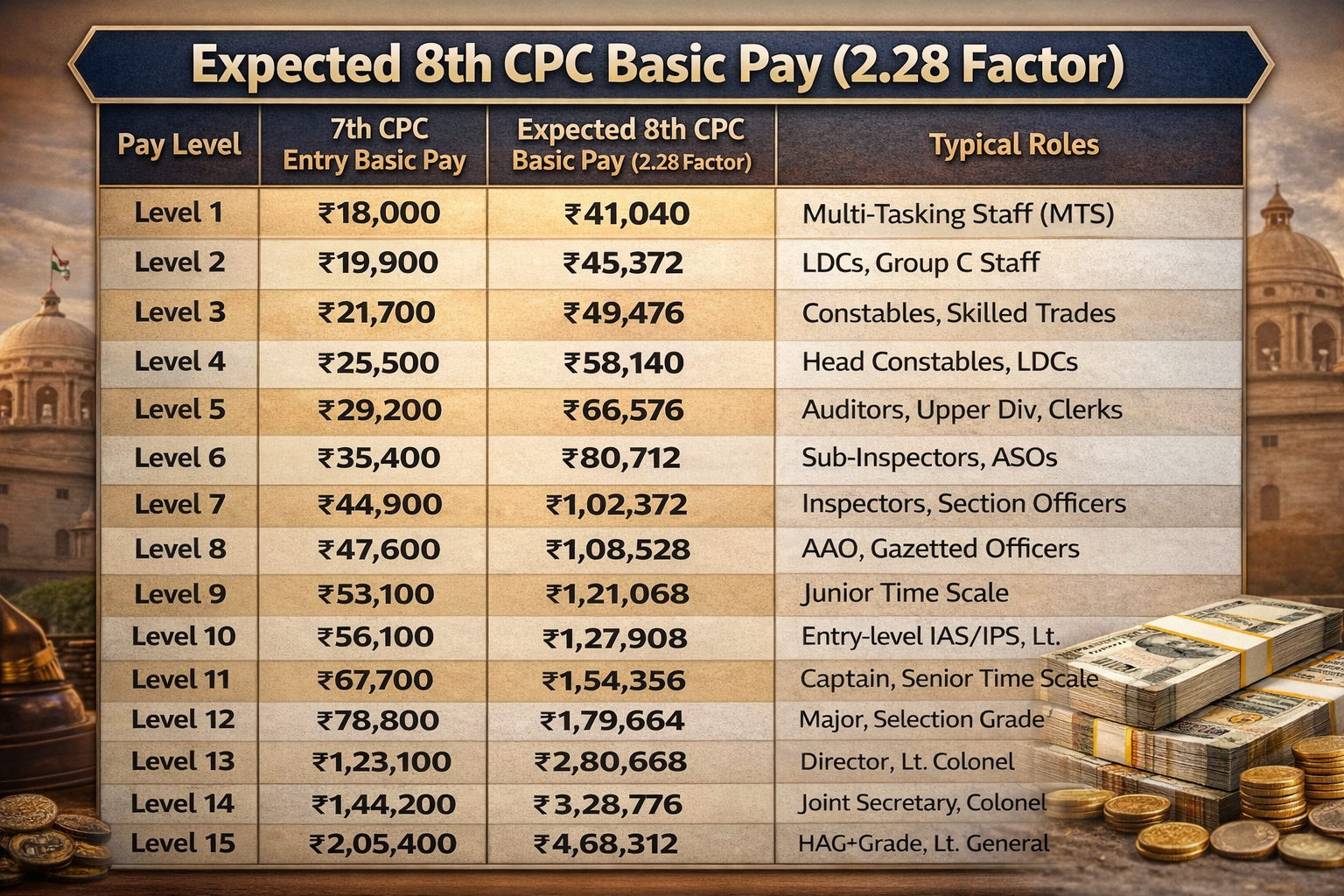
Take your current 7th CPC Basic Pay
Multiply by the expected fitment factor (2.28)
Add House Rent Allowance (HRA)
X cities: 30%
Y cities: 20%
Z cities: 10%
Dearness Allowance (DA) resets to 0%, but future DA will grow on a higher base
Sample Salary Impact
| Pay Level | Current Basic | New Basic (2.28) |
|---|---|---|
| Level 1 | ₹18,000 | ₹41,040 |
| Level 6 | ₹35,400 | ₹80,712 |
| Level 10 | ₹56,100 | ₹1,27,908 |
This shows why the 8th CPC is transformative, especially for mid-level officers.
7. Conclusion: Arrears, Timeline, and the Bigger Picture
Although the 8th Pay Commission is expected to be effective from 1 January 2026, the final report, approvals, and system changes will take time. Most projections suggest:
Final rollout: 2026–27
Arrear payments: By mid-2027
These arrears could run into several lakh rupees per employee, providing a one-time liquidity boost.
In the end, the 8th CPC is not just about higher pay slips. It is about redefining the economic value of India’s public workforce in a global economy shaped by inflation, technology, and demographic change. If implemented wisely, it can protect purchasing power, support growth, and maintain fiscal balance at the same time.
📌 Frequently Asked Questions (FAQ): 8th Pay Commission 2026
Q1. What is the 8th Pay Commission?
The 8th Pay Commission (8th CPC) is a government-appointed body that revises the salary, pension, and allowances of central government employees and pensioners. It replaces the 7th Pay Commission and is expected to be effective from 1 January 2026.
Q2. When will the 8th Pay Commission be implemented?
The expected effective date is 1 January 2026.
However, the final approval and payment of revised salaries and arrears may take time. Most estimates suggest arrears could be paid by mid-2027.
Q3. What is the minimum salary under the 8th Pay Commission?
The proposed minimum basic salary is around ₹41,000 per month, compared to ₹18,000 under the 7th Pay Commission.
This increase is based on inflation-adjusted wage norms and the 2.28 fitment factor.
Q4. What is the fitment factor in the 8th Pay Commission?
The fitment factor is a multiplier used to calculate the new basic pay.
Formula:
New Basic Pay = Old Basic Pay × Fitment Factor
For the 8th CPC, 2.28 is considered the most realistic base fitment factor.
Q5. Why is the fitment factor 2.28 considered important?
A 2.28 fitment factor directly converts the current minimum pay of ₹18,000 into about ₹41,000, which aligns with:
Inflation since 2016
Cost of living data (2025–26)
Labour wage norms
It balances employee welfare and government finances.
Q6. Is there a demand for a higher fitment factor like 2.86?
Yes. Employee unions are demanding a 2.86 fitment factor, arguing that:
Real household inflation is higher
Education and healthcare costs have surged
Past pay commissions offered stronger hikes
However, a higher factor would significantly increase the fiscal burden, making it less likely.
Q7. How will pension change under the 8th Pay Commission?
If the 2.28 fitment factor is applied:
Minimum pension will rise from ₹9,000 to ₹20,520 per month
This benefits more than 67 lakh central government pensioners, especially considering rising medical costs.
Q8. Will Dearness Allowance (DA) continue after 8th CPC?
Yes, but DA will reset to 0% on the new basic pay from January 2026.
After that, DA will again increase every six months, calculated on the higher revised basic salary.
Q9. How can I calculate my 8th Pay Commission salary?
You can estimate your salary using this method:
Take your current 7th CPC basic pay
Multiply it by 2.28
Add HRA (10%, 20%, or 30% depending on city)
DA will apply later on the revised base
This gives a close estimate of your expected salary.
Q10. Will the 8th Pay Commission increase inflation in India?
In the short term, higher salaries may increase consumption and demand.
However, if implemented gradually, the impact on inflation is expected to be manageable, while supporting economic growth through higher spending.
Q11. Does the 8th Pay Commission affect state government employees?
No. The 8th Pay Commission directly applies only to central government employees and pensioners.
However, many state governments later revise salaries by following central pay commission patterns.
Q12. Is the 8th Pay Commission final and confirmed?
As of now:
Terms of Reference (ToR) have been approved
Final recommendations are still awaited
Exact figures may change, but a major salary revision in 2026 is almost certain.