1. The Executive Summary: A “Goldilocks” Economy
As someone who has observed Indian politics and economics for over three decades, I can say this with confidence: India’s current economic phase is rare. Not overheated. Not sluggish. Just right.
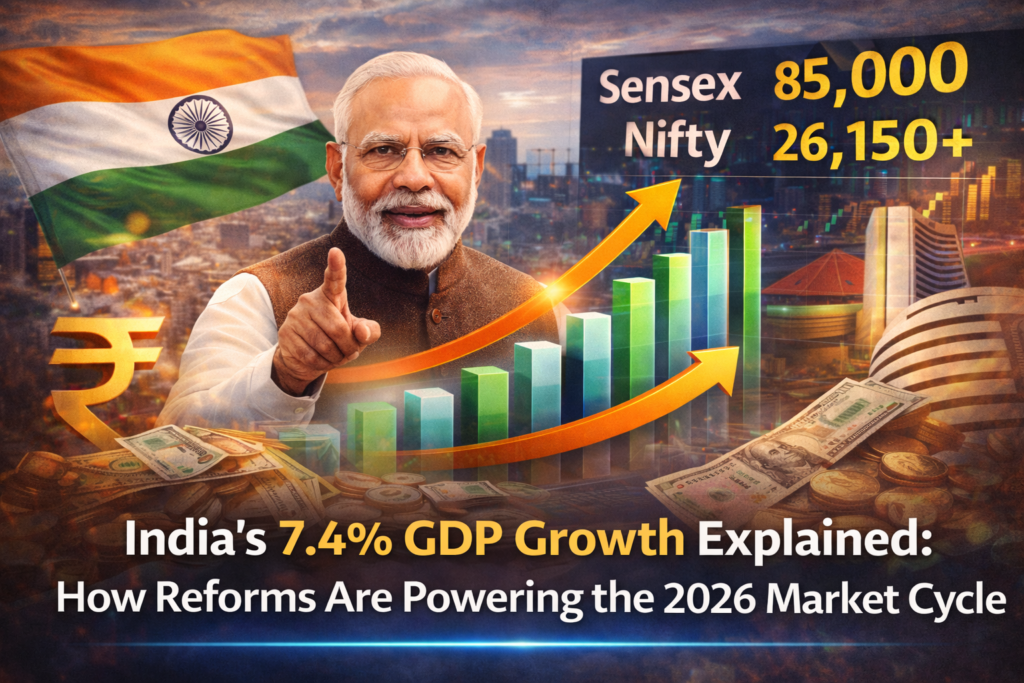
The latest National Statistics Office (NSO) projection of 7.4% GDP growth for FY 2025–26 places India in what economists call a “Goldilocks economy”—strong growth without runaway inflation. At a time when global economies are struggling with trade wars, geopolitical tensions, and policy uncertainty, India stands out as an island of relative stability.
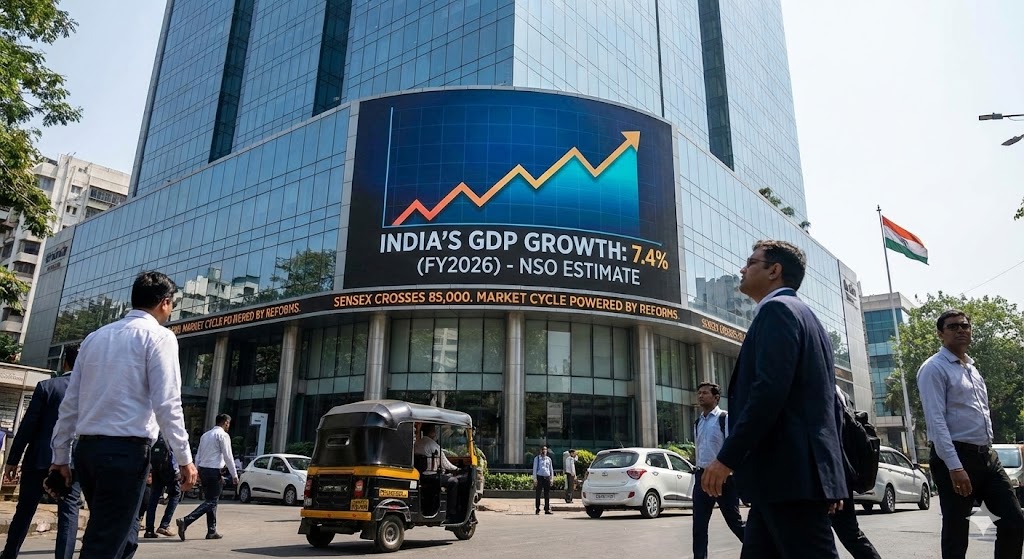
The world today fears a renewed US-led tariff war, slowing global trade and weakening export-driven economies. India, however, is protected by a powerful internal shield: domestic consumption, public investment, and services-led growth.
In my 30 years of tracking economic cycles, I have rarely seen such a synchronized alignment of monetary policy and fiscal policy. On one side, the RBI has delivered cumulative rate cuts of 125 basis points, making credit cheaper. On the other, the government has pushed GST rationalisation, infrastructure spending, and targeted welfare.
This is not accidental growth. This is the “Double Engine” model in action.
2. Breaking the 7.4% Barrier: Real-Time Data (NSO 2026)
Let us look at the numbers carefully, because numbers tell the real story.
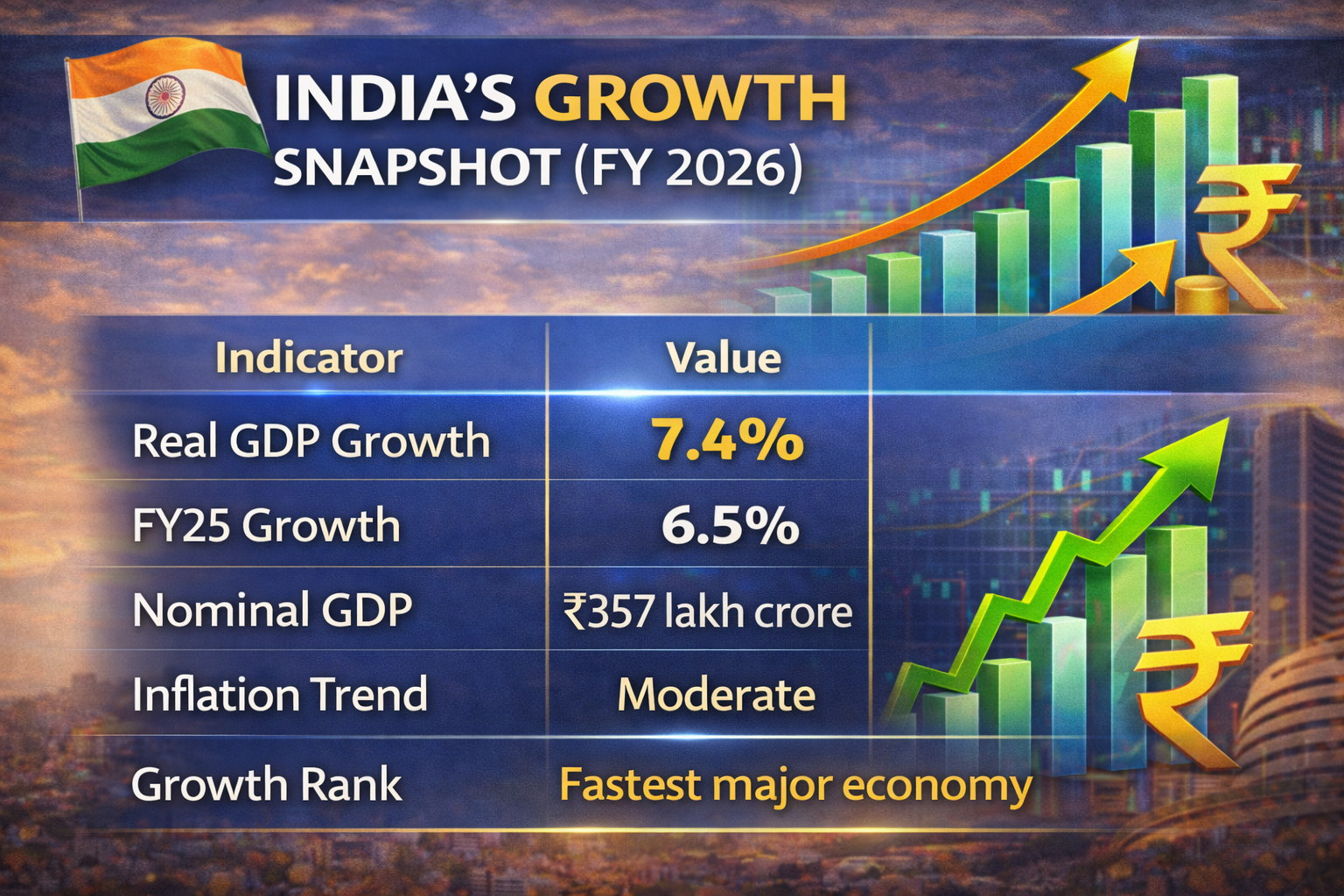
According to NSO’s advance estimates for FY 2025–26:
Real GDP growth: 7.4%, up from 6.5% in FY 2024–25
Nominal GDP: Crossing ₹357 lakh crore, a massive expansion of India’s economic base
Per capita income: Continues its steady rise, strengthening middle-class consumption

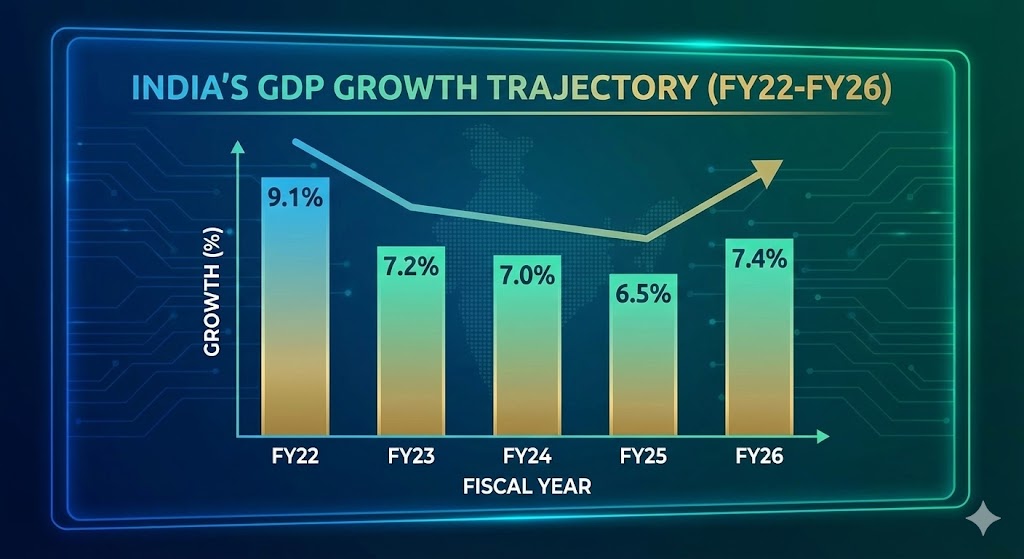
This jump is not cosmetic. It reflects a deeper structural shift in how India grows.
The Gross Value Added (GVA) data is especially telling. The services sector is leading the charge, growing at a robust 9.9%, driven by financial services, professional services, IT-enabled businesses, and digital platforms.
Critics often label this as “jobless growth.” That argument does not hold in 2026. The surge in services employment—banking, fintech, consulting, logistics, healthcare, and digital commerce—is a direct outcome of Digital India, financial inclusion, and formalisation of the economy.
When millions of Indians move from cash to digital payments, from informal jobs to formal services, growth becomes broader and more resilient.
This is not a bubble. This is a base being built.
National Statistics Office (NSO) – GDP Data
3. The Manufacturing PMI “Stall”: A Strategic Pivot, Not a Slowdown
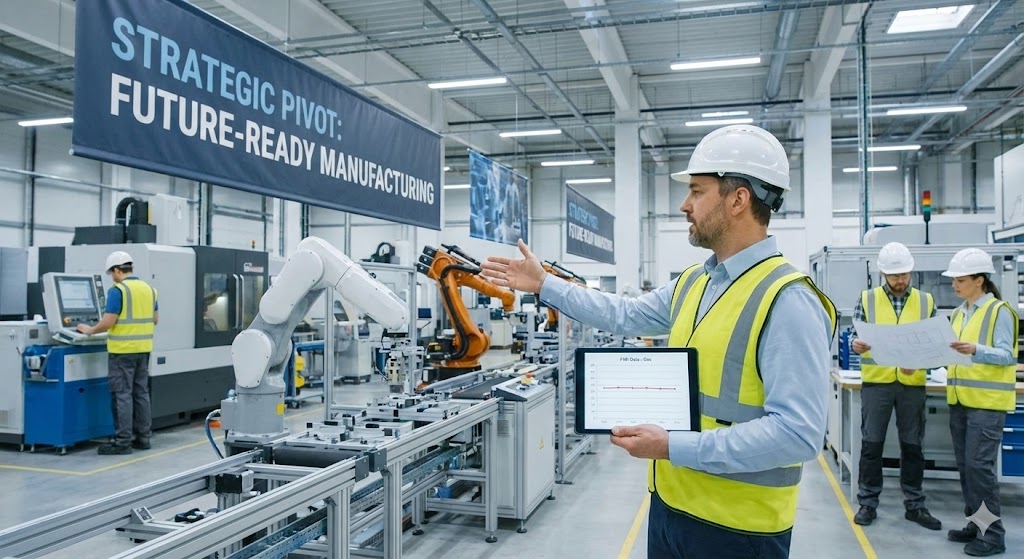
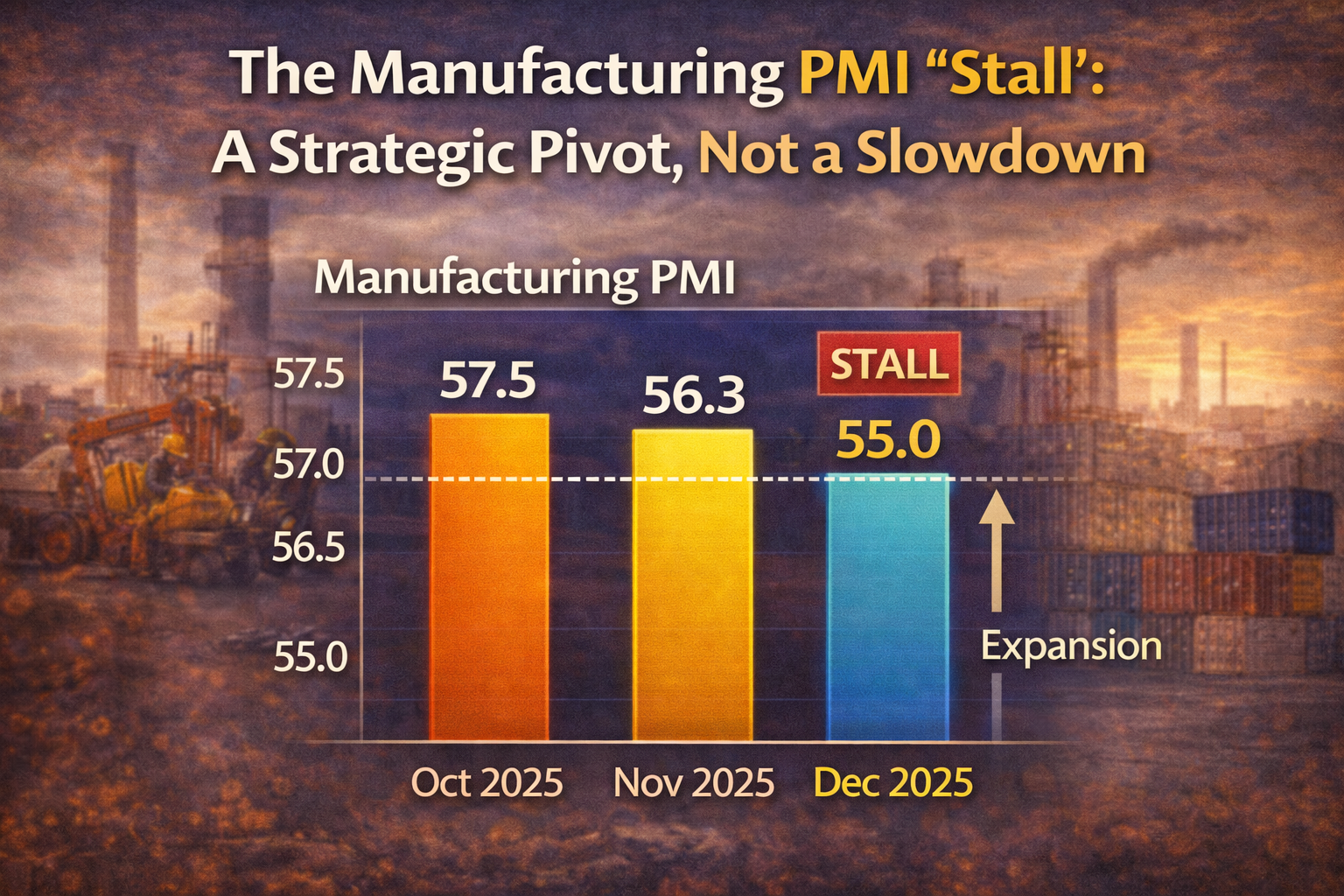
Some observers point to the December 2025 Manufacturing PMI reading of 55.0 and claim that India’s factory engine is losing steam. That interpretation misses the larger picture.
First, let us be clear:
A PMI above 50 means expansion. A reading of 55 still signals strong industrial activity.
Second, this is not a slowdown. It is consolidation.
Global shipping disruptions, energy price volatility, and weak external demand have forced governments worldwide to recalibrate manufacturing strategies. India is no exception. The key difference is how India is responding.
 Instead of chasing low-margin mass exports, the government is pivoting towards export-oriented, high-value manufacturing. This includes:
Semiconductors
Electric vehicles (EVs)
Advanced electronics
Green energy equipment
With PLI 2.0 schemes now operational for semiconductors and EVs, the manufacturing engine is not braking—it is changing gears.
In economics, pauses before leaps are common. What matters is direction. And India’s direction is clear.
Ministry of Commerce & Industry – PLI & Manufacturing
4. Market Bull Run: Sensex 85,000 and the “Nifty 29K” Narrative
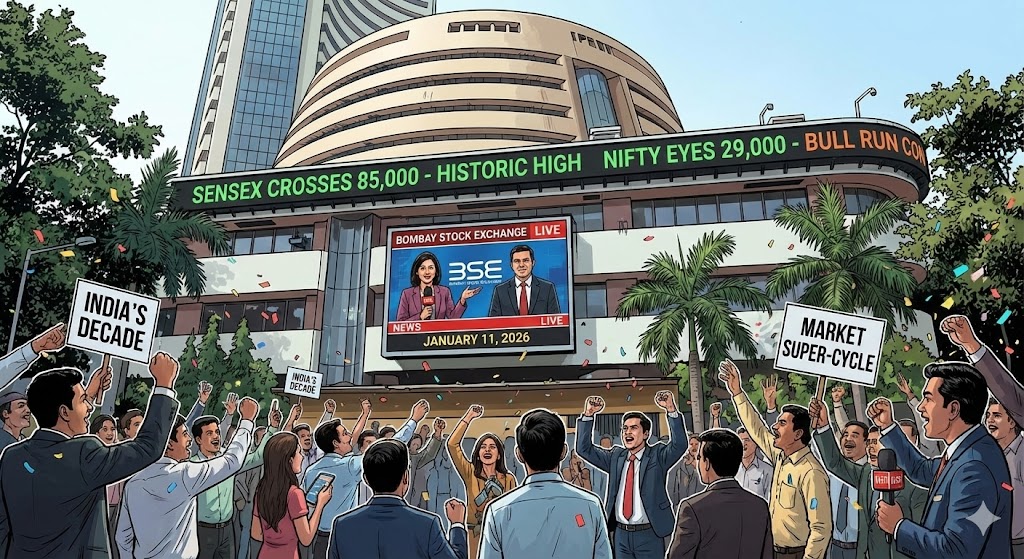
Markets are forward-looking machines. They do not react to yesterday’s news; they price tomorrow’s expectations.
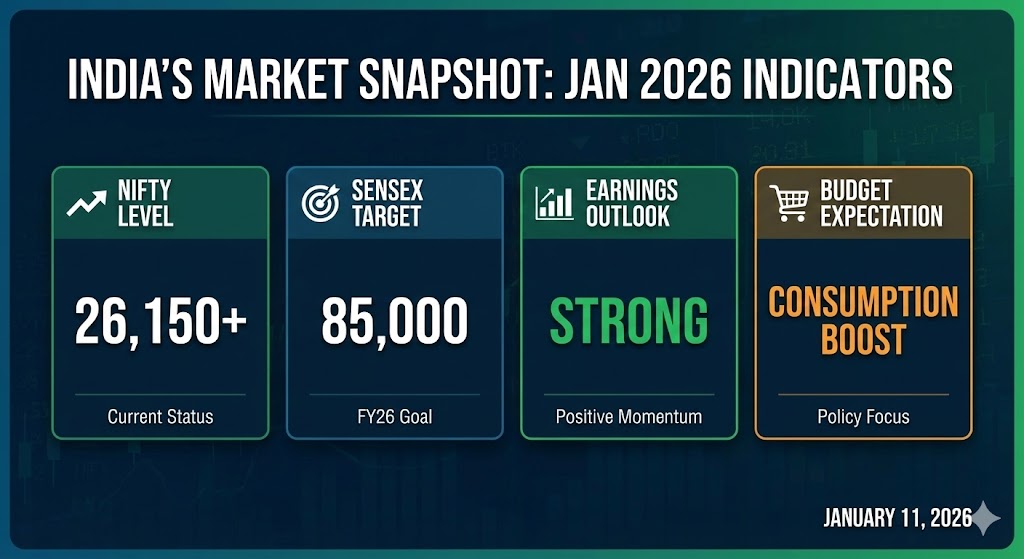
As of January 11, 2026, the Nifty holding firm above 26,150 is not speculative euphoria. It reflects the market’s belief that Budget 2026 will deliver a fresh consumption boost.
GST Council – GST Rate Changes
The single biggest trigger behind this optimism is GST 2.0, rolled out in September 2025. By slashing GST rates on automobiles, white goods, and consumer durables, the government effectively returned billions of rupees to Indian households in the form of lower prices.
This increase in disposable income is already visible in festive sales, credit growth, and retail demand.
Markets are rewarding predictability. They are rewarding reform continuity. And yes, they are rewarding political stability.
Targets like Sensex 85,000 and Nifty 29,000 are not fantasies. They are logical extensions of earnings growth, liquidity support, and policy confidence.
Ministry of Finance – GST & Fiscal Policy
5. “Top 5 Stocks for FY 2026”: Aligning with National Mission
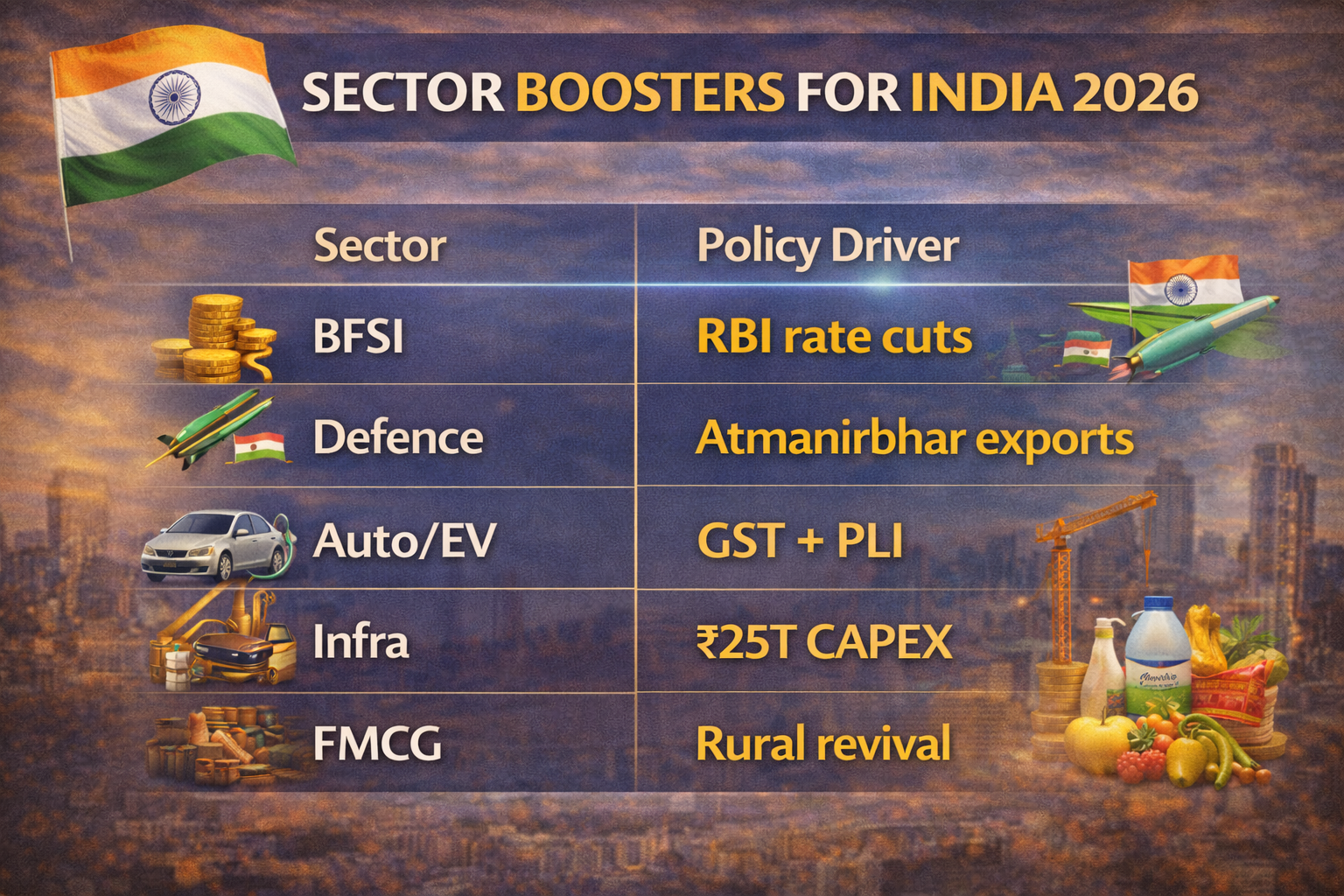
Rather than calling these “stock tips,” it is more accurate to call them policy beneficiaries. In India, national priorities shape corporate winners.
Banking & Financial Services (BFSI): HDFC Bank / SBI
Banks are the first beneficiaries of RBI’s 125 bps rate cut. Lower interest rates boost loan demand, while credit growth remains strong at around 13%. Public and private banks alike are riding a healthy balance-sheet cycle.
Defence: HAL / BEL
India’s defence strategy is no longer import-heavy. The Atmanirbhar Bharat push aims for ₹50,000 crore in defence exports. Companies like HAL and BEL sit at the center of this transformation.
Auto & EV: Maruti / Tata Motors
The GST cut from 28% to 18% on entry-level vehicles is a direct demand booster. Combined with EV incentives and rising urban incomes, auto makers are entering a golden phase.
Infrastructure: Larsen & Toubro (L&T)
India’s infrastructure story runs on a ₹25 trillion Central-State CAPEX pipeline. Roads, railways, ports, power—L&T remains the backbone contractor for this expansion.
Consumption: HUL / ITC
With rural incomes improving due to record food production and Direct Benefit Transfers (DBT), consumption majors are seeing demand revival beyond metros.
These are not random picks. They align with India’s development priorities.
6. The Geoeconomic Shield: Defying Global Headwinds
Globally, uncertainty is rising. The United States has once again floated extreme tariff threats, unsettling global trade sentiment. Many export-dependent economies are nervous.
India’s response has been pragmatic, not reactive.
Instead of dependence on one market, the government is pushing Free Trade Agreement (FTA) diversification. Agreements with the UK, Oman, and New Zealand, along with negotiations in other regions, reduce India’s exposure to any single trade shock.
On the capital side, something historic is happening.
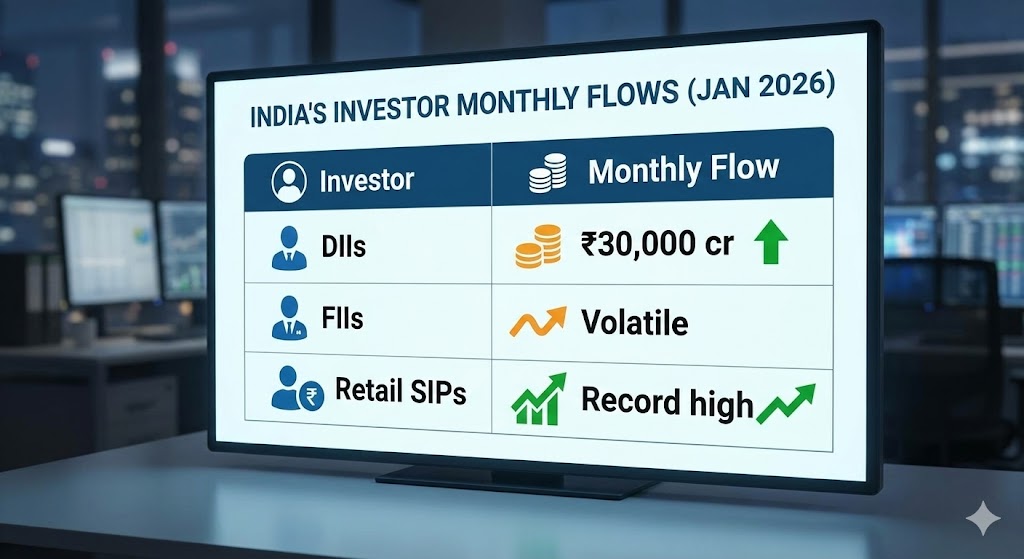
Even as Foreign Institutional Investors (FIIs) remain volatile, Domestic Institutional Investors (DIIs) have become the backbone of Indian markets. Systematic Investment Plan (SIP) inflows touched a record ₹30,000 crore per month in early 2026.
This means Indian households are now financing India’s growth.
That is structural strength.
7. Conclusion: The Roadmap to the $5 Trillion Reality
The year 2026 may well be remembered as the point when India proved it could grow independent of the Western economic cycle.
This is not isolationism. It is insulation.
Strong domestic demand, reform-led governance, financial inclusion, infrastructure spending, and demographic advantage are working together as a single engine.
For investors, the message is clear:
The “Short India” trade is dead.
For citizens, the signal is equally strong:
Reforms may take time, but they compound.
The “Viksit Bharat” journey is no longer a slogan. It is showing up in GDP data, market confidence, and global perception.
The super-cycle is not a promise anymore.
It is already underway.
❓ Frequently Asked Questions (FAQ)
1. What does India’s 7.4% GDP growth mean for FY 2026?
India’s projected 7.4% GDP growth for FY 2026 means the economy is expanding faster than most major economies. It reflects strong domestic demand, stable inflation, higher government spending, and the impact of long-term reforms such as GST, infrastructure investment, and digitalisation.
2. Who released the 7.4% GDP growth estimate?
The estimate was released by the National Statistics Office (NSO) as part of its advance projections for FY 2025–26. NSO data is considered the most authoritative source for India’s macroeconomic numbers.
3. Why is India growing faster than other major economies?
India’s growth is driven mainly by domestic consumption, services expansion, and public investment. Unlike export-heavy economies, India is less dependent on global trade cycles, which helps it remain resilient during global slowdowns.
4. Is this growth sustainable or temporary?
The growth appears sustainable because it is backed by structural reforms, rising formal employment, financial inclusion, and infrastructure creation. It is not dependent on short-term stimulus alone.
5. What role did government reforms play in this growth?
Government reforms such as GST rationalisation, infrastructure spending, production-linked incentives (PLI), and ease of doing business have improved efficiency, boosted investment, and strengthened demand across sectors.
6. How important is the services sector in India’s 2026 growth story?
The services sector is the biggest contributor, growing close to 10%. Financial services, professional services, IT, logistics, and digital platforms are generating jobs and driving income growth, especially among the middle class.
7. Does strong GDP growth mean more jobs are being created?
Yes. While manufacturing jobs grow steadily, the biggest employment gains are coming from services such as banking, fintech, consulting, healthcare, logistics, and digital commerce. This reflects a shift toward a modern, formal economy.
8. Why did manufacturing PMI dip in late 2025?
Manufacturing PMI dipped to around 55 due to global uncertainty and export volatility. However, a PMI above 50 still indicates expansion, and the dip reflects consolidation rather than a slowdown.
9. What is the significance of GST 2.0 for consumers?
GST 2.0 reduced tax rates on automobiles, consumer durables, and select goods. This increased disposable income, boosted demand, and supported consumption-led growth.
10. How does RBI rate cutting help economic growth?
Lower interest rates make loans cheaper for businesses and consumers. This boosts housing demand, auto sales, business expansion, and overall credit growth, which supports economic momentum.
11. Why are Indian stock markets optimistic about 2026?
Markets are optimistic because of strong earnings growth, stable policy direction, fiscal support, and rising domestic investments through SIPs and mutual funds.
12. What is meant by a “market super-cycle”?
A market super-cycle refers to a long phase of sustained growth driven by structural changes, not short-term speculation. In India’s case, reforms, demographics, and domestic capital are key drivers.
13. How are domestic investors changing India’s markets?
Domestic Institutional Investors (DIIs) and retail SIP investors now provide steady capital inflows, reducing dependence on foreign investors and making markets more stable.
14. How does India handle global risks like trade wars?
India reduces risk by diversifying trade partners, focusing on domestic demand, and strengthening manufacturing through PLI schemes. This limits the impact of external shocks.
15. What is the long-term goal of India’s growth strategy?
The long-term goal is to become a $5 trillion economy, raise living standards, create quality jobs, and build a resilient, self-sustaining economic system.
🔍 People Also Ask (PAA)
Why is India’s GDP growth highest among major economies in 2026?
India’s growth is driven by strong domestic consumption, government spending, and a fast-growing services sector, unlike many economies that depend heavily on exports.
Is 7.4% GDP growth good for investors?
Yes. Higher growth improves corporate earnings, boosts employment, and supports stock market performance, making the environment attractive for long-term investors.
How reliable are NSO GDP projections?
NSO projections are based on comprehensive data from multiple sectors and are considered the official benchmark for India’s economic performance.
Does high GDP growth increase inflation?
Not necessarily. When growth is supported by productivity gains, supply-side reforms, and stable monetary policy, inflation can remain under control.
What sectors benefit the most from India’s growth in 2026?
Key beneficiaries include banking, infrastructure, automobiles, defence, FMCG, and professional services.
Is India entering a long-term economic boom?
India appears to be entering a multi-year growth phase supported by demographics, reforms, digitalisation, and domestic capital formation.
How does infrastructure spending help GDP growth?
Infrastructure spending creates jobs, improves logistics, reduces costs for businesses, and attracts private investment, creating a multiplier effect across the economy.
Why are SIP inflows important for Indian markets?
SIP inflows provide stable, long-term capital to markets, reduce volatility, and reflect growing financial awareness among Indian households.
Can global recession derail India’s growth?
A global recession may slow exports, but India’s growth is less vulnerable due to its large domestic market and policy buffers.
What is the biggest risk to India’s growth outlook?
Major risks include global financial shocks, geopolitical tensions, and unexpected commodity price spikes, though India is better positioned than in past cycles.
What should investors focus on during this growth phase?
Investors should focus on quality companies aligned with national priorities such as infrastructure, banking, manufacturing, and consumption.
Is the $5 trillion economy target realistic?
With sustained growth, reform continuity, and rising productivity, the $5 trillion target is achievable over the medium term.