1. Introduction: The “Black Friday” of Global Trade
January 9, 2026, may quietly go down as one of the most important days for global trade in this decade. While headlines focus on courts and politics in Washington, markets across the world are already reacting as if the worst-case scenario is coming true.
On this very day, the Supreme Court of the United States is hearing arguments on the legality of the so-called “Liberation Day” tariffs. These tariffs, imposed through executive powers, are now under judicial scrutiny. But investors are not waiting for the verdict. They are pricing in uncertainty.
In India, the reaction was immediate. The Sensex fell nearly 780 points in a single session, while the Nifty 50 extended its losing streak to four consecutive days. The trigger was fear — fear that the proposed “Sanctioning Russia Act” and the threat of 500% tariffs would fundamentally disrupt global trade.
What makes this moment different is that this is no longer just tough talk. The tariff threat is now directly linked to energy purchases, geopolitics, and strategic alliances. For India, this is not a trade issue alone. It is a direct challenge to its long-standing policy of strategic autonomy.
. Russian Oil Discounts & Global Energy Context
2. The Macro View: “Tariff-Led Prosperity” or the Road to Recession?
From Washington’s perspective, the logic seems simple. The US administration argues that tariffs work. And at first glance, the data appears to support that claim.
The US trade deficit has fallen to its lowest level since 2009. Officials close to Donald Trump point to this as proof that protectionism strengthens domestic industry. Factories are producing more, imports are slowing, and headline GDP growth looks impressive.
But this view hides an important detail. Current US GDP growth, projected above 5%, is largely front-loaded. Companies rushed to stockpile goods before tariffs became even harsher. Warehouses are full, inventories are high, and consumption looks strong — for now.
Economists warn that this is not sustainable growth. Once inventory stocking slows, demand weakens. Higher tariffs raise input costs, reduce purchasing power, and eventually hurt both exporters and consumers.
Adding to this uncertainty is the Supreme Court case. If the court rules that the executive overstepped its authority, the US government may be forced to refund nearly $150 billion in collected tariffs. That outcome would not only shock markets but also weaken the very fiscal argument behind aggressive trade barriers.
In short, what looks like tariff-led prosperity today could easily turn into a synchronized slowdown tomorrow.
US Sanctions & Trade Law Framework
3. The India Focus: Caught Between Russian Oil and U.S. Markets
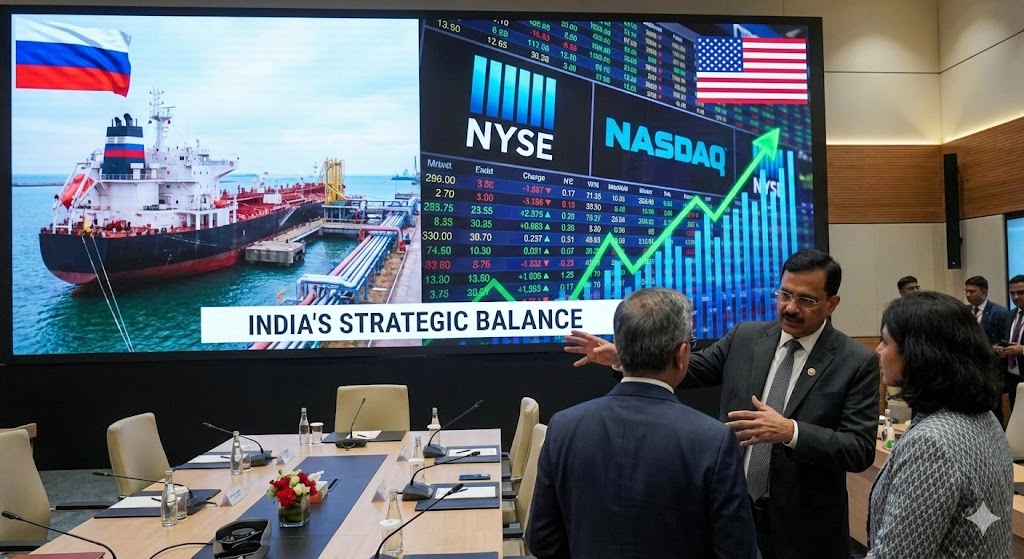
India finds itself in a uniquely difficult position. On one hand, it needs affordable energy to sustain growth. On the other, it relies heavily on access to the US market.
The proposed Sanctioning Russia Act of 2025 directly targets countries buying Russian oil. The threat is blunt: continue energy trade with Russia and face tariffs as high as 500% on exports to the US.
This is not theoretical. India already faces an average 50% tariff on nearly 55% of its merchandise exports to the United States. Adding a punitive energy-linked tariff on top of that would severely damage export competitiveness.
Certain sectors are especially vulnerable. IT services, which technically fall outside traditional tariffs, face indirect pressure through higher compliance costs, digital service taxes, and visa restrictions. Textiles and jewelry exporters are already seeing margin erosion as buyers renegotiate prices or shift orders.
Yet, there is a paradox. Despite rising trade barriers, India’s exports to the US grew 11.3% between April and November 2025. This shows remarkable resilience. Indian companies adapted, absorbed costs, and remained competitive.
The question is not whether India can adapt — it is how long this resilience can last if tariff walls keep rising.
4. The Global Ripple: Canada, Mexico, and the China Pivot
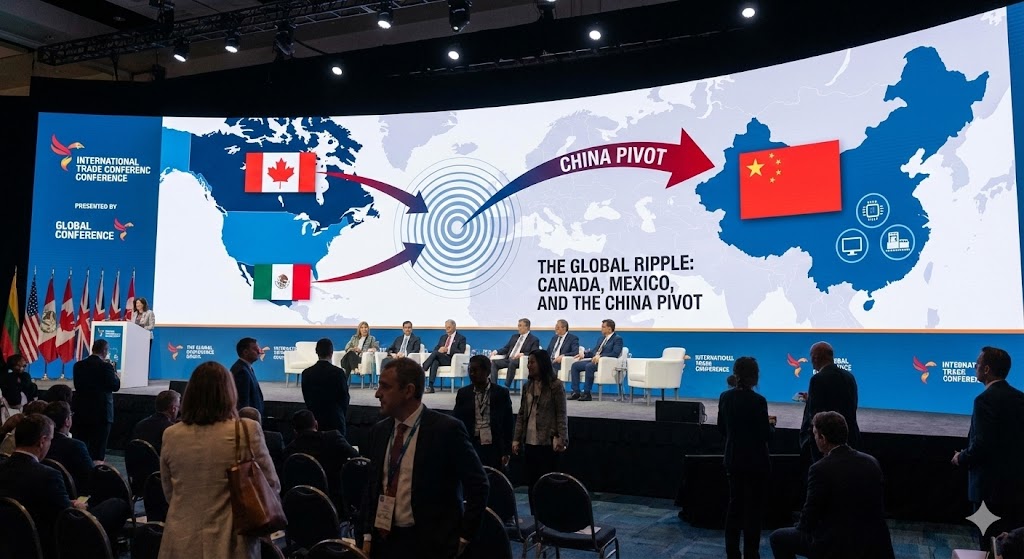
The impact of US tariff volatility is not limited to India. It is reshaping trade behavior across continents.
In Canada, exports to the US have fallen to around 67% of total exports, a multi-year low. This decline has forced political leaders, including Prime Minister Mark Carney, to openly discuss a pivot toward Asian markets.
Mexico, traditionally one of the biggest beneficiaries of US supply chain shifts, has also begun to push back. In response to US pressure, Mexico imposed retaliatory tariffs ranging from 10% to 50% on over 1,000 products. This includes auto components sourced from India, creating a complex, multi-layered trade barrier.
Meanwhile, China appears to have accepted a “managed tariff” regime. Instead of fighting the US head-on, China has quietly redirected exports toward Africa, ASEAN, and Latin America. It is playing a long game.
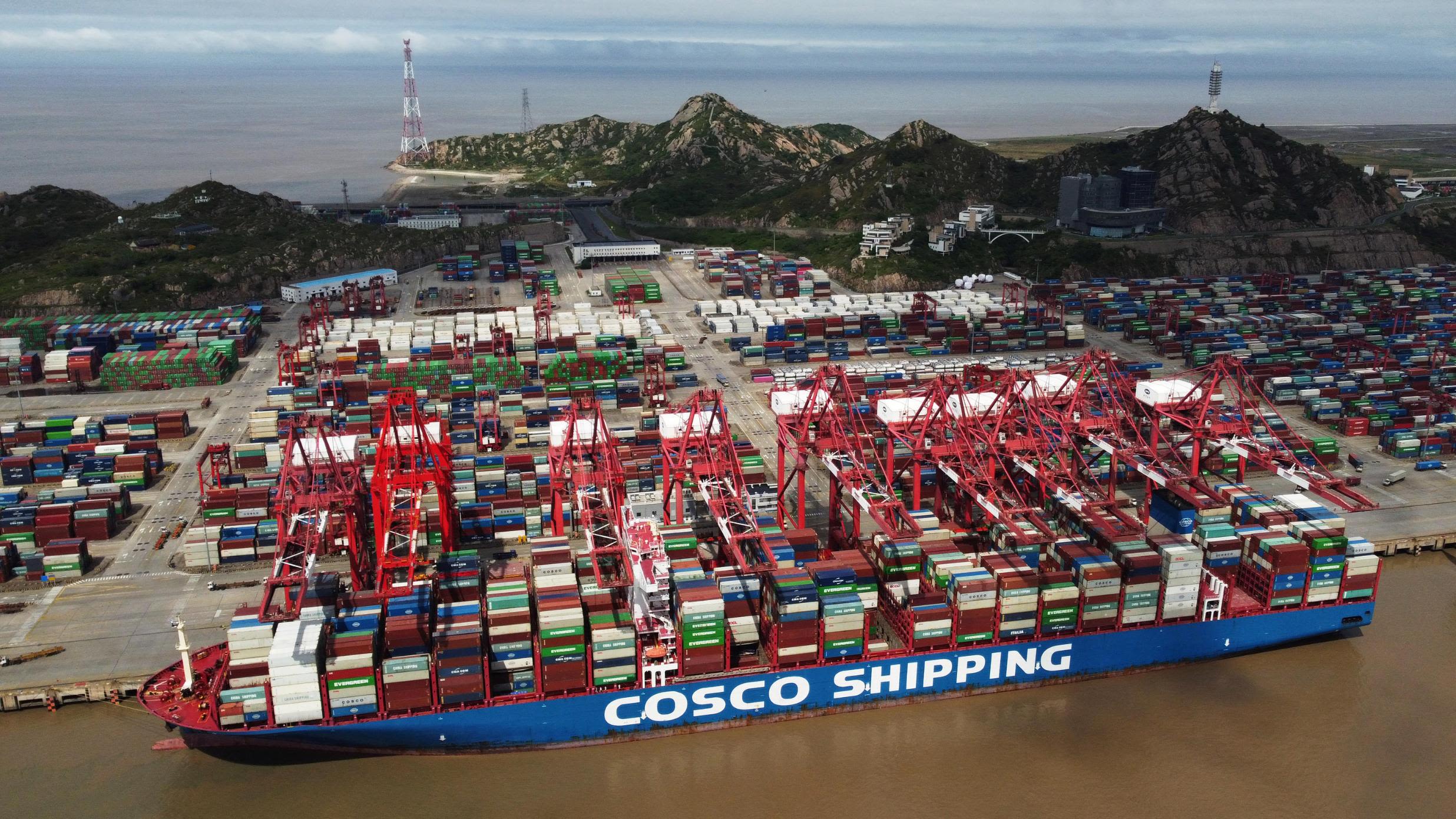
The result is a logistics nightmare. Global shipping giant Maersk noted in its January 2026 update that shipping costs are rising not only due to tariffs, but due to compliance confusion, rerouted supply chains, and unpredictable border rules.
Global trade is not shrinking — it is fragmenting.
5. Geopolitics & Logic: The Triple Catalyst for India
For Indian investors and policymakers, the timing of this trade shock is critical. Three powerful forces are colliding at once.
First, Q3 corporate earnings are about to begin. These results will reveal how much tariff cost Indian companies are absorbing and how much they are passing on to consumers. Early guidance suggests margin pressure in export-heavy sectors.
Second, the Union Budget 2026 is just weeks away. The government faces a difficult choice: respond with countervailing duties or continue diplomatic engagement. Aggressive retaliation could protect domestic industry but risks escalation.
Third, foreign portfolio investors are already nervous. Nearly $19 billion exited Indian markets in 2025. January 2026 has already seen close to $900 million in outflows. Trade uncertainty adds another layer of risk.
Together, these three factors — earnings, policy, and capital flows — make tariff volatility far more dangerous than it appears on the surface.
6. Conclusion: Navigating a Fragmented Global Order
As someone who has watched global trade cycles for over three decades, one conclusion is clear: the era of smooth, rules-based global free trade is effectively on pause.
In 2026, bilateral deals, strategic alliances, and economic pressure tools are replacing multilateral cooperation. Tariffs are no longer economic instruments alone — they are geopolitical weapons.
For India, the answer is not panic or blind retaliation. The real solution lies in accelerating Make in India 2.0, strengthening domestic supply chains, and reducing dependence on imported critical components.
If the world is moving toward a fragmented order, resilience will matter more than access. The countries that invest early in self-reliance, flexibility, and diversified trade partnerships will survive the “500% wall.”
The global trade map is being redrawn. India’s challenge — and opportunity — is to redraw its own role within it.
India–Russia Oil Import Data (Official & Trusted)
Frequently Asked Questions (FAQ)
1. Why is India caught between Russian oil and U.S. markets?
India depends heavily on affordable energy to support economic growth, which is why it continues to buy discounted Russian oil. At the same time, the United States is one of India’s largest export destinations. When the US threatens tariffs on countries trading with Russia, India faces pressure on both energy security and export access.
2. How important is Russian oil for India’s economy?
Russian oil has helped India control inflation and reduce import costs. Since 2022, Russia has emerged as one of India’s top crude oil suppliers, allowing refiners to protect margins and keep fuel prices relatively stable despite global volatility.
3. What is the U.S. “500% tariff” threat actually targeting?
The proposed 500% tariff targets countries that continue buying Russian oil and gas. It is designed to discourage energy trade with Russia by making exports to the US economically unviable. Such a tariff would effectively block access to the American market rather than regulate trade.
4. Which Indian sectors are most at risk from U.S. tariffs?
Export-oriented sectors with thin margins face the highest risk. These include:
Textiles and garments
Gems and jewelry
Auto components
Certain IT and business services through indirect compliance costs
These industries depend heavily on US demand and price competitiveness.
5. Can India easily replace Russian oil with other suppliers?
Not easily. Alternative suppliers often sell oil at higher prices, increasing India’s import bill and inflation risk. Sudden replacement would hurt refiners, raise fuel costs, and pressure the rupee. This is why India prefers diversification rather than abrupt disengagement.
6. How does this situation affect India–US relations?
India–US relations remain strategically strong, but trade tensions add friction. India aims to balance geopolitical alignment with economic realism. This episode tests how much strategic autonomy India can maintain while deepening ties with Western economies.
7. Why hasn’t India reduced exports to the US despite higher tariffs?
Indian exporters have shown strong resilience. Factors such as competitive pricing, currency support, diversified product lines, and long-term contracts have helped exports grow despite tariffs. However, this resilience may weaken if tariff pressure intensifies further.
8. Could India face sanctions like other countries?
Direct sanctions are unlikely, but indirect economic pressure through tariffs, compliance rules, and regulatory barriers is possible. These tools allow pressure without formal sanctions, making them politically easier to deploy.
9. What does this mean for Indian investors?
For investors, this situation increases short-term volatility. Export-heavy stocks, logistics companies, and sectors dependent on US demand may face pressure. At the same time, domestic manufacturing and energy-linked businesses could benefit from policy support.
10. What is India’s long-term solution to such trade risks?
India’s long-term solution lies in:
Strengthening domestic manufacturing
Reducing dependence on critical imports
Diversifying export markets
Accelerating Make in India 2.0
Structural resilience matters more than short-term trade wins in a fragmented global order.
People Also Ask (PAA)
Why does India continue to buy Russian oil despite U.S. pressure?
India buys Russian oil mainly because it is cheaper and helps control inflation. Affordable energy is critical for India’s economic growth. While the US discourages this trade, India prioritizes energy security and economic stability over sudden policy shifts.
Can the US really impose a 500% tariff on India?
Legally, the US can impose very high tariffs under national security or sanctions-related laws. A 500% tariff would not regulate trade but effectively block market access. However, such an extreme step would also disrupt US supply chains and raise costs for American consumers.
How dependent is India on the US export market?
The United States is India’s largest single-country export destination. Sectors like IT services, textiles, jewelry, and auto components rely heavily on US demand, making tariff threats a serious concern for Indian exporters.
What happens if India stops buying Russian oil?
If India reduces Russian oil imports abruptly, it would likely face higher energy costs, increased inflation, and pressure on the rupee. Alternative suppliers usually sell at higher prices, increasing the country’s import bill.
Is this situation similar to a trade war?
This goes beyond a traditional trade war. Instead of reciprocal tariffs, it involves geopolitical conditional trade, where access to markets is linked to foreign policy choices. This marks a new phase of economic pressure.
How are Indian companies reacting to tariff uncertainty?
Many Indian exporters are diversifying markets, renegotiating contracts, absorbing short-term costs, and investing in local manufacturing. Large firms are adapting better, while smaller exporters face greater stress.
Does buying Russian oil hurt India–US strategic relations?
Strategic relations remain strong, but trade tensions create friction. India and the US continue cooperation in defense, technology, and diplomacy, even as they disagree on energy and trade policies.
Why haven’t Indian exports collapsed despite high tariffs?
Indian exports have remained resilient due to competitive pricing, currency support, long-term contracts, and strong demand in certain sectors. However, sustained tariff escalation could weaken this resilience over time.
What does this mean for Indian stock markets?
Markets react negatively to uncertainty. Export-heavy stocks and logistics companies are more vulnerable, while domestically focused manufacturing and infrastructure sectors may benefit from policy support.
Is India moving toward de-risking from US trade dependence?
Yes, gradually. India is expanding trade ties with the Middle East, Africa, ASEAN, and Latin America while promoting domestic manufacturing to reduce dependence on any single export market.
What is the long-term takeaway for India from this crisis?
The key lesson is resilience. In a fragmented global trade order, countries that strengthen domestic supply chains, diversify trade partners, and reduce strategic vulnerabilities will be better positioned to handle external shocks.