
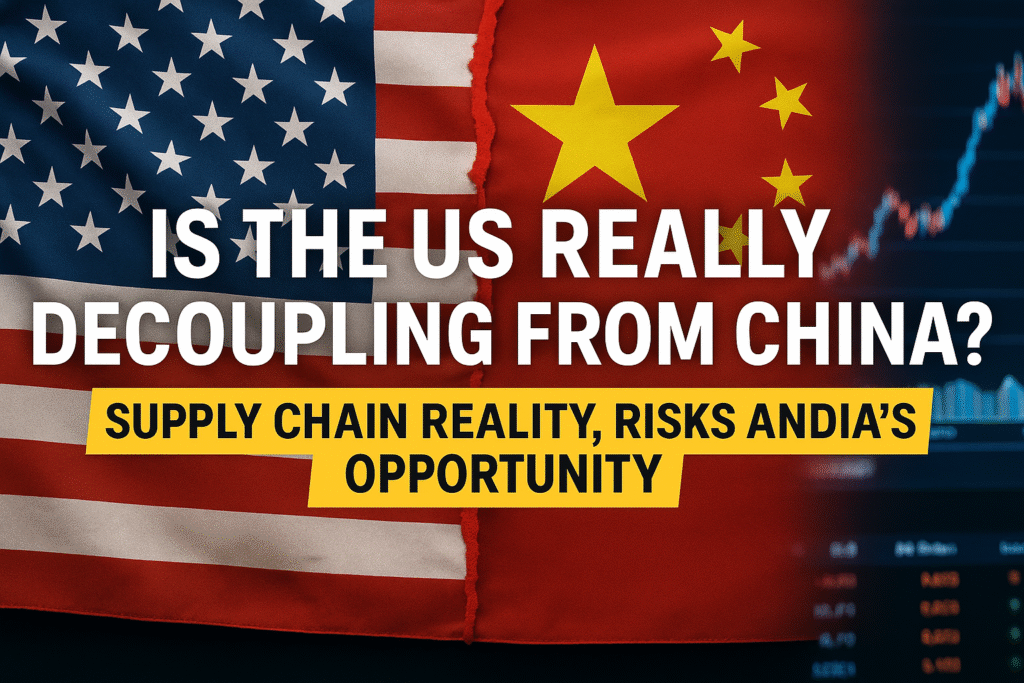
Introduction: Why “Decoupling” Has Become a Global Buzzword
Over the last few years, the word “decoupling” has become one of the most searched and debated terms in geopolitics, economics, and corporate strategy. From policy speeches in Washington to boardrooms of multinational companies, the idea that the United States is cutting its economic dependence on China has taken hold in public imagination. Headlines often suggest that global supply chains are being torn apart and rebuilt from scratch, with China slowly being replaced.
But when we move beyond political messaging and social media narratives, the reality looks far more complex. While the US has clearly changed its approach toward China, calling it a strategic competitor rather than a partner, this does not automatically translate into a clean economic break. Trade volumes, investment flows, and corporate sourcing data show a more nuanced picture—one where selective separation exists alongside deep and continuing interdependence.
For countries like India, this debate is especially important. Decoupling is not just a US–China issue; it is reshaping global manufacturing, investment decisions, and trade routes. Understanding what is really happening—and what is not—is essential for businesses, consultants, and policymakers who want to position themselves correctly in the evolving global economy.
What Supply Chain Decoupling Really Means
At its core, supply chain decoupling refers to the deliberate reduction of economic interdependence between two countries, particularly in critical sectors. In theory, full decoupling would mean shifting production, sourcing, and technology ecosystems away from China and rebuilding them elsewhere. However, in practice, what we are seeing is not pure decoupling but a mix of de-risking and diversification.
De-risking means reducing excessive dependence on a single country for critical inputs, without completely abandoning it. Diversification involves spreading production across multiple countries to avoid disruptions. Many public debates confuse these terms, leading to exaggerated conclusions. When a US company shifts part of its production to Vietnam or India, it does not necessarily mean it has exited China. Often, China remains a key supplier of components, machinery, or raw materials.
Another misconception is that decoupling is happening uniformly across all sectors. In reality, the process is highly selective. Strategic and security-sensitive industries see far more separation, while consumer goods and low-margin manufacturing remain deeply tied to China due to cost, scale, and infrastructure advantages.
Why the US Wants to Reduce Dependence on China
The push to reduce reliance on China is driven by a combination of strategic, economic, and political factors. National security is at the top of the list. US policymakers worry that dependence on China for critical technologies—such as semiconductors, telecommunications equipment, and defense-related components—creates vulnerabilities in times of conflict or crisis.
The COVID-19 pandemic reinforced these concerns. Shortages of medical supplies, pharmaceuticals, and personal protective equipment exposed how concentrated global supply chains had become. Many US lawmakers concluded that overdependence on China was not just an economic risk but a public health risk as well.
Technology competition adds another layer. Advanced chips, artificial intelligence, and quantum computing are now seen as strategic assets. The US fears that allowing China unrestricted access to cutting-edge technology could weaken its military and economic edge. As a result, export controls, investment screening, and industrial subsidies have become central tools in US policy.
Key Sectors Undergoing Decoupling
Not all industries are treated equally in the decoupling debate. Semiconductors are the most visible example. The US has imposed strict controls on advanced chip exports to China and is investing heavily in domestic manufacturing through industrial policies. While China remains a major consumer of chips, access to the most advanced technology is being deliberately restricted.
Pharmaceuticals are another area of concern. The US imports a significant share of active pharmaceutical ingredients from China and India. Policymakers are now encouraging domestic production and “friendly sourcing” to reduce reliance on a single geography.
Rare earth elements represent a strategic vulnerability. China dominates global processing capacity for these materials, which are essential for electronics, renewable energy, and defense systems. The US and its allies are investing in alternative supply chains, though progress is slow and costly.
Electronics manufacturing shows a more mixed picture. Final assembly is gradually moving to countries like Vietnam and India, but many components still originate in China. This highlights the limits of rapid decoupling.
Official website of World Trade Organization (WTO) click now
China’s Response Strategy
China has not remained passive in the face of US policy shifts. One major response has been domestic substitution. Beijing is investing heavily in developing its own technology ecosystem, particularly in semiconductors, operating systems, and industrial machinery. While progress is uneven, the long-term goal is clear: reduce dependence on foreign suppliers.
China has also adjusted its Belt and Road Initiative, focusing more on strategic and regional partnerships rather than grand global projects. Trade ties with the Global South—including Southeast Asia, Africa, Latin America, and parts of the Middle East—have strengthened. These regions now account for a growing share of China’s trade, offsetting some losses from Western markets.
In essence, China is diversifying its economic relationships just as the US is, reinforcing the idea that globalization is evolving rather than collapsing.
Who Is Benefiting from the Shift?
Several countries are emerging as partial beneficiaries of supply chain realignment. India stands out due to its large domestic market, improving infrastructure, and policy push for manufacturing. Global firms in electronics, pharmaceuticals, and auto components are expanding operations in India to reduce China concentration.
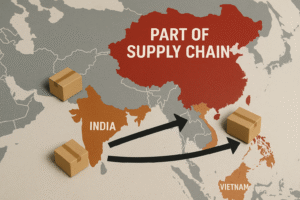
Vietnam has benefited significantly from electronics and apparel manufacturing relocation, thanks to its export-oriented policies and proximity to China. Mexico is gaining from nearshoring trends, especially for US-bound manufacturing that requires shorter supply chains. Eastern Europe, particularly countries close to the EU, is attracting investment in automotive and industrial manufacturing.
However, it is important to note that these gains are incremental, not absolute replacements for China. No single country currently matches China’s scale, efficiency, and ecosystem depth.
The Cost of Decoupling
Decoupling is not cheap. Shifting production away from China often leads to higher costs due to less developed infrastructure, lower productivity, or higher labor expenses. These costs ultimately feed into inflation.
For US consumers, this can mean higher prices for electronics, household goods, and vehicles. For businesses, it means tighter margins or the need to redesign products and supply networks. Governments also bear fiscal costs through subsidies and incentives designed to attract manufacturing.
From a global perspective, widespread decoupling could reduce efficiency and slow growth, especially if geopolitical considerations override economic logic.
Can the US Fully Exit China? A Reality Check
Trade data suggests that a full exit is highly unlikely. Despite tariffs and tensions, China remains one of the US’s largest trading partners. While the composition of trade has changed, total volumes remain significant. Many US companies still rely on China for components, intermediate goods, and consumer products.
China’s dominance in certain manufacturing stages makes complete decoupling impractical in the short to medium term. Rebuilding entire ecosystems elsewhere takes time, capital, and coordination. This is why most experts believe the future lies in selective separation rather than total disengagement.
Future of Global Supply Chains
The future points toward regionalization rather than the end of globalization. Supply chains are becoming more distributed, with production hubs emerging in Asia, North America, and Europe. Companies are prioritizing resilience alongside efficiency.
India has a major role to play here. If it continues to improve logistics, regulatory clarity, and skill development, it can become a central node in diversified global supply chains. However, competition is intense, and policy consistency will be key.
US–China Trade War 2025: Global Stock Market Impact, Sector Winners & What It Means for Indian Investors. Read Now
Conclusion: Strategic Takeaways for Businesses and Investors
The narrative of complete US–China decoupling is oversimplified. What is really happening is a gradual, selective rebalancing of global supply chains driven by security concerns, risk management, and geopolitical competition.
For businesses and investors, the lesson is clear: China is not disappearing from global supply chains, but its role is changing. India stands to benefit if it plays its cards right—by focusing on competitiveness, scale, and long-term policy stability.
Decoupling, in reality, is less about separation and more about strategic adaptation. Those who understand this nuance will be best positioned in the new global economic order.






1 thought on “Decoupling from China? The Real Story Behind US Supply Chain Strategy and India’s Rising Role”