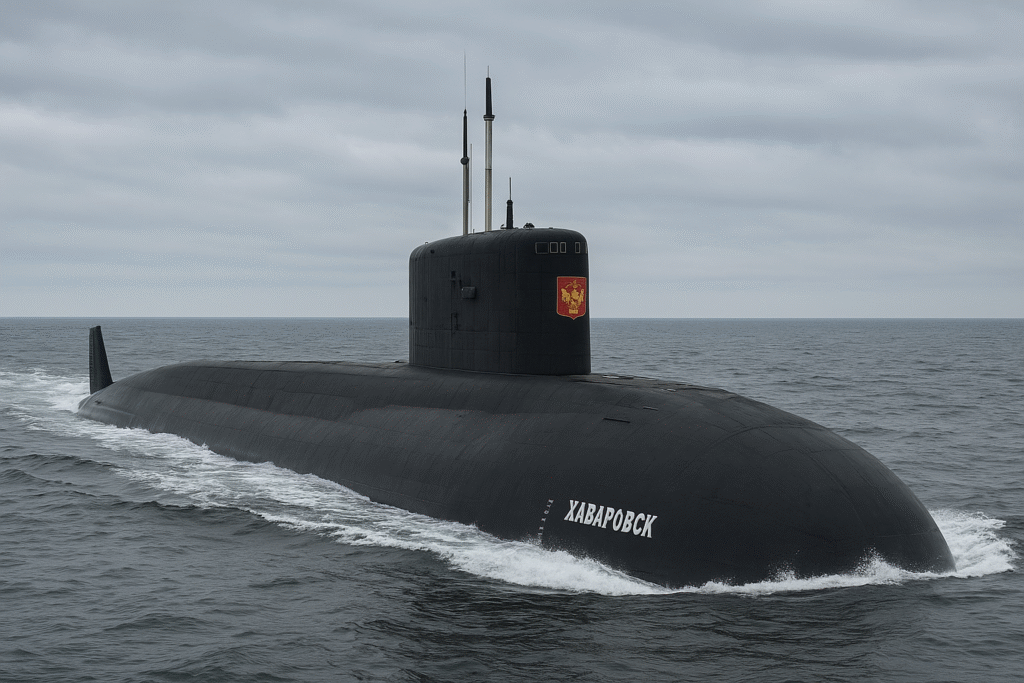
Russia Launches World’s Most Dangerous Submarine ‘Khabarovsk’: Full Specifications, Comparison, and Impact on Indian Navy
Introduction: Russia Unveils the Fearsome ‘Khabarovsk’ Submarine
Russia has once again shaken the global defence landscape by launching its most advanced nuclear-powered submarine, the Khabarovsk-class (Project 09851). Nicknamed the “world’s most dangerous submarine”, this powerful vessel was launched at the Sevmash Shipyard in Severodvinsk in November 2025.
What makes it so deadly? The Khabarovsk carries the Poseidon nuclear-powered underwater drones, also known as the “Doomsday Torpedoes,” capable of traveling thousands of kilometers underwater and carrying nuclear warheads. Let’s dive deep into its specifications, how it compares with the best submarines in the world, whether India could buy it, and its implications for global naval power.
Complete Specifications of Russia’s Khabarovsk Submarine
The Khabarovsk submarine is part of Russia’s secretive strategic underwater program designed to dominate the deep sea. Below are the key specifications available from open sources:
| Parameter | Details |
|---|---|
| Class & Project | Khabarovsk-Class (Project 09851) |
| Type | Nuclear-Powered Special-Purpose Submarine |
| Builder | Sevmash Shipyard, Russia |
| Designer | Rubin Design Bureau |
| Displacement | Approx. 10,000 tons |
| Length | Around 113 meters |
| Beam (Width) | 10 meters |
| Speed | Up to 30–32 knots (underwater) |
| Operating Depth | 500 meters (approx.) |
| Crew Capacity | Around 100 personnel |
| Endurance | 90–120 days at sea |
| Armament | Up to 12 Poseidon Nuclear Drones |
| Propulsion | Nuclear Reactor |
| Primary Role | Strategic Deterrence & Underwater Drone Deployment |
Why It’s Called the World’s Most Dangerous Submarine
The Khabarovsk’s uniqueness lies in its Poseidon drones — nuclear-powered torpedoes that can travel autonomously across oceans at extreme depths. These drones can cause devastating nuclear tsunamis and render coastal cities uninhabitable. The combination of stealth, nuclear power, and unmanned weapons makes it a terrifying addition to Russia’s naval arsenal.

Khabarovsk vs World’s Best Submarines: A Detailed Comparison
| Submarine Class | Country | Type | Displacement | Key Features |
|---|---|---|---|---|
| Khabarovsk (Project 09851) | Russia | Strategic Drone Carrier | 10,000 tons | Carries 12 Poseidon drones, nuclear-powered |
| Virginia-Class Block V | USA | Attack Submarine | 10,200 tons | 40 Tomahawk missiles, advanced stealth |
| Yasen-M Class | Russia | Attack / Cruise Missile Sub | 13,800 tons | Tsirkon Hypersonic missiles |
| Borei-A Class | Russia | Ballistic Missile Submarine | 24,000 tons | Bulava SLBMs, second-strike capability |
| Type 095 | China | Nuclear Attack Sub | 7,000 tons | Pump-jet propulsion, modern sonar |
Why Khabarovsk Stands Out
Unique Mission: It’s not an attack submarine — it’s a strategic deterrence platform carrying unmanned nuclear drones.
Long Endurance: Nuclear propulsion gives it almost unlimited underwater range.
Stealth Advantage: Minimal noise signature due to advanced hull design.
Psychological Weapon: Its existence itself acts as a deterrent, reshaping naval warfare concepts.
In short, while submarines like the Virginia-class dominate in versatility, and the Yasen-M in firepower, Khabarovsk’s Poseidon drones give it a unique edge in doomsday-level deterrence.

Can India Buy the Khabarovsk for Its Navy?
The question of whether India can or should buy the Khabarovsk submarine sparks strategic curiosity.
Possibility
Realistically, India cannot purchase the Khabarovsk because:
It’s a strategic nuclear weapons platform, not meant for export.
Russia strictly controls its nuclear technologies under international non-proliferation treaties.
It’s designed for Russian strategic deterrence, not conventional naval warfare.
However, India can learn from its technology:
The integration of unmanned underwater drones.
Use of nuclear propulsion for long-endurance missions.
Advanced sonar and stealth hull coatings for reduced detection.
Practical Barriers
Cost could exceed $4–5 billion per unit.
Need for nuclear-trained crew and special infrastructure.
Doctrinal mismatch — India’s submarine fleet focuses on diesel-electric (AIP) and ballistic missile submarines (Arihant-class).
So, while buying Khabarovsk is not feasible, adapting its technology into India’s indigenous submarine program is both realistic and desirable.

Top 10 Submarines in the World (2025 Update)
| Rank | Submarine Class | Country | Type | Key Features |
|---|---|---|---|---|
| 1 | Virginia-Class Block V | USA | Nuclear Attack | Stealth, VPM module, cruise missiles |
| 2 | Yasen-M Class | Russia | Cruise Missile Sub | Tsirkon hypersonic missiles |
| 3 | Borei-A Class | Russia | SSBN | Carries 16 Bulava SLBMs |
| 4 | Khabarovsk-Class (Project 09851) | Russia | Strategic Drone Carrier | Poseidon drones, long endurance |
| 5 | Type 095 Class | China | Nuclear Attack | Next-gen quiet propulsion |
| 6 | Suffren (Barracuda-Class) | France | Attack | Cruise missiles, modular design |
| 7 | KSS-III Batch II | South Korea | Diesel-Electric / AIP | SLBM capability |
| 8 | Type 212CD | Germany/Norway | AIP | Ultra-stealth fuel-cell system |
| 9 | A26 Blekinge-Class | Sweden | Conventional | Modular UUV systems |
| 10 | Kalvari-Class (India) | India | Diesel-Electric | Indigenous production, AIP-ready |
Advantages of Khabarovsk Submarine
Unprecedented Strategic Deterrence – Poseidon drones can strike coastal cities from underwater.
Deep-Sea Operation Capability – Can operate silently at depths over 500 meters.
Nuclear Propulsion – Unlimited underwater endurance.
Autonomous Weapons System – Drone-based warfare revolution.
Global Range – Can patrol and strike across continents.
Psychological Edge – Creates fear and uncertainty in adversaries’ naval doctrines.
Disadvantages of Khabarovsk Submarine
Extremely High Cost – Development and maintenance costs are massive.
Limited Versatility – Designed mainly for strategic deterrence, not for multiple combat roles.
Complex Logistics – Requires high-end nuclear infrastructure and training.
Diplomatic Risks – Deployment may raise tensions and arms-race fears.
Export Restrictions – Unlikely to be shared with other nations, including India.
Operational Risk – Autonomous nuclear drones pose command and control challenges.
How Khabarovsk Could Reform the Indian Navy (If Acquired)
If India ever acquired or developed a submarine like Khabarovsk, it could revolutionize its naval capabilities:
Boost Strategic Deterrence: Strengthen second-strike capabilities and ensure undersea dominance in the Indian Ocean.
Technological Leap: Enhance nuclear propulsion, sonar, and stealth research.
Deterrence Against China: Provide a powerful deterrent in the Indo-Pacific balance.
Force Multiplier: Would allow India to patrol deep seas for extended durations without surfacing.
Industrial Growth: Encourage Indian shipyards (Mazagon Dock, L&T) to develop next-gen submarine designs.
However, this would require decades of technological transfer, indigenous R&D, and infrastructure investment.
Should India Buy It? Expert Analysis
Pros:
Unmatched strategic advantage.
Deterrent against nuclear and naval threats.
Strengthens India-Russia defence ties.
Cons:
High cost, limited export availability.
Doctrinal mismatch with India’s needs.
Risk of technology dependency on Russia.
Complex to maintain and integrate.
Verdict:
India should not buy Khabarovsk directly, but focus on developing indigenous nuclear submarines inspired by its technology. The upcoming INS Arighat and follow-up SSBNs should prioritize long-range stealth, nuclear propulsion, and advanced underwater drones.
Conclusion
The Khabarovsk submarine represents a new era of naval warfare — where autonomous, nuclear-powered underwater drones redefine strategic deterrence. It’s not just another submarine; it’s a symbol of undersea supremacy and technological might.
For India, while direct acquisition isn’t practical, the lessons from Khabarovsk’s innovation can guide future submarine projects. Strengthening indigenous programs like Project 75(I) and Arihant-class SSBNs, along with deeper Russia-India defence collaboration, could help India achieve similar capabilities in the next decade.
In the end, the world’s most dangerous submarine isn’t just about destruction — it’s about deterrence, power projection, and the evolution of undersea warfare.