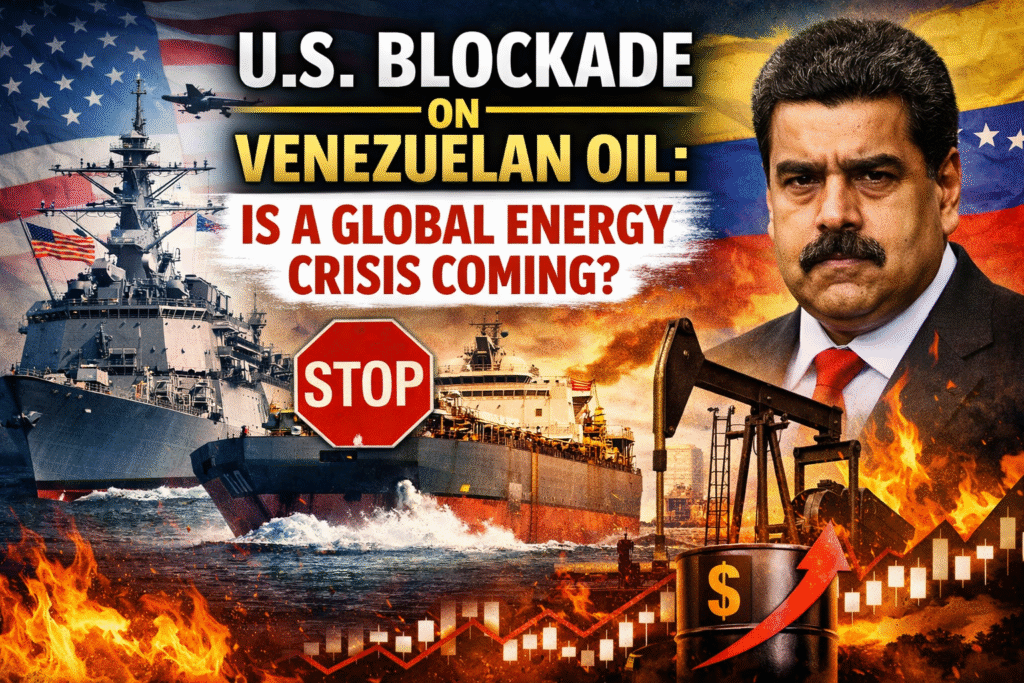
📌 U.S. Blockade on Venezuelan Oil: A Global Shockwave Explained
In a dramatic escalation of tensions, U.S. President Donald Trump has ordered a “total and complete blockade” of all sanctioned oil tankers entering or leaving Venezuela. This is not just a new headline — it’s one of the most consequential geopolitical moves in the Western Hemisphere in decades, targeting the economic lifeline of a nation that holds the world’s largest proven crude oil reserves.
The decision, announced in mid-December 2025, designates Venezuela’s government and associated oil operations as linked to narcotrafficking and terrorism — a shift that carries not just economic but also legal and strategic weight. The stated goal of the blockade is to cut off President Nicolás Maduro’s main source of revenue and to pressure his government into political change. Yet the method — effectively an economic siege enforced by naval presence — carries historic echoes of conflict and raises critical questions about international norms.
This article breaks down what is happening, why it matters, and how it could reshape global oil markets, regional stability, and international law.
🌍 Introduction: What the U.S. Decision Means and Why You Should Care
On December 16, 2025, the U.S. administration publicly declared a blockade on sanctioned Venezuelan oil tankers — a move that military and energy analysts say could seriously strangle the cash flow that keeps Venezuela’s fragile economy afloat. Oil is the backbone of the Venezuelan state: it accounted for well over 90% of export revenues for decades, though volumes have collapsed from over 3 million barrels per day (bpd) in the 1990s to under 1 million bpd in recent years due to mismanagement and sanctions.
This action is not happening in a vacuum. The world already faces a fragile oil market, lingering inflation concerns, and geopolitical competition spanning the Middle East to Eastern Europe. Venezuela’s crude — especially its heavy, extra-heavy grades — is a key input for global refiners that process lower-quality crude for fuel products. Disruptions ripple out to energy prices, freight costs, and ultimately what consumers pay at the pump. In fact, following the blockade announcement, Brent crude prices rose more than 1% as traders priced in the risk of reduced exports.
For everyday people, this could translate into higher gasoline costs, increased inflationary pressure on goods (because fuel is needed to ship products), and heightened geopolitical risk that shapes world markets in 2026.
🔎 What Exactly Is Happening Now
🛑 U.S. Naval Blockade and Seizures

President Trump’s announcement was more than rhetoric. The U.S. military has moved significant naval assets — including warships and aircraft carriers — into Caribbean waters near Venezuela to enforce the blockade. At least one sanctioned tanker, the Skipper, was seized by U.S. authorities off Venezuela’s coast earlier in December.
According to reporting, over 30 sanctioned vessels remain in Venezuelan waters or unable to move without fear of seizure — sharply curtailing exports.
🌎 International Reactions
The move has triggered diplomatic pushback. Russia, a long-standing ally of Venezuela, publicly warned the U.S. against what it called a “fatal mistake,” highlighting the risk of destabilizing the broader Western Hemisphere.
Mexico’s president has urged the United Nations to intervene to prevent bloodshed and stressed peaceful resolution over foreign intervention.
Meanwhile, President Nicolás Maduro has denounced the blockade as imperialist aggression designed to seize control over Venezuela’s wealth, and ordered his navy to escort tankers bound for Asia — a direct defiance of U.S. actions.
⚠️ Military Engagements and Regional Tension
The U.S. has conducted a separate series of maritime strikes, claiming they target drug smuggling linked to Venezuelan networks. Independent reports attribute nearly 100 deaths to these interdictions, fueling ethical and legal controversies.
The combined picture: blockade enforcement, military presence, and escalating rhetoric — a cocktail that carries real risk of unintended confrontations.
⚡ Why This Matters
🛢️ Impact on Global Oil Markets
Venezuela’s exports, though lower than historical highs, still matter. Analysts estimate the blockade could affect up to 600,000 barrels per day of exports — a meaningful amount in the global balance, especially for heavy crude markets.

China — Venezuela’s largest buyer — historically accounts for roughly three-quarters of crude exports, with the U.S. itself importing around 17% of Venezuelan oil output in 2025, according to shipment data.
If these flows are significantly disrupted, markets could tighten, lifting prices and adding inflationary pressure. Even rumors or partial enforcement can move oil futures — as seen with recent price bumps after the blockade announcement.
🌎 Regional Stability & Politics
Latin American countries are split. Some governments call for diplomacy, while others back Venezuela’s sovereignty. The risk is that economic hardship inside Venezuela — already driving migration to neighboring countries — worsens, sparking broader social and economic instability across the region.
Further, increased military deployments — including U.S. carriers and jets in the Caribbean — heighten the risk of accidents or escalation, especially in international waters and airspace.
🧠 International Law Questions
Blockades have traditionally been instruments of war. Legal scholars argue that enforcing a naval blockade without a clear declaration of war or UN mandate could violate international norms. Critics in the U.S. Congress have called it “an act of war” requiring congressional approval, while the administration prefers the term “quarantine” to avoid legal implications.
These debates matter because they frame the legitimacy of U.S. actions and influence how allies and international institutions respond.
🔍 Explainer: What Led to This Escalation
📌 U.S. Accusations Against Maduro’s Government

The Trump administration has accused Venezuela’s leadership of using oil revenues to finance narcotrafficking networks and corruption — allegations that underpin sanctions and the current blockade strategy. The U.S. has also designated factions within Venezuela’s power structures as linked to “narco-terrorism.”
📌 Economic Sanctions and Tariffs
Earlier in 2025, the U.S. imposed a 25% tariff on countries importing Venezuelan oil, aiming to further isolate Venezuela economically. This unprecedented trade tactic signaled a hardening U.S. stance before the blockade.
📌 Military Operations Beyond the Blockade
Beyond naval enforcement, the U.S. military has engaged alleged drug traffickers at sea in operations that some observers see as part of a broader pressure campaign. These actions are rooted in a larger strategy to curb narcotics flows, but are entangled with wider geopolitical pressure on Venezuela.
🌐 What This Means for the World
🔹 Oil Prices Could Fluctuate
If Venezuelan exports drop sharply, the loss of hundreds of thousands of barrels per day could push global benchmarks higher, especially for heavy crude blends. Traders are already pricing in such risks.
🔹 Geopolitical Realignment
With Russia vocal in its support for Maduro and Mexico appealing to the UN, the crisis could realign alliances and pressure regional institutions to take unprecedented stands. Such realignments can have lasting effects beyond oil, ranging from trade to defense cooperation.
🔹 Humanitarian & Migration Impact
Venezuelans have already endured mass migration over the past decade. Further economic strangulation — if oil revenue dries up — could accelerate displacement into neighboring countries, straining social services and cross-border relations.
To visit official website of USA Navy click here
❓ Quick FAQ (Great for SEO)
What is the U.S. blockade on Venezuelan oil?
It’s a naval enforcement effort by the U.S. to prevent sanctioned Venezuelan oil tankers from entering or leaving Venezuelan ports, intended to choke off revenue to the Maduro government.
Could this lead to war?
Legal experts warn that blockades resemble acts of war under international law unless backed by a UN mandate — making the current situation a serious flashpoint.
How might this affect oil prices?
Oil prices have already reacted with modest increases. If exports tighten further, futures markets could rise more sharply, affecting consumer fuel prices globally.
What do Venezuela’s allies think?
Russia has warned the U.S. against escalation, Mexico has sought UN mediation, and Venezuela has defiantly continued exports through alternative naval arrangements.
📌 Conclusion: A Turning Point with Far-Reaching Stakes
What is unfolding between the U.S. and Venezuela is not just another diplomatic spat — it is a strategic confrontation with implications for energy security, international law, regional stability, and everyday global economics. From rising oil prices to legal debates over blockades and war powers, the ripple effects will likely shape headlines well into 2026.
The world is watching: some with hope for democratic change in Venezuela, others with fear of widening conflict or economic disruption. Whatever happens next, the stakes are high — not just for Caracas and Washington, but for global markets and ordinary citizens whose lives depend on stable energy supply and peaceful cooperation.
To visit official website of the White House. click here
📌 FAQ: U.S.–Venezuela Oil Blockade Explained
1️⃣ What is the U.S. blockade on Venezuelan oil?
The blockade is a U.S. military and economic action that restricts Venezuelan oil tankers from entering or leaving ports if they are under sanctions. It prevents Venezuela from selling crude internationally, mainly to countries like China, India, and Cuba. The purpose is to cut off oil revenue to President Nicolás Maduro’s government, which the U.S. accuses of corruption and narcotrafficking.
2️⃣ Why did the United States launch this blockade now?
The move is part of Washington’s long-running strategy to pressure the Maduro government into democratic reforms. It follows years of sanctions and accusations that Venezuela uses oil profits illegally. U.S. military forces in the Caribbean were already active under anti-narcotics operations, which made enforcement easier.
3️⃣ How does this blockade affect oil prices globally?
Venezuelan crude exports are between 550,000–700,000 barrels per day. Even partial removal from the market pushes prices higher because global supply tightens. After the blockade announcement, oil benchmarks like Brent crude showed immediate upward movement as traders priced in supply risk.
4️⃣ Could this crisis lead to a war between the U.S. and Venezuela?
Direct war is unlikely, but military clashes are possible. A blockade is legally close to an “act of war” under international law. With U.S. warships in the Caribbean and Venezuelan naval escorts guarding tankers, the risk of miscalculation or a naval incident is very real.
5️⃣ Why is Russia reacting strongly to the blockade?
Russia has billions invested in Venezuela’s oil fields, infrastructure, and loans. If Venezuela collapses economically, Moscow loses influence and money. That’s why the Kremlin warned the U.S. against a “fatal mistake” and called the blockade illegal.
6️⃣ What role are Mexico and Latin American nations playing?
Mexico has publicly supported Venezuela and asked the United Nations to intervene to avoid conflict. Other nations like Colombia and Brazil are watching carefully — fearful of a refugee surge if Venezuela’s economy breaks down further.
7️⃣ Will consumers feel this crisis in their pocket?
Yes. Global fuel and transportation prices could rise. Even a small jump in crude prices increases:
petrol & diesel rates
shipping costs
airline ticket prices
food prices
Because most goods move using fuel, energy shocks spread everywhere.
8️⃣ Can Venezuela survive without selling oil to the U.S.?
Venezuela already shifted away from the U.S. market and exports mostly to China. But losing tanker access and insurance will hurt badly. Without consistent exports, the government will struggle to pay salaries, import food, and maintain its energy grids.
9️⃣ How long can a blockade like this legally continue?
There is no global limit, but international law requires justification. Without United Nations approval, critics argue the blockade may violate maritime freedom rules. The longer it lasts, the louder legal protests will become.
🔟 Is this the beginning of a new global energy crisis?
It could be, depending on how markets react. Oil tensions in the Middle East + Venezuela blockade + Russia-Ukraine fallout together create a high-risk global environment. If Venezuelan supply collapses, prices may surge into 2026.
📌 People Also Ask (PAA)
1️⃣ Why did the United States block Venezuelan oil tankers?
Because the U.S. claims Venezuela uses oil revenue to support corruption, narcotrafficking networks, and anti-democratic activities.
2️⃣ How much oil does Venezuela export to the world?
Venezuela exports around 550,000–700,000 barrels per day, mainly to China, Cuba, and Asia.
3️⃣ Will the U.S.–Venezuela blockade increase global oil prices?
Yes. Reduced supply pressure can push crude oil and gasoline prices upward globally.
4️⃣ Is Venezuela’s oil important for global energy supply?
Venezuela holds the world’s largest proven oil reserves — over 300 billion barrels, making its crude vital to world markets.
5️⃣ Could Venezuela respond militarily to the U.S. blockade?
Venezuela has warned of military resistance, and its navy has begun escorting tankers, increasing risks of confrontation.
6️⃣ Why is Russia supporting Venezuela?
Russia invested billions in Venezuela’s oil industry and views U.S. actions as a threat to its geopolitical interests.
7️⃣ Will the blockade cause fuel price rise in the United States or India?
If oil markets tighten, gasoline, diesel, and LPG prices can increase globally, including India and the U.S.
8️⃣ How is China reacting to the Venezuela blockade?
China is continuing to buy Venezuelan crude and may increase naval escorts to protect shipments.
9️⃣ Can Venezuela bypass U.S. naval blockades?
Ships can reroute through proxy nations, but insurance issues and seizure risks make it extremely difficult.
🔟 Is Venezuela heading toward economic collapse again?
If oil exports fall further, Venezuela may face hyperinflation, food shortages, and deeper poverty.
1️⃣1️⃣ What does the blockade mean for 2026 global energy outlook?
Analysts say energy markets may face new volatility, especially if Middle East tensions continue.
1️⃣ How will the Venezuela oil blockade affect gas prices in the United States?
U.S. gasoline prices could rise if Venezuelan heavy crude disappears from the market, especially for Gulf Coast refiners that rely on similar grades. Even a $3–$5 increase per barrel can raise pump prices across states like Texas, Florida, and California.
2️⃣ Why is the U.S. targeting Venezuelan oil under Trump’s new order?
The U.S. government claims Venezuelan oil revenue supports corruption, drug networks, and anti-American activities, and is pushing for democratic change.
3️⃣ Could this crisis impact U.S. jobs in the oil industry?
Yes. Higher input costs may affect refining jobs, shipping routes, and investment decisions in U.S. oil hubs such as Houston and Louisiana.
4️⃣ Is this blockade legal under international law?
Experts warn that blockades without UN approval resemble acts of war, which is why legal debates are heating up inside the U.S. Congress.
5️⃣ Will the blockade push the U.S. into conflict with Russia or China?
The U.S. risks global escalation because both Russia and China support Venezuela. Tensions could spill into the Caribbean or trade relations.
1️⃣ Will the Venezuela blockade push petrol and diesel prices higher in India?
Yes. India’s fuel prices move with global oil benchmarks like Brent. Any supply squeeze can push petrol and diesel rates upward — affecting transport and inflation.
2️⃣ Why should Indians care about U.S.–Venezuela oil tensions?
India imports more than 85% of its oil from abroad. Any disruption in global supply, even outside Asia, directly affects household budgets and business transport costs.
3️⃣ Is India still buying Venezuelan oil?
India reduced Venezuelan crude imports after U.S. sanctions, shifting focus to Middle East suppliers. But with global shortages, buyers may look again at alternative sources.
4️⃣ Will cooking gas (LPG) become more expensive because of this crisis?
If global oil prices rise, LPG import costs will also jump, affecting Indian household budgets and subsidy pressure.
5️⃣ Can India benefit from higher oil prices?
Higher crude prices hurt India overall, but oil companies exporting refined fuel products — like Reliance — may see short-term profit gains.