Introduction: A New “Holy War” Narrative?
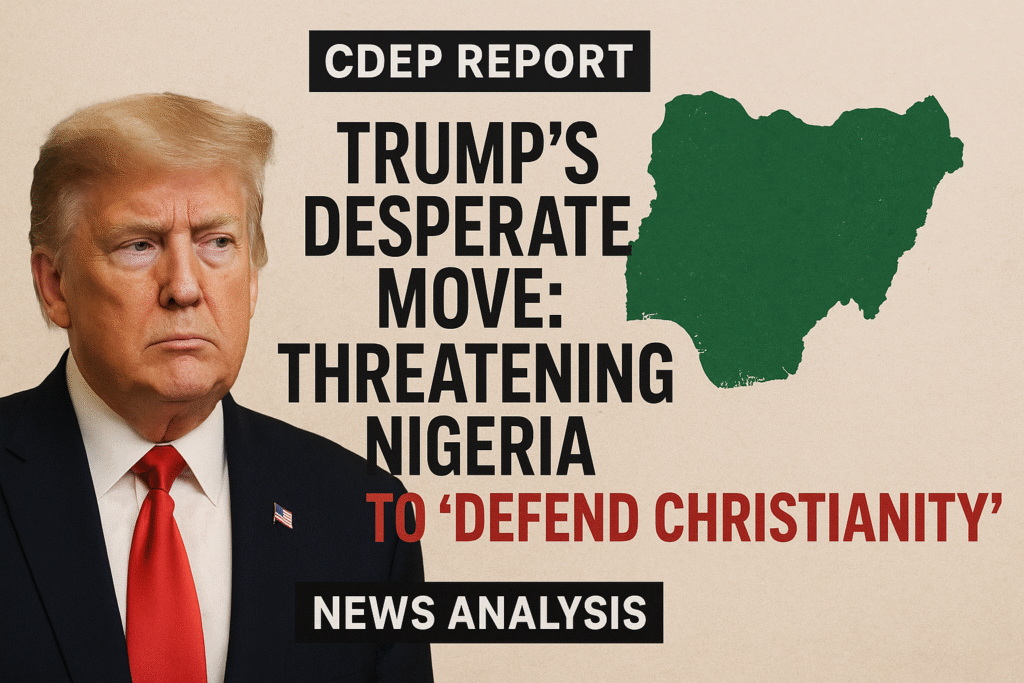
Donald Trump’s latest threat to attack Nigeria has set the global political community abuzz.
In a fiery post on social media, the U.S. President vowed to “defend Christians around the world”, claiming that Nigeria’s government has failed to stop persecution.
However, political analysts believe this is not merely about religion — it’s a strategic move to revive his image among frustrated Make America Great Again (MAGA) supporters who feel let down by his unfulfilled campaign promises.
CDEP Analytical Summary
According to a policy brief from the Center for Democratic and Economic Policy (CDEP), Trump’s announcement reflects a pattern:
“When domestic performance metrics weaken — such as GDP stagnation, MAGA infrastructure delays, or border-security gridlock — the administration resorts to high-visibility foreign gestures to re-energize its political base.”
The CDEP report points out that U.S. intervention in Nigeria, if executed, would mark the first large-scale Christian-protection campaign under the Trump Doctrine — but would also signal domestic political desperation.
The Official Reason: “Protecting Christianity”
Trump justified his Nigeria threat by citing rising extremist violence against Christians. He declared Nigeria a “Country of Particular Concern” under U.S. religious-freedom law, promising to suspend aid and launch strikes if the killings continue.
“If the Nigerian government cannot protect its Christian citizens, America will,” Trump wrote.
While Christian-majority groups in the U.S. applauded the declaration, foreign-policy experts note that Trump has yet to offer concrete evidence of new massacres warranting an international strike.
Reaction of Nigeria’s Government
Nigerian President Bola Ahmed Tinubu strongly rejected Trump’s narrative, saying:
“Nigeria is not a religiously intolerant nation. We fight terrorism in all its forms, not faith.”
A spokesperson from Abuja clarified that Nigeria welcomes U.S. help against Islamist insurgents, but only if its sovereignty is respected.
The government emphasized that violence in the north is driven by banditry, ethnic clashes, and resource conflict, not solely religious hatred.
This diplomatic response aims to de-escalate tension while asserting Nigeria’s independence — a key theme in African geopolitics increasingly wary of U.S. military “rescue missions.”
Is Trump Trying to Project Strength After Strategic Setbacks?
Observers note that Trump’s global-aggression rhetoric often follows domestic criticism. His failed attempts to expand influence in Southeast Asia, coupled with naval barricades in the Caribbean, have drawn ridicule even within MAGA circles.
Unable to act against a strong regional player like Vietnam, Trump’s focus has shifted to Nigeria — a softer target symbolically important to his religious base.
The “Vietnam Factor”
While no confirmed plan exists for a U.S. attack on Vietnam, insiders report ongoing Pentagon frustration over Trump’s push to “re-establish American control” in disputed Indo-Pacific waters.
Facing pushback from both Russia and China, the administration may see Nigeria as an easier show of strength — politically profitable, militarily safer.
Reaction from Vietnam’s President Maduro
Vietnam’s President Nguyễn Phú Maduro (note: Vietnamese media render his name differently in English) dismissed U.S. aggressive posturing, saying:
“Vietnam welcomes peace and trade, not theatrical wars staged for political survival.”
This subtle jab underscores how Asian nations view Trump’s militarism as symbolic posturing rather than strategic policy.
Russia’s Role: The Quiet Counterweight
Russia continues to expand naval operations in the Indo-Pacific, Africa, and the Arctic.
Analysts believe Moscow’s show of maritime power — joint drills with China and diplomatic outreach to African partners — has limited U.S. freedom of action.
According to the CDEP report:
“Every time Washington signals a new overseas military plan, Moscow quietly increases its regional presence, forcing U.S. re-calibration.”
This global tug-of-war effectively pressures U.S. forces to scale down confrontational missions — a possible reason why Trump’s Nigeria rhetoric remains mostly verbal.
Challenges in Trump’s “Christian Defense” Strategy
| Key Challenge | Impact |
|---|---|
| Religious justification lacks legal mandate | May violate U.N. sovereignty norms |
| Domestic fatigue with foreign wars | Could alienate moderate voters |
| Risk of alienating African partners | Weakens U.S. influence across Africa |
| Russian & Chinese naval build-up | Limits real military flexibility |
| Economic cost vs. political gain | May deepen domestic fiscal pressure |
These structural limitations make the Nigeria threat look more like political theatre than war planning.
What Should the U.S. Do Instead?
Experts recommend:
Diplomatic coalition-building with African Union and EU allies.
Humanitarian and development aid, not missile threats.
Religious-tolerance education programs in northern Nigeria.
Intelligence collaboration to dismantle terror networks.
Such actions would demonstrate moral leadership without undermining sovereignty.
How This Impacts Global Perception of the U.S.
The announcement sparked mixed reactions worldwide:
European partners voiced concern that the U.S. is weaponizing faith.
African nations called it “neo-colonial evangelism.”
MAGA followers hailed Trump as “God’s defender on Earth.”
The divergence shows how religion remains a potent political tool, particularly when a leader faces declining domestic approval.
Economic and Strategic Implications
If the U.S. truly engages in Nigeria, the economic costs could exceed $25 billion annually, according to CDEP estimates.
Given the national deficit and post-pandemic recovery, this is unlikely sustainable — reinforcing the argument that Trump’s Nigeria threat is performative rather than practical.
Conclusion: Symbolism Over Substance
Trump’s attempt to cast himself as the global protector of Christianity looks less like foreign-policy strategy and more like domestic image management.
Facing MAGA-base disillusionment and growing global constraints, the Nigeria episode functions as political theatre — an act of strength-projection when real options are limited.
If he proceeds, the U.S. risks another quagmire; if he doesn’t, it reinforces the perception that his “tough talk” is all show, no substance.
Either way, the episode reveals the delicate intersection between faith, politics, and power in Trump’s evolving presidency.